

 Oops! We couldn’t find any results...
Welcome to this month’s RADAR, the newsletter for Republic’s digital asset community. We are here to bring you the latest developments as the wave of global asset tokenization increasingly aligns with institutional infrastructure and regulatory frameworks.
Inside this issue, we analyze the private to public market dynamics surrounding SpaceX, the AI ambitions of ByteDance, and recent operational breakthroughs in real-world asset tokenization. We also explore the structural foundations of the Sui network, the expansion of the Etherlink ecosystem, and major updates coming to the Republic Wallet infrastructure.

The Historic Nasdaq Debut: Decades of operating entirely as a private enterprise concluded on June 12, 2026 when SpaceX completed the largest initial public offering in corporate history. Trading under the Nasdaq ticker SPCX, the company locked in a fixed subscription price of $135 per share. This initial pricing raised $75 billion via the issuance of 555.6 million Class A shares, establishing an implied debut valuation of $1.77 trillion and positioning SpaceX as the seventh-largest U.S. listed company at launch.
(Source: NBC News / Wall Street Desk – SpaceX locks in IPO price of $135, making it largest stock debut ever)
Retail Capital Allocations and Early Market Volatility: In a significant departure from standard institutional distribution structures, the company designated 30% of its entire offering directly to retail investors across major brokerage platforms. Driven by immense initial order-book demand, the stock experienced a notable first-day pop, closing at $160.95 per share, up 19%. This initial momentum briefly carried the stock to a high of $202 per share within its first week, pushing the overall market capitalization past the $2 trillion threshold.
(Source: The New York Times / Wealth Management – If You Have a 401(k), How Much SpaceX Stock Will You Own?)
Fast-Track Index Inclusion and Wall Street Analyst Coverage: Highlighting its unprecedented market entry, SpaceX was fast-tracked into the tech-heavy Nasdaq 100 index on July 7, 2026. This rapid addition, made possible by revised index eligibility rules, is estimated to draw between $4.3 billion and $5.4 billion in buying from passive index-tracking funds and ETFs. Concurrently, the expiration of the post-IPO quiet period unleashed a wave of bullish institutional analyst coverage. Major investment firms initiated coverage with buy-equivalent ratings, featuring price targets ranging from $190 to $300 per share. Morgan Stanley positioned SpaceX as a core foundational play, characterizing its integrated launch, satellite connectivity, and data systems as the ultimate infrastructure layer for generative artificial intelligence workflows.
(Source: Equity Market Insights – SpaceX Joins Nasdaq 100 as Wall Street Turns Bullish After IPO)

Capital Allocation for AI Infrastructure: Leveraging its estimated $50 billion in profit from the prior fiscal year to fund aggressive growth, ByteDance has implemented a mid-year upward adjustment to its 2026 infrastructure budget. Updated reporting indicates the company has raised its annualized AI capital expenditure forecast by 25% to over 200 billion yuan, approximately $30 billion, to navigate full-chain supply inflation and rising memory chip costs. This targeted budget is heavily allocated toward local domestic semiconductor procurement and high-density artificial intelligence data centers as the company scales its core commercial models.
(Source: Briefs Finance / Science and Technology Board Daily — ByteDance Lifts 2026 AI Spending To $30 Billion: Report)
Private Secondary Market Valuation Benchmarks: Institutional trading metrics from early July reveal shifting valuation bands across private secondary markets. Recent transaction data shows global private technology registries securing allocations at a foundational valuation of $450 billion, presenting a strategic entry discount relative to other high-volume secondary blocks. Premium institutional transactions handled by firms such as General Atlantic have cleared at a $550 billion threshold, while individual founding shareholder blocks continue to test the upper bounds of the market with implied offers near $600 billion.
(Source: PRWire / GCM Grosvenor Data — AIX secures ByteDance at significant discount as AI portfolio buildout accelerates)
Enterprise Cloud Architecture and Engagement: The enterprise cloud subsidiary of the company, Volcano Engine, has captured approximately 50% of the enterprise Model-as-a-Service market share in China, supported by rising developer utilization. To further monetize these computational assets, ByteDance is rolling out premium subscription frameworks for its Doubao chatbot application, which recently recorded over 300 million monthly active users.
(Source: IDC Market Research Report — China Public Cloud Model-as-a-Service (MaaS) Market Share Tracker)

How Sui Works: A Deep Dive into High-Throughput Infrastructure
Recent updates in Republic Insights area feature an analysis of the Sui network, focusing on how its object-centric data model redefines asset ownership and storage on-chain. Unlike account-based architectures, the infrastructure processes independent transactions in parallel, achieving rapid finality and lower operational fees. The platform's real-world footprint has scaled extensively, with Sui’s decentralized finance ecosystem surpassing $2 billion in Total Value Locked (TVL) and daily active addresses frequently averaging 1 million.
Republic serves as a core infrastructure partner within the Sui network. In addition to powering the compliant, on-chain Sui LaunchPad for real-world asset (RWA) issuers, Republic operates one of the top validators on the network, with over 117 million SUI tokens actively delegated through its node. This allows users to secure institutional-grade yield via a self-custodial framework directly integrated within the native ecosystem.
Republic Insights Guide on Sui
From Uranium to Treasuries: Etherlink Unlocks Real-World Assets
Our analyst team also examined Etherlink, a non-custodial Layer 2 solution built on Tezos, which is gaining traction as a premier venue for tokenized real-world assets. The network provides MEV protection and low, predictable transaction fees, making it highly attractive for asset managers looking to bring traditional instruments on-chain. By bridging institutional compliance and decentralized performance, Etherlink has enabled complex, highly liquid asset issuance, ranging from tokenized uranium funds to sovereign treasury instruments.
Republic Insights Guide on Etherlink

Upcoming Republic Wallet Architecture Optimizations
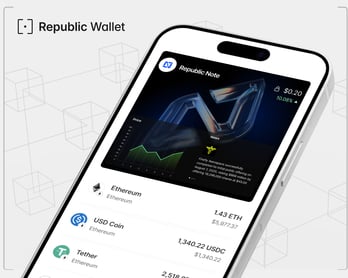
An upgraded architecture for the Republic Wallet is now available. The incoming framework introduces enhanced multi-chain connectivity, faster transaction routing, and an updated interface designed to simplify how users interact with both digital assets and regulated tokenized securities. This deployment reinforces our commitment to providing a secure, compliant, and self-custodied gateway to the digital asset ecosystem.
Republic Insights Guide on Wallet
Canton Network
Live Infrastructure and Landmark U.S. Treasury Settlement: The Canton Network has successfully transitioned from trial environments into live financial market infrastructure. On July 1, 2026, global electronic trading platform Tradeweb announced the execution of the first real-time, on-chain U.S. Treasury transaction on Canton. Facilitated via the network’s synchronized settlement engine, the transaction saw Franklin Templeton transfer tokenized U.S. Treasury securities to Virtu Financial in exchange for on-chain cash (USDCx). By enabling assets to settle atomically outside traditional banking hours, the live deployment establishes Canton as a primary settlement layer for continuous, 24/7 global capital markets.
(Source: Tradeweb Markets — Tradeweb Facilitates Landmark On-Chain U.S. Treasuries Transaction on the Canton Network)
The DTCC Tokenization Service Activation: Canton is serving as the first foundational blockchain for the launch of the Depository Trust & Clearing Corporation (DTCC) tokenization service which entered its official limited production trading phase in July 2026. Backed by an industry working group of more than 50 elite financial institutions, the service brings a fraction of the DTC’s massive $114 trillion asset inventory on-chain. The framework tokenizes highly liquid instruments, including Russell 1000 constituents, major index ETFs, and U.S. Treasuries, onto distributed ledgers while retaining identical ownership rights and investor protections.
(Source: The Depository Trust & Clearing Corporation — DTCC Advances DTC Tokenization Service; 50+ Firms Join)
Disclaimers: Digital assets and private market investments involve a high degree of risk and may result in the loss of principal capital. Always conduct thorough independent research before participating in any tokenized asset offering or network protocol.