


 Oops! We couldn’t find any results...

Stablecoins have quietly become the backbone of the digital asset economy. As crypto matures, these dollar-pegged tokens are redefining how value is stored, transferred, and accessed, powering everything from DeFi and centralized exchanges to cross-border payments and tokenized assets.
In 2025, with the market hitting all-time highs in supply and transaction volume, and regulatory clarity finally emerging, stablecoins are no longer just trading tools. They’re fast becoming core infrastructure for a global, programmable financial system.
This article breaks down the evolution of stablecoins, the rise of major issuers, key regulatory shifts like the Stablecoin Act of 2025, and the growing role of stablecoins in both institutional finance and everyday use.
Introduction: What Are Stablecoins and Why Do They Matter?
As the crypto market evolves, stablecoins have become essential infrastructure, bridging traditional finance with blockchain-based systems. Unlike volatile assets like Bitcoin or Ethereum, stablecoins are designed to maintain a fixed value, typically pegged 1:1 to fiat currencies like the U.S. dollar. This stability makes them ideal for real-world financial applications, from low-cost payments and cross-border remittances to on-chain savings and liquidity management. Their value is especially clear during market turbulence, when investors look to preserve capital without fully exiting crypto.
In 2024 alone, stablecoins facilitated over $27.6 trillion in transaction volume, supporting everything from payments and decentralized applications to on-chain treasury operations. What started as a crypto-native tool has now become the connective tissue of global finance, borderless, programmable, and increasingly indispensable.
For both institutions and everyday users, stablecoins are no longer just digital dollars; they’re a modern financial utility with global reach and growing momentum.
Types of Stablecoins: How They Work and Who Issues Them
Stablecoins come in many forms, but not all are created equal when it comes to adoption, liquidity, or trust. The way each is backed, and who issues them, plays a critical role in shaping their market presence and use cases.
Below is a breakdown of the major categories of stablecoins and how they compare in scale, design, and purpose.
1. USD-Backed Stablecoins: The Clear Leaders
These are the most dominant stablecoins in the market, pegged 1:1 to the U.S. dollar and typically backed by cash or short-term U.S. Treasuries. Their simplicity, liquidity, and regulatory alignment have made them the preferred choice for institutions and retail users alike.
Examples: USDT (Tether), USDC (Circle), PYUSD (PayPal), RLUSD (Ripple), USDS (formerly DAI), BUSD
Market Share: Over 90% of the global stablecoin market
Volume & Liquidity: Extremely high, USDT alone often exceeds $50B+ in daily trading volume
Use Cases: Payments, trading, DeFi, institutional settlement, retail adoption
Notes: USDC and PYUSD emphasize transparency and compliance; RLUSD is overcollateralized and built for institutional use; USDS (formerly DAI) blends crypto and fiat collateral with decentralized governance roots.
2. Other Fiat-Pegged Stablecoins
2.1 EUR-Backed Stablecoins
Examples: EURS, EURT, cEUR
Market Cap: Generally under $100 million
Liquidity: Lower—typically single-digit millions in daily volume
Use Cases: Access to euro-denominated DeFi and regional financial tools
Notes: Primarily used within the Eurozone; adoption remains limited compared to USD-pegged assets.
2.2 LATAM Fiat-Backed Stablecoins
Examples: BRZ (Brazil), MXNT (Mexico), ARST (Argentina)
Market Cap & Volume: Relatively small, often under $1 million in daily volume
Use Cases: Bridging local fiat to crypto in high-inflation economies
Notes: Useful for regional access and localized payments, but lack global liquidity.
3. Commodity-Backed Stablecoins (e.g., Gold)
These tokens are pegged to physical assets (most commonly gold) and offer a way to hedge against fiat currency inflation.
Examples: PAXG, XAUT
Market Cap: ~$1.1 billion combined
Liquidity: Moderate, between $5M–$20M in daily trading volume
Use Cases: Digital gold exposure, inflation hedging
Notes: While niche, commodity-backed stablecoins are growing steadily, particularly during periods of economic uncertainty.
4. Algorithmic & Synthetic Stablecoins
These rely on algorithmic mechanisms or derivatives rather than full collateralization to maintain their peg. While innovative, they come with higher risk.
Examples: FRAX, USDe, USDtb, TerraUSD (defunct)
-
Market Cap Highlights:
USDe: $5.24B
USDtb: $1.4B (after 1,500% surge in March 2025)
Use Cases: Scalable decentralized finance models
Notes: The collapse of TerraUSD in 2022 remains a warning. However, projects like Ethena Labs are gaining momentum with more robust, delta-neutral models.
5. Yield-Bearing Stablecoins
These stablecoins are designed to generate passive income for holders by being backed with yield-generating assets, like tokenized U.S. Treasuries.
Examples: USDY, USYC
Market Cap: ~$1.3B combined
Backing: Tokenized U.S. Treasury securities
Use Cases: On-chain passive income, treasury diversification
Notes: Particularly attractive to institutions looking for regulated, low-volatility yield in digital form.
While innovation continues across the entire stablecoin landscape, USD-backed stablecoins remain the foundation, offering the scale, trust, and interoperability that make them indispensable to both traditional and decentralized finance.
The Stablecoin Market Hits New Highs
The stablecoin sector is expanding at a record pace. As of March 2025, total stablecoin market capitalization has surpassed $230 billion, with Ethereum commanding 53.4% of that supply.
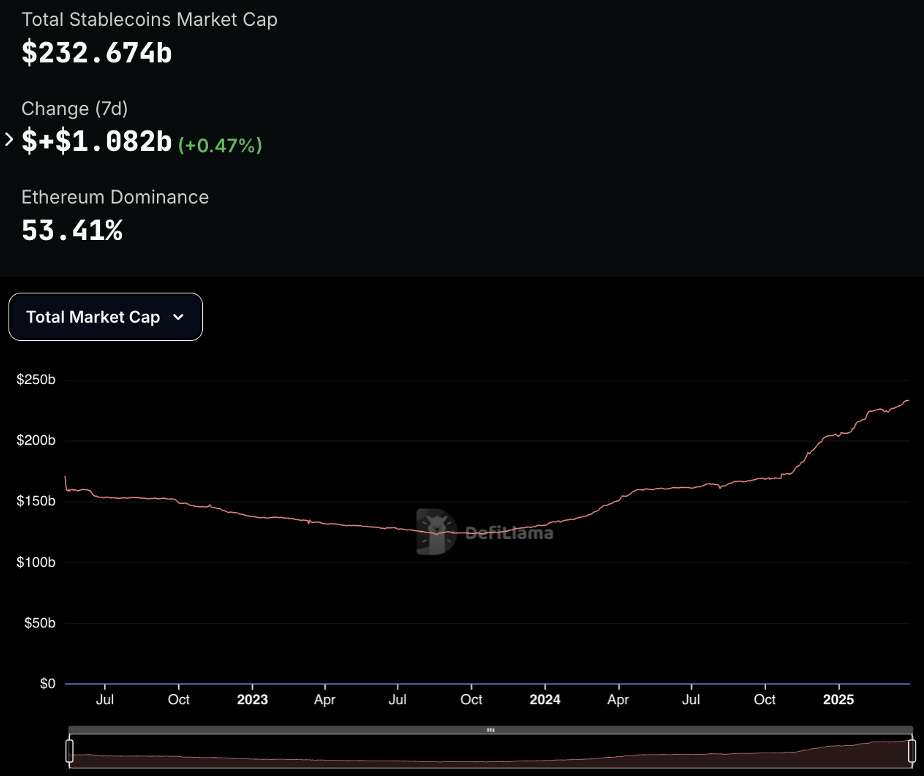 Source: DeFiLlama
USD-backed stablecoins remain the clear leaders in the space, both in market capitalization and trading volume, far outpacing those tied to other fiat currencies or commodities.
This dominance carries significant geopolitical weight. Because most stablecoins are pegged to the U.S. dollar, many see the rise of these assets as a way for the United States to reinforce the dollar’s role as the global reserve currency. In that sense, stablecoin adoption isn’t just about financial innovation, it also aligns with broader U.S. interests in maintaining dollar hegemony in an increasingly digital economy.
Furthermore, stablecoins also reshape cross-border payments: they’ve slashed settlement times from days to minutes and reduced fees by as much as 80%, offering businesses a compelling alternative to outdated payment rails. For companies dealing with over $120 billion in annual losses due to friction in legacy systems, this is a game-changer.
On the issuer side, Tether (USDT) still leads the pack, recently minting $1 billion on Tron to strengthen its role in exchange liquidity and cross-chain transactions.

Meanwhile, USDC (Circle) hit a record $60 billion market cap, bolstered by institutional demand and its landmark regulatory approval in Japan, becoming the first USD-pegged stablecoin licensed for retail use there.

At the protocol level, adoption is accelerating rapidly. In February 2025 alone, Ethereum-based stablecoins handled over $4.1 trillion in transfers, more than double the $1.9 trillion seen in the same month last year. Active stablecoin wallets have surged 53% year-over-year, now totaling 30 million users across DeFi platforms and centralized exchanges.
This momentum shows that stablecoins are gaining traction across all levels of finance, from global institutions to everyday users in regions like Latin America, Sub-Saharan Africa, and Eastern Europe, where they’re increasingly used for remittances, savings, and protection against local currency instability.
Regulation: The Stablecoin Act of 2025 and What It Means
The proposed Stablecoin Transparency and Accountability for a Balanced Ledger Ecosystem (STABLE) Act of 2025 represents a pivotal moment for U.S. digital asset policy. For the first time, it offers clear guardrails for stablecoin issuance, paving the way for compliant, institution-ready digital dollars.
Here’s what the bill lays out in practical terms:
Only regulated entities may issue stablecoins, including licensed banks, credit unions, and federally approved non-bank financial institutions.
All stablecoins must be fully backed 1:1 with cash, short-term U.S. Treasuries (under 93 days), or similarly liquid, low-risk assets.
States may approve their own issuers, but their frameworks must meet or exceed federal standards, creating a national baseline for regulatory consistency.
Yield-bearing and algorithmic stablecoins are subject to a two-year moratorium, while regulators assess risks and develop safeguards. This includes experimental models like FRAX and legacy failures like TerraUSD (UST).
Interoperability standards may be introduced to ensure stablecoins function seamlessly across platforms, chains, and ecosystems.
A two-year grace period gives existing issuers time to register and adapt without halting innovation or market growth.
Banning of high-risk practices such as rehypothecation, preventing issuers from reusing or leveraging collateral, reducing systemic risk and reinforcing trust in reserve backing.
For developers, institutions, and regulators alike, this bill offers the most comprehensive framework to date, combining legal clarity, consumer protection, and regulatory alignment. If enacted, it could unlock a new era of trusted, scalable stablecoin innovation across traditional and decentralized finance.
Institutional Moves and Global Approvals
Stablecoins are going mainstream as banks, fintechs, and institutional players enter the market, driven by clearer regulations and demand for compliant digital dollars.
The shift accelerated dramatically with Stripe’s $1.1B acquisition of stablecoin infrastructure startup Bridge, the payment giant's largest crypto bet to date, and a clear endorsement of blockchain's payments future.
The race to define the future of stablecoin infrastructure is no longer being led by crypto-native startups alone, it’s increasingly being shaped by established financial institutions building directly on-chain. Here are a few key institutional moves and global regulatory milestones shaping this shift:
🔵 USD1: A Politically-Backed, US-Compliant Stablecoin
World Liberty Financial unveiled USD1 on March 25, 2025 - a new Treasury-backed stablecoin for institutional use. Custodied by BitGo and positioned as a compliant alternative to USDT/USDC, it targets sovereign investors and financial networks prioritizing transparency and regulatory alignment.
🔵 Avit: Banks Enter Stablecoin Arena
U.S. banks Custodia (WY) and Vantage (TX) launched Avit, an Ethereum-based, fully collateralized dollar stablecoin. What sets Avit apart is its issuance by FDIC-supervised banks, marking a shift toward bank-led digital currency models that prioritize compliance, auditability, and customer trust.
🔵 Global Stablecoin Momentum Accelerates
Paxos expands with regional stablecoins: USDG (Singapore) and USDL (UAE/LATAM) via Ripio/Buenbit
JPM Coin automates corporate treasury flows for its institutional clients
Société Générale launches MiCA-compliant EURCV on Stellar (bridged to Ethereum/Solana) a signal of growing European interest in tokenized, on-chain financial assets.
Fidelity pursues SEC approval for a 1:1 Treasury-backed stablecoin and on-chain fund shares ($80M Treasury Digital Fund), bridging traditional finance with blockchain.
The UK's FCA unveiled a 5-year plan prioritizing innovation-friendly stablecoin regulation through tech-driven oversight and enhanced compliance - a green light for institutional adoption.
Together, these developments underscore a clear shift: stablecoin innovation is moving from the edges of crypto into the center of global finance. With banks, fintechs, and regulated entities entering the market, the next wave of stablecoin adoption will be defined by trust, compliance, and real-world utility.
Risks, Challenges, and Considerations
While stablecoins are rapidly gaining traction across crypto and traditional finance, their continued growth depends on addressing several structural and regulatory challenges. These factors will shape how stablecoins scale, and how much trust they command, in the years ahead.
📌 Reserve Transparency & Centralized Control
Questions around reserve quality and auditing persist, especially for issuers like Tether (USDT). Although transparency has improved, concerns remain over the composition of backing assets and the frequency of independent attestations.
Additionally, many centralized stablecoins come with issuer-level controls, allowing them to freeze or burn tokens. While useful for compliance, these features raise user autonomy and censorship concerns, particularly for decentralized finance users.
📌 Algorithmic Fragility
The collapse of TerraUSD (UST) in 2022 stands as a major cautionary tale. When UST lost its peg, it triggered a hyperinflationary death spiral in its sister token, LUNA, wiping out over $60 billion in market value.
The event exposed the systemic risks of uncollateralized, algorithm-driven models and continues to influence policymaking worldwide. In response, the EU’s MiCA framework has explicitly banned algorithmic stablecoins.
📌 Illicit Use & Sanctions Evasion
Despite the traceability of blockchain transactions, stablecoins have been used in money laundering, fraud, and sanctions evasion, particularly in high-risk or lightly regulated jurisdictions. Their speed and global accessibility make them a useful tool for bad actors, though blockchain analytics firms like Chainalysis are working to curb misuse.
📌 Fragmented Global Regulation
Even as frameworks like the Stablecoin Act of 2025 in the U.S. and MiCA in the EU take shape, regulatory inconsistency remains a challenge.
MiCA requires daily reserve attestations and 1:1 backing.
The U.S. Clarity for Payment Stablecoins Act limits non-bank issuers to a $10 billion cap on outstanding supply.
While progress is being made, addressing these risks is critical for ensuring stablecoins live up to their promise as secure, transparent, and trusted financial infrastructure.
Conclusion: Stablecoins Are Leading, Now They Must Lead Responsibly
Stablecoins have evolved from a crypto niche to a cornerstone of global digital finance. No longer just for traders, they now power cross-border payments, fuel DeFi, and bridge traditional finance with blockchain.
With over $230 billion in circulation and rising institutional adoption, stablecoins are becoming foundational. Regulatory moves like the Stablecoin Act of 2025 and approvals in markets like Japan show governments are preparing for their mainstream integration.
But with growth comes responsibility. The collapse of TerraUSD exposed the risks of poor design and lack of transparency, reinforcing the need for accountability.
The future of stablecoins depends on trust, built through transparency, full backing, and regulation. If done right, they won’t just support the financial system, they’ll help shape its future. The question now isn’t if stablecoins will lead global finance, but how to ensure they do so responsibly.
Disclaimer
The content of this article is for informational purposes only and should not be considered financial, investment, or legal advice. Investing in cryptocurrency projects involves a high degree of risk, including the potential loss of all invested funds. The views expressed are those of the author and do not necessarily reflect the opinions of Republic. Readers should perform their own due diligence and consult with a qualified financial advisor before making any investment decisions. Past performance is not indicative of future results. Cryptocurrency markets are highly volatile, and regulatory environments are subject to change. Always invest responsibly.