


 Oops! We couldn’t find any results...

For most of history, the chance to own a piece of a young company before the rest of the world caught on belonged to the wealthy.
That’s changed in recent years.
Thanks to the JOBS Act of 2012 and the launch of Regulation Crowdfunding in 2016, you can now back early-stage companies with the same kind of upside potential that used to be reserved for Silicon Valley insiders.
That’s a genuinely big deal. And it’s worth understanding how to make the most of it.
Browse investment opportunities on Republic
Startup investing 101
When you invest in a startup, you put money into a young, private company and receive equity in return.
The idea is straightforward: if the company grows, your slice has the potential to grow with it.
Unlike buying shares on the public market, you’re getting in early, while a business is still proving its idea and often before it has much revenue.
Backing a company before it goes public or gets acquired creates the opportunity that a single modest stake can return many times what you put in.
It's important to note that while gains are uncapped, there is a substantial likelihood of total investment loss. Startup investing is risky.
The good news: that risk is something you could potentially manage with strategy, not something to avoid by sitting out. Below are examples of a few strategies that others have utilized. Not all strategies may be suitable for every investor, please do your own research to come to a determination as to what is best for you.
The Power Law: Why winners matter more than losers
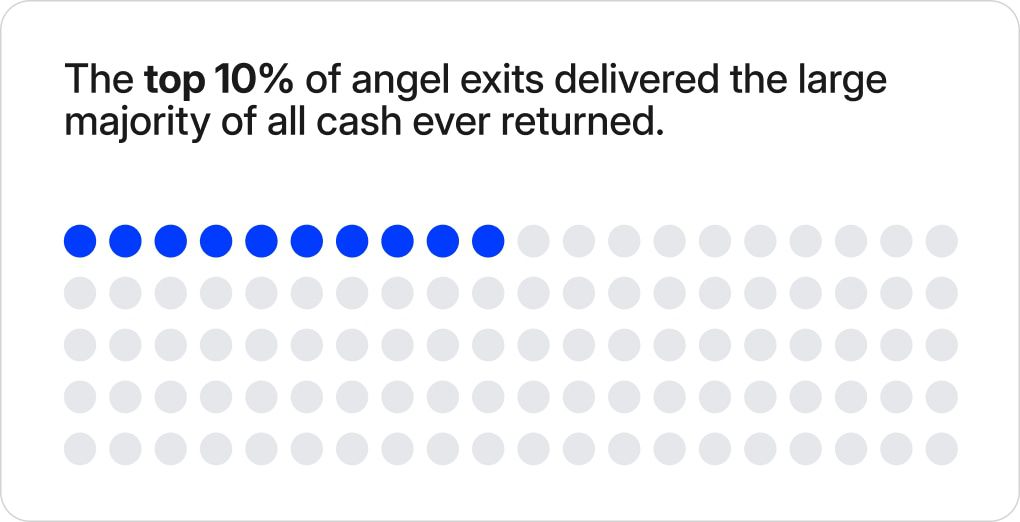
Power law is considered by some an important idea in startup investing.
On the public stock market, returns tend to spread out fairly evenly. Startups work differently: a small number of huge winners potentially produce nearly all the gains with the other investments not returning anything.
One survey found that the top 10% of angel exits delivered the large majority of all the cash ever returned.1 Companies like Uber, Airbnb, and Zoom proved lucrative to early backers, although the vast majority of startups do not achieve this level of success.
This is why failure rate isn’t the whole story.
It’s true that only about one in 10 startups survives over the long term (a rate that’s held steady since the 1990s).2 The most common reason? A company built something the market didn’t want. Roughly 42% of failures come down to a lack of market need.3
That doesn’t sink a smart portfolio, however. You’re not trying to bat 1.000. The strategy is trying to own the one breakout that pays for everything else.
Consider the search engine wars of the late 1990s. Money poured into Alta Vista, Lycos, and Ask Jeeves. They all faded. Enormous returns went to backers of Google.*
As super-angel Chris Adelsbach frames it, “Too many people invest $50,000 in five companies rather than $5,000 in 50 companies.”4
Spreading your capital isn’t playing it safe. It’s one potential strategy that turns the power law in your favor.
Build a portfolio, not a lottery ticket
So how do you actually do that? Think like a fund.
Sequoia Capital’s Fund XI returned 8x to its investors over roughly 10 years (Note: Individual retail portfolios operate at a different scale and access level than institutional venture funds.). It made 88 investments from a $395 million pool, about 1.13% per company. Most went to zero. A handful (like LinkedIn and YouTube) drove the lion’s share of the return.
That’s power law in action.
You don’t necessarily need 88 investments. But diversification could potentially increase the chances of stronger performance if you can go beyond just three or five.
A few things to consider:
Keep any single investment to no more than 10–20% of your startup allocation
Contemplate smaller investments across more companies
Aim for the range where the math starts working: some experienced angels and analysts point to 20 to 30 companies5
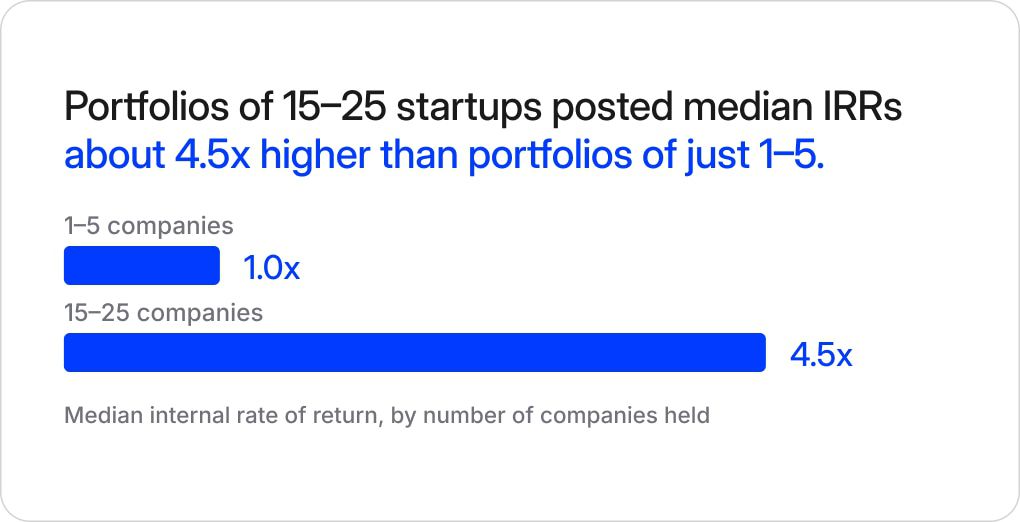
In the study cited, portfolios of 15-25 companies posted median internal rates of return about 4.5x higher than portfolios of just 1-5 companies (with less volatility)6*
Diversified startup portfolios researched in this study have historically reported IRRs in the range of roughly 22–31% over longer periods of time. 7*
Two or three startups investments could be compared to an investment decision strategy of purchasing a lottery ticket based on projected outcome. Two or three dozen investments is more comparable to an investment strategy. Please consider your personal circumstances when making any investment strategy decision.
Patience is a virtue
One more thing the Sequoia example teaches: that 8x took about a decade.
Startup investing rewards patience. Your stakes are illiquid; you generally can’t sell until the company is acquired or goes public. Higher returns typically don’t become liquid for five to 10 years if a liquidity event ever occurs. Gains may take years to be realized.
That’s the nature of the game: real companies take time to produce big outcomes.

Treat startup investing as a small slice of your overall finances. Only commit money you can comfortably lock away for years and are willing to lose.
Then the long horizon becomes an advantage: you can let your winners compound without being forced to sell early.
Where to start
Republic believes there are two paths to startup investing and we offer both.
Accredited investors—generally, income over $200,000 (or $300,000 jointly with a spouse) in each of the last two years or a net worth above $1 million (excluding your primary residence)—can invest directly in private deals, join angel groups, or commit to venture funds.8
If you have a Republic account, log in and complete your accreditation verification today: 👉 Accreditation Verification
If you do not meet the accredited threshold, Republic provides access to investments in startups with minimums as low as $100. The SEC rules place a cap on how much non-accredited investors can put across all crowdfunding offerings in a 12-month period at 5-10% of the greater of their annual income or net worth.
These guardrails are designed to let you participate sensibly.
Respect the power law of distribution of returns, build a real portfolio, and give it time. Do those three things and you’ve given yourself a shot at the upside that used to be locked away.
The best part? You can start today.
Browse investment opportunities on Republic
* Past performance is not indicative of future results
1 Alto
2 Failory
5 Allied
6 Alto
7 Alto
8 To learn more about accreditation see: SEC