


 Oops! We couldn’t find any results...







Information also available in audio form
Summary
Morpheus Space is a provider of scalable and efficient spacecraft electric propulsion systems. Its technology disrupts the New Space industry by introducing the Sphere Ecosystem: a fusion between cutting edge electric propulsion, automation software, and Hardware-as-a-Service. This full-stack solution enables satellite service providers to operate entire constellations as one entity at the best prices possible to date.
- Scalability: The current status-quo is to develop a dedicated propulsion system for a single satellite category.
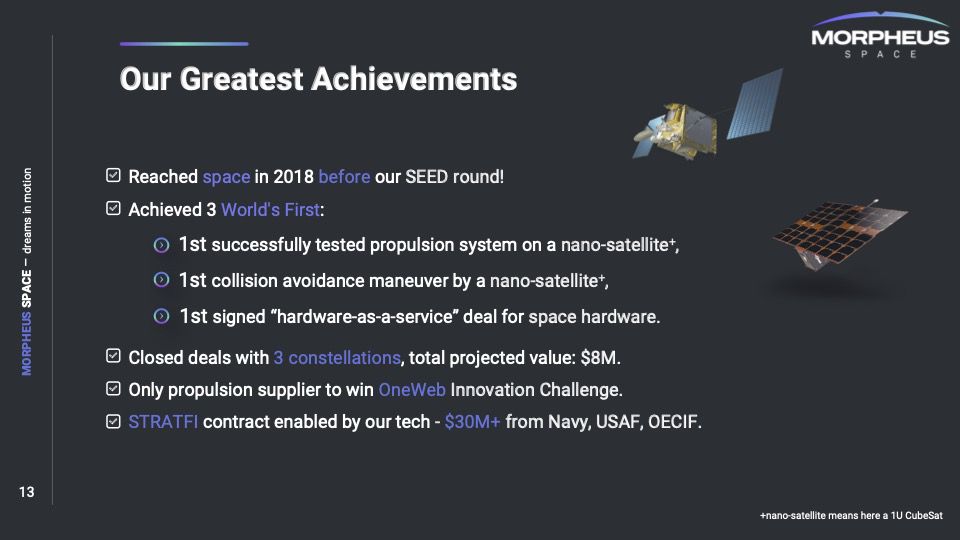
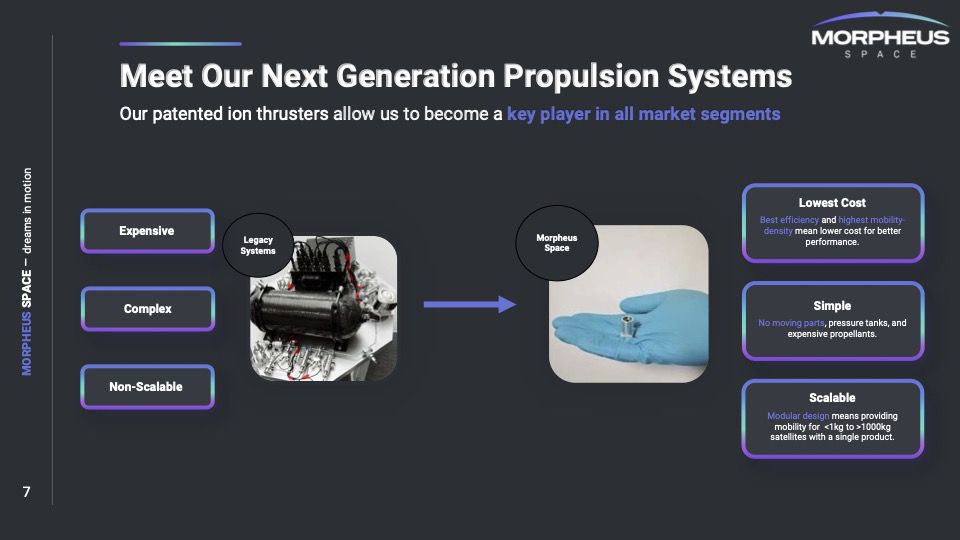
Morpheus’ customers can easily obtain a propulsion system that fits their requirements without dedicated system designs. From below 1 kg to over 1000 kg satellites, the company’s propulsion modules cover the widest market and unlock the benefits of cost-efficient mass production. - De-Risked Technology: Morpheus has been in space and operational since 2018. In that time, they have closed 3 satellite constellation deals valued at $8M total.
- Track Record: Morpheus has thus far achieved 3 world first’s: 1st successfully tested propulsion system on a nano-satellite, 1st collision avoidance maneuver by a nano-satellite, 1st signed “hardware-as-a-service” deal for space hardware.
- Market Size: Morpheus estimates that the three markets it serves make up a total TAM of $146B. These include satellite propulsion TAM $33B, Satellite Components and Services TAM $95B and Mission Design and Operations TAM $18B.
Problem
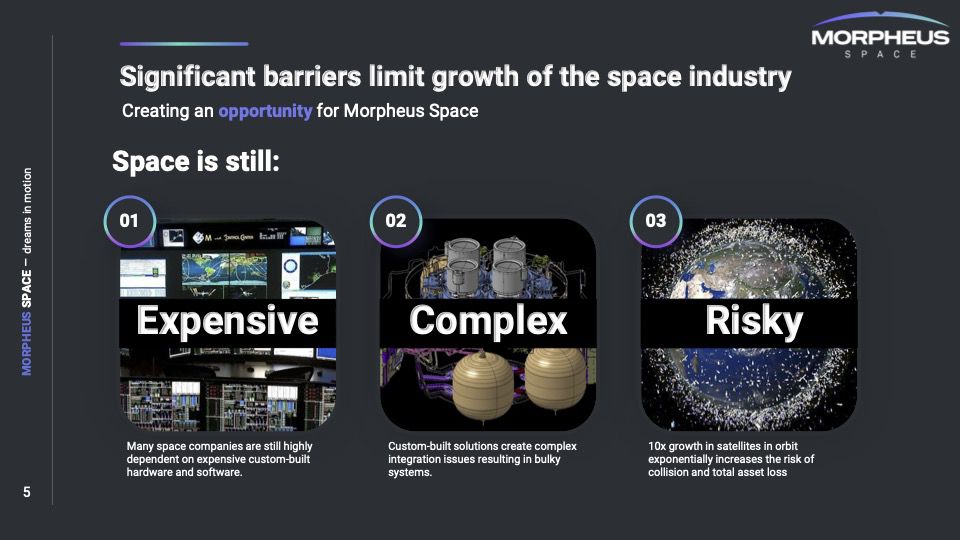
On-orbit maneuverability remains limited for many space systems, particularly for small spacecraft. Affordable, reliable and high-performance electric propulsion is a key ingredient for space systems designers desiring high impulse. That is why the Morpheus solution is a welcome addition to the supply chain and is well positioned to impact both near earth and deep space missions using small spacecraft.
Morpheus Space co-founder and president István Lórincz noted: “Space is big – everybody knows that, but there are hubs, like airports and crossroads, where the risk of collision soars. If you don’t have a traffic management system, those collisions will happen.” This is why the ability to “change lanes” has become a matter of urgency. Satellites aren’t built with brakes. They don’t have steering wheels, and propulsive engines don’t come as standard. At least, they didn’t. Now the need is real.
Solution
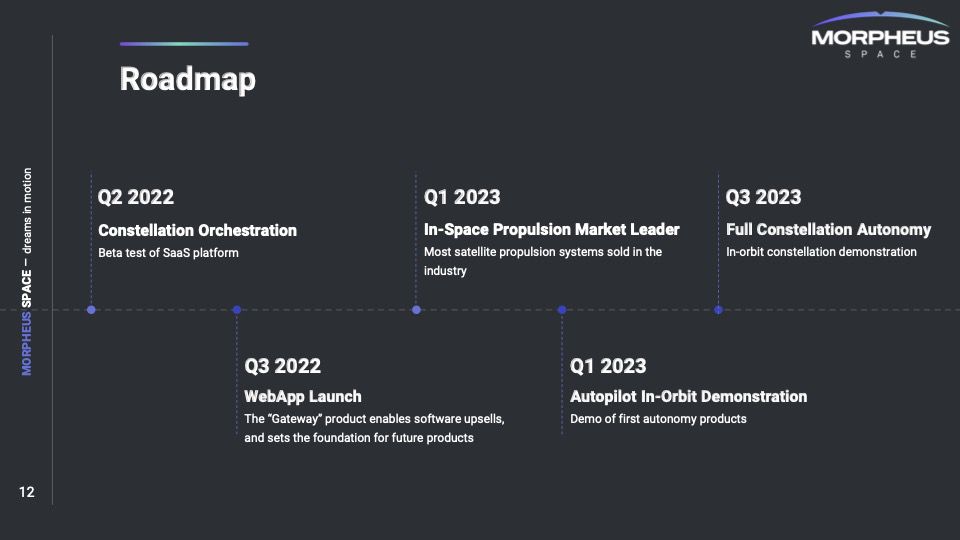
To address these concerns Morpheus developed its SPHERE ecosystem, to power end-to-end autonomous constellation operations. A natural extension of the devices and systems that brought Morpheus Space to market in 2018, SPHERE will act as a command center for all things propulsion.
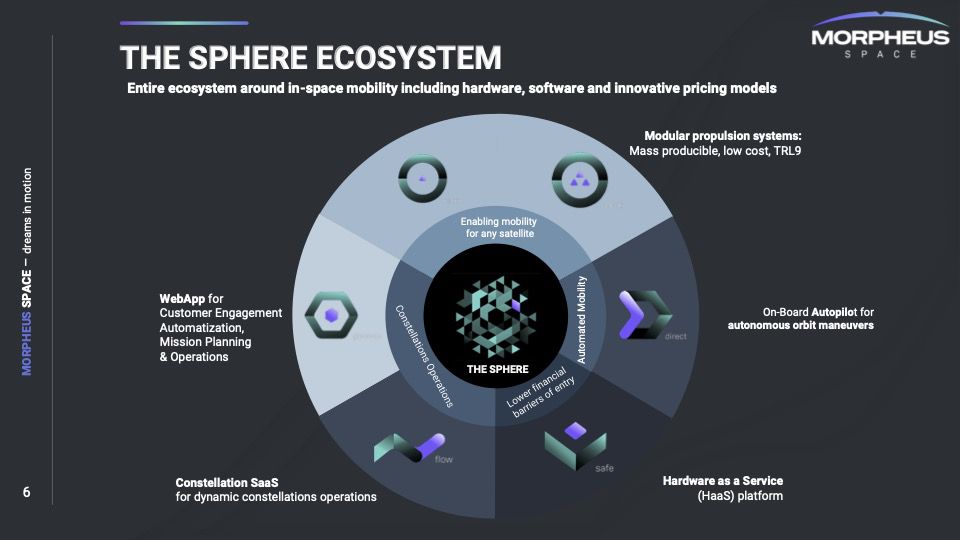
As the Company evolves from a propulsion system manufacturer into an overarching space mobility provider, the team is seeking to lower the barriers of entry into the space industry through its unique pricing model and cutting-edge tech integration. The following products and features have been integrated into Morpheus' platform to make up the SPHERE ecosystem and provide customers with a seamless experience:
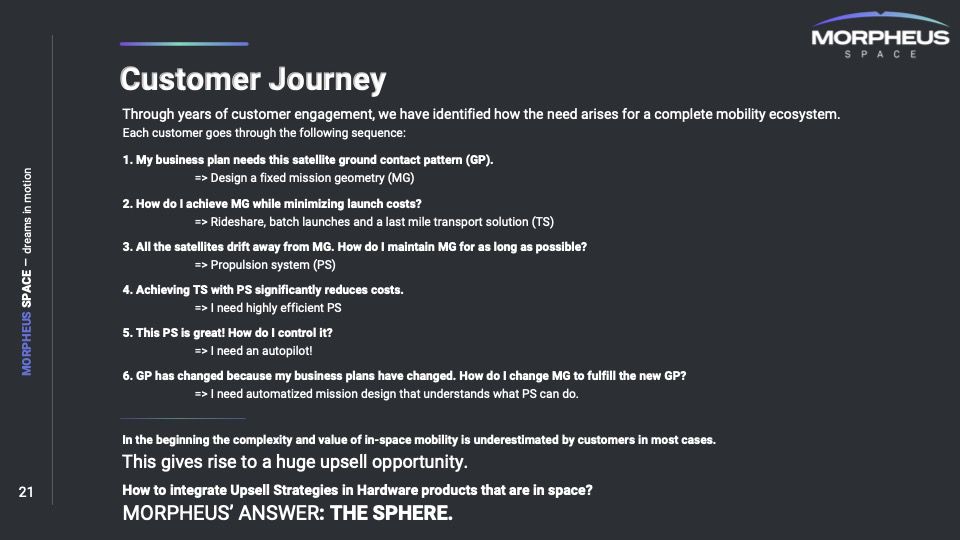
Customers kept asking the same three questions:
- How do we move in space?
- Where do we go?
- How do we get there?
To answer those questions, SPHERE was created to expand on Morpheus' application as a mobility provider. The approach to scalable hardware for the space industry has led Morpheus to push for new, innovative ways to improve the competitiveness and sustainability of our customers.
- SPHERE Go: The world's most scalable and efficient electric propulsion systems, MultiFEEP & NanoFEEP
- SPHERE Direct: A plug-and-play platform agnostic autopilot powered by on-demand use
- SPHERE Flow: A mission design software-as-a-service (SaaS) that enables constellations to become ever-changing to fulfill dynamic objectives
- SPHERE Safe: A cost model that enables on-demand use of active satellite hardware and extra features and hardware-as-a-service (HaaS)
- SPHERE Gateway: A web application that automates the whole customer journey from first product exposure to satellite operations
Product
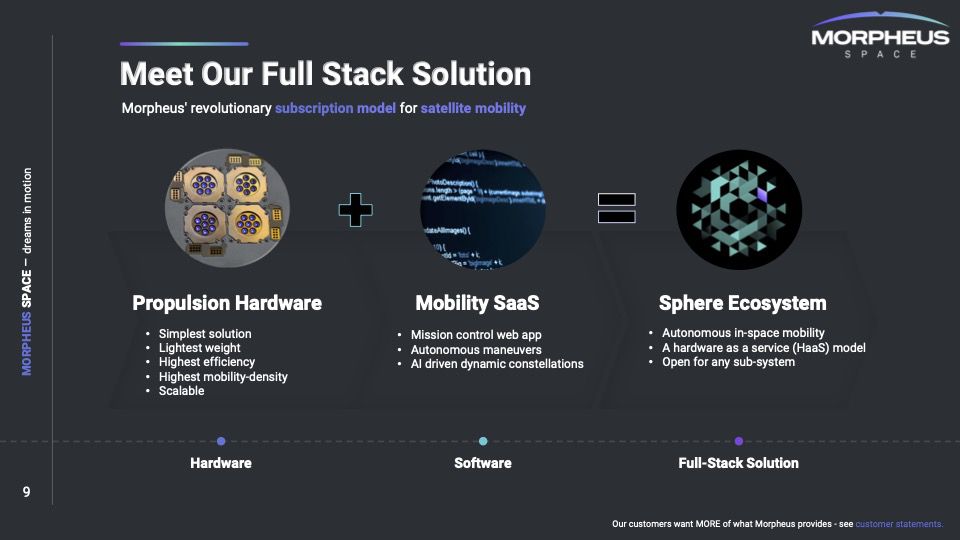
Propulsion Hardware: 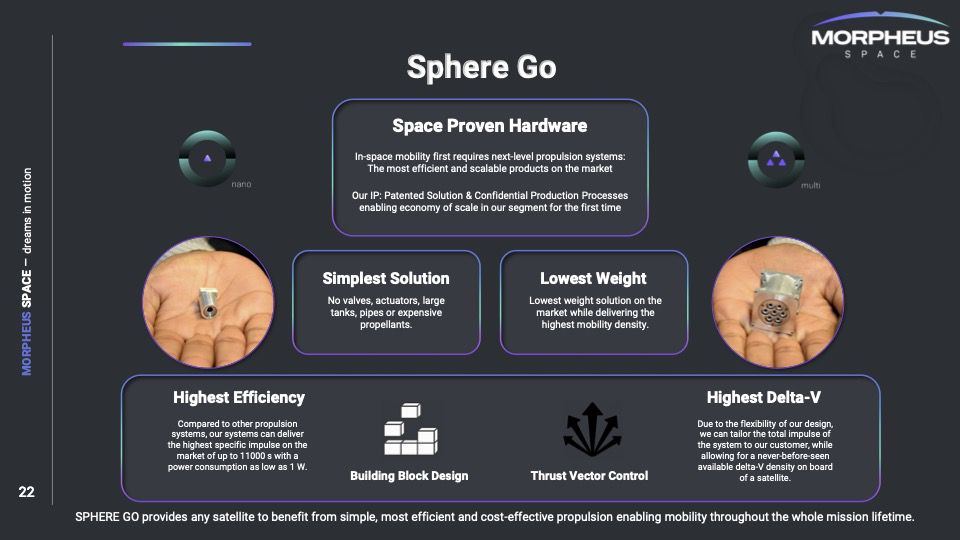
Mobility SaaS:
- On-board autopilot for autonomous orbit maneuvers
- Enabling dynamic constellation geometries and operations
Hardware as a service (HaaS) cost model for space
- Online application that enables seamless customer journey
Traction
Customers
- Closed deals with 3 constellations, total projected value: $8M
- STRATFI contract enabled Morpheus tech—$30M+ from Navy, USA, OECIF
Business model
Service-based pricing model for satellite components, with yearly subscriptions and additional on-demand upsell options.
Morpheus wants its customers to be able to buy modules for a low upfront fee. They intend to build and deliver it. And once the satellite goes into orbit and is creating revenue, customers start to pay a subscription. Instead of buying blocks of data, they buy movement potential – or Delta V. They can use that as much or as little as they like, and top it up if need be. Such an approach would make satellites cheaper to build upfront.
Shifting our customer’s CAPEX to OPEX by 25x significantly reduces economical barriers to entry — in-space mobility will become a new space currency with Morpheus being at an unbeatable price position, the Company envisions.
Market
Morpheus estimates that the three markets it serves make up a total TAM of $146B.
These include:
- Satellite Propulsion (TAM $33B)
- Satellite Components and Services (TAM $95B)
- Mission Design and Operations (TAM $18B).
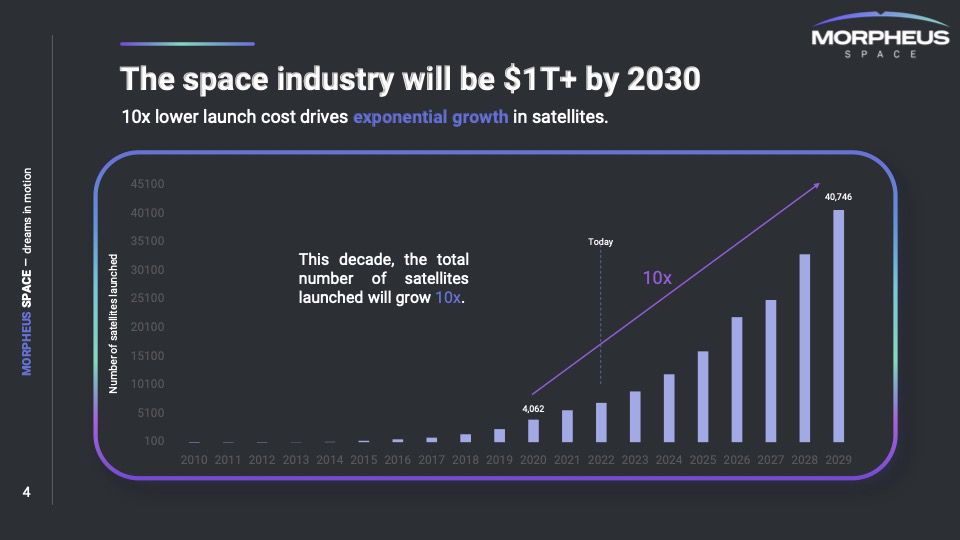
These markets are expected to grow substantially over the next decade driven by 10x lower launch costs. In-space propulsion systems will be the backbone of space exploration, and they’re becoming even more important as companies and government agencies deploy ever-more low-earth orbit (LEO) satellite constellations.
SpaceX alone hopes to deploy 42,000 Starlink satellites over the next several decades. As more satellites are added to low earth orbit, it will be increasingly crucial for smaller spacecraft to have the means to maneuver within their constellations. Smallsats might need to dodge malfunctioning spacecraft and debris, or shift their position to heal an issue somewhere else on the network.
Competition
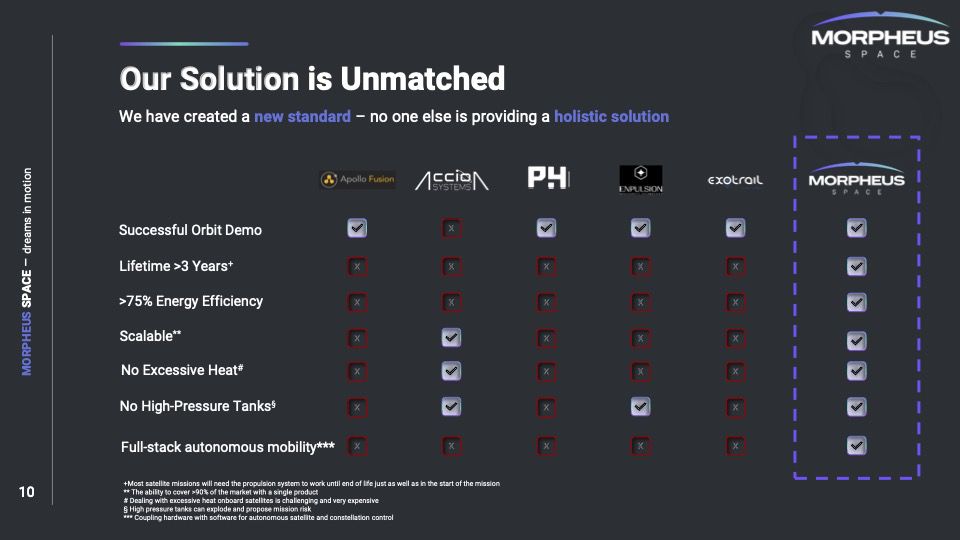
The rise of smallsat constellations has spawned dozens of propulsion startups promising more efficient thruster as concerns over congested orbits grow. Some notable competitors include Accion Systems ($42M Series C led by Tracker capital $83.5M post money), Phase Four ($26M series B led by New Science Ventures), Enpulsion (world's leading manufacturer of micro and nanosatellite propulsion systems based on Field-emission Electric Propulsion Technology), and Exotrail (French startup partnered with the Defense Innovation Agency (AID), an organization which is part of the French Ministry of Defense).
Vision and strategy
Funding
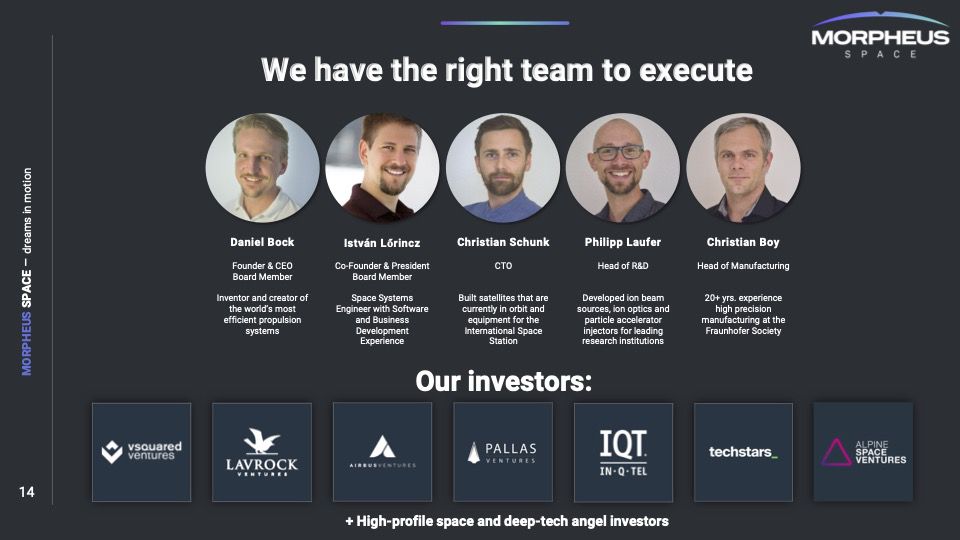
Founders
Disclaimers
In addition to the carried interest Republic Deal Room Advisor LLC is entitled to for the syndicated investments it organizes, certain principals of Republic Deal Room Advisor LLC may have a personal interests in these investments, as disclosed below. When making an investment decision please review any applicable disclosures as they represent pre-existing financial interests held by those principals of Republic Deal Room Advisor LLC.
We do not represent that the information contained herein is accurate or complete, and it should not be relied upon as such. Opinions expressed herein are subject to change without notice. Certain information contained herein (including any forward-looking statements and economic and market information) has been obtained from and/or prepared by the Company or other third-party sources and in certain cases has not been updated through the date hereof. While such sources are believed to be reliable, Republic Deal Room Advisor LLC does not assume any responsibility for the accuracy or completeness of such information. Republic Deal Room Advisor LLC does not undertake any obligation to update the information contained herein as of any future date.