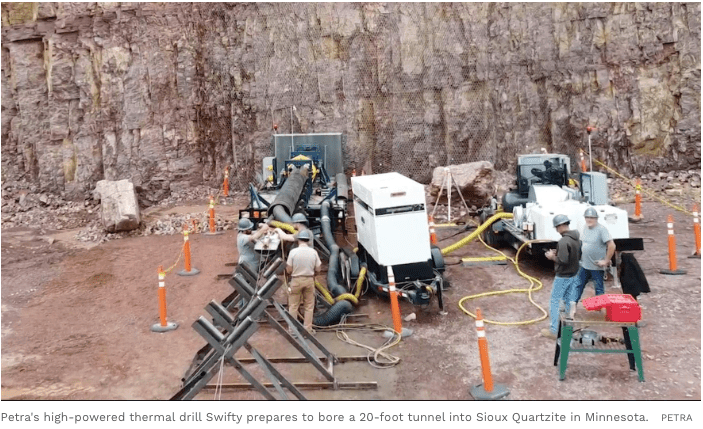
A Tesla Cofounder's New Focus: Rock-Tunneling Robots To P...
Forbes
Ian Wright, one of Tesla's five cofounders , is best known for developing electric cars and trucks over the past two deca...


 Oops! We couldn’t find any results...






Petra provides robotic solutions to cost-effectively bore underground tunnels through previously impenetrable geologies to bury critical utilities, filling previously unmet needs for undergrounding and rock removal. Future-proofing America’s critical grid infrastructure (water, gas, fiber etc.) from natural disasters/climate change will require putting it underground, which Petra is building to address.
This is Special Purpose Vehicle (SPV) to invest in Petra's $15M Series A+ raise on an $85M pre-money valuation. ACME Capital is the lead investor, with participation from DCVC. Both funds have a track record investing in companies orientated around robotics, heavy industry, and industrial engineering.
Investment highlights (all figures provided as of February 2022):
Petra advisor Bob Foster said in a statement: “As the former president of SoCal Edison, I oversaw capital projects in urban, suburban, and rural mountainous areas. A robot that can bury utility facilities in bedrock would have been a game-changer for us. In cities, it would allow us to bury utilities in bedrock, below the existing infrastructure. In mountainous areas, like the Sierra foothills, it would allow us to bury utilities in the most fire-prone regions of our state.”
Future-proofing America’s critical grid infrastructure from climate change and natural disaster will require putting it underground. Incumbents don’t have the right tools to do this cost effectively, and geologies like hard rock (and by extension all geologies at <60” in diameter) are impenetrable. These more difficult geologies render many areas unserviceable, such as mountainous regions. Conventional utility undergrounding methods are suited for easier geologies. This is because conventional machines rely on thrust force (engagement with rock) to break it. Utility undergrounding needs a tunneling method capable of going through all geologies at a variety of diameters.
Petra is creating a tunneling robot capable of cost-effectively boring utility-sized tunnels through the most difficult geologies on earth. Petra’s flagship product, Swifty, tunnels through difficult materials with the use of thermal spallation, rather than making direct contact with the rock. Thermal spallation involves applying a mix of gas and heat above 1,800 degrees Fahrenheit, causing fractures to form in the rock. These fractures expand causing material to break away from the face, leaving a bore consistent in shape and diameter, and characteristically smooth. Footage here.
Rock types successfully tunneled through using Swifty: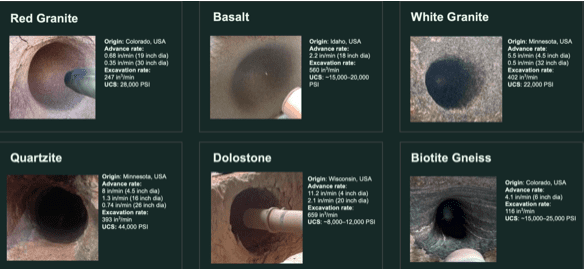
Petra’s boring machine consists of a diesel-burning turbine and afterburner which is spray-cooled near the face by water. The superheated jet from this turbine acts as the heat source used to drive thermal spallation in rock. As a tunnel is produced, the machine is jacked forward to continue boring. Swifty is a remote-operated robot, and personnel maintain a safe distance. The company acknowledges that fumes from diesel burning are produced, and the noise requires hearing protection, but there is no silica dust produced thanks to spray cooling (silica dust is harmful to the lungs when inhaled by humans), and no visible smoke.
The company seeks to cut costs to as little as $200 per linear foot tunneling through soft soil and to about $600 per foot through hard rock, with commercial operations to start in late 2022. It plans to join engineering companies on projects as a subcontractor handling tough tunneling assignments, and in some cases may conduct tunneling projects of its own and lease space to utilities wishing to run their power lines through it. “Our mission is to make undergrounding utilities ubiquitous,” Abrams told Forbes. “We're starting with building a robot to bury utilities in hard rock because it’s the biggest problem for utility companies and their construction partners.”
The company recently announced a successful pilot of its robot, Swifty. According to the firm, the robot successfully bored a 20-foot tunnel through Sioux Quartzite at a rate of one inch-per-minute. The metamorphic rock is notoriously hard, making it a popular choice for buildings in the upper Midwest region in which it is found. That strength, however, also makes it a formidable challenge from infrastructure and other projects that require tunneling. Next Petra stated that it plans to test its method outside of the laboratory on projects involving granite, dolomite, limestone, and basalt to try to prove that its method can work in places like California, Colorado, and the Appalachian Mountains. The company has spoken with 242+ customers in the last 12 months and converted on 9 partnerships.
The average price for conventional micro-tunnels is $4000/linear foot. Petra plans to price at $1000-$2000/linear foot to make tunneling through hard rock economically viable and to win market share.
Petra estimates their TAM at $3-4T with multiple use cases for 18-to-60-inch tunnels, including water pipeline, fiber, natural gas, wastewater/sewage, and power. Petra’s serviceable market is the hard rock tunneling segment, a ~$1T opportunity in its own right at 30% of the market.
Petra’s emergence may prove well timed, as the Bipartisan Infrastructure Bill signed into law by President Biden earmarks $65B of federal funds for power infrastructure and $47B for resiliency efforts. In addition, the US Energy Information Administration has projected that global energy demand will increase by 50% in the next 30 years, requiring more transmission lines.
California utilities are under particular pressure to find ways to bury power lines that have been linked to triggering some of the state’s worst recent wildfires in remote, mountainous areas. At the same time the cost of tunneling through challenging areas is exorbitant, running from $6K per linear foot to as high as $25K. A study published last month concluded that run-ins with underground utility lines cost $61B annually in the US alone and presents increasing risks to public safety. Petra hopes to reduce the cost of burying utility lines by 50 to 80 percent, making it a viable option.
Petra boasts a diverse leadership team (female CEO and CPO) which has combined raised $100M+ for robotics and smart hardware ventures and led robotics and development teams in universities like Stanford and Purdue.
Kim Abrams (CEO/Co-founder)
Shivani Torres (CPO)
Ian Wright (CTO)
Beyond plasma torches and Petra’s method involving heat and gas, other innovative or less-traditional methods to drilling are being developed. Projects at the Colorado School of Mines and in China’s Fujian Province used water jets at the front of cutter heads that grind into hard rock. The water helps reduce strain on metal cutters and soften the ground. In cities like Athens and Madrid, the BADGER Project is using robots to dig tunnels and 3D-printing pipes. And companies like Silo.ai and Sewerai are creating hardware and software to help inspect pipes for repairs or maintenance.
The company notes that Swifty provides a number of novel advantages over conventional microtunneling methods. For one thing, conventional machines are purpose-built for a single diameter. However, Swifty is the first robot capable of boring a range of diameters between 20-60 inches, dramatically reducing the cost of tunneling.
In addition to the carried interest Republic Deal Room Advisor LLC is entitled to for the syndicated investments it organizes, certain principals of Republic Deal Room Advisor LLC may have a personal interests in these investments, as disclosed below. When making an investment decision please review any applicable disclosures as they represent pre-existing financial interests held by those principals of Republic Deal Room Advisor LLC.
We do not represent that the information contained herein is accurate or complete, and it should not be relied upon as such. Opinions expressed herein are subject to change without notice. Certain information contained herein (including any forward-looking statements and economic and market information) has been obtained from and/or prepared by the Company or other third-party sources and in certain cases has not been updated through the date hereof. While such sources are believed to be reliable, Republic Deal Room Advisor LLC does not assume any responsibility for the accuracy or completeness of such information. Republic Deal Room Advisor LLC does not undertake any obligation to update the information contained herein as of any future date.

Invest in the app