


 Oops! We couldn’t find any results...

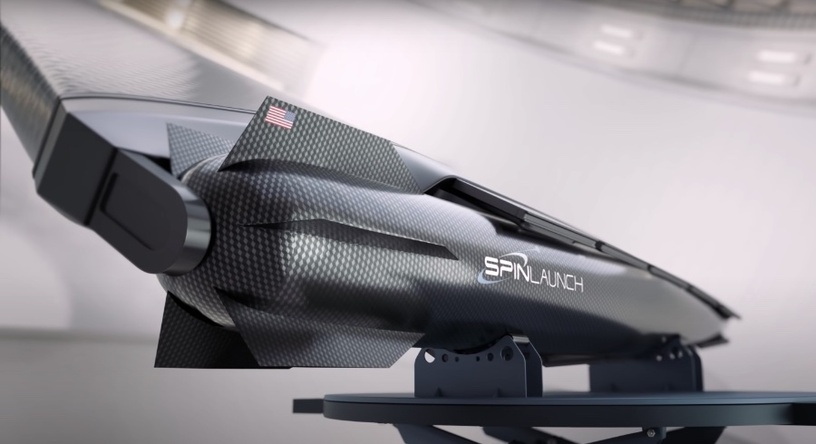









SpinLaunch is a kinetic launch space company that uses a spinning arm to catapult satellite-carrying rockets into Low Earth Orbit more rapidly & cost effectively. Sound crazy? Watch the launch video below.
Problem
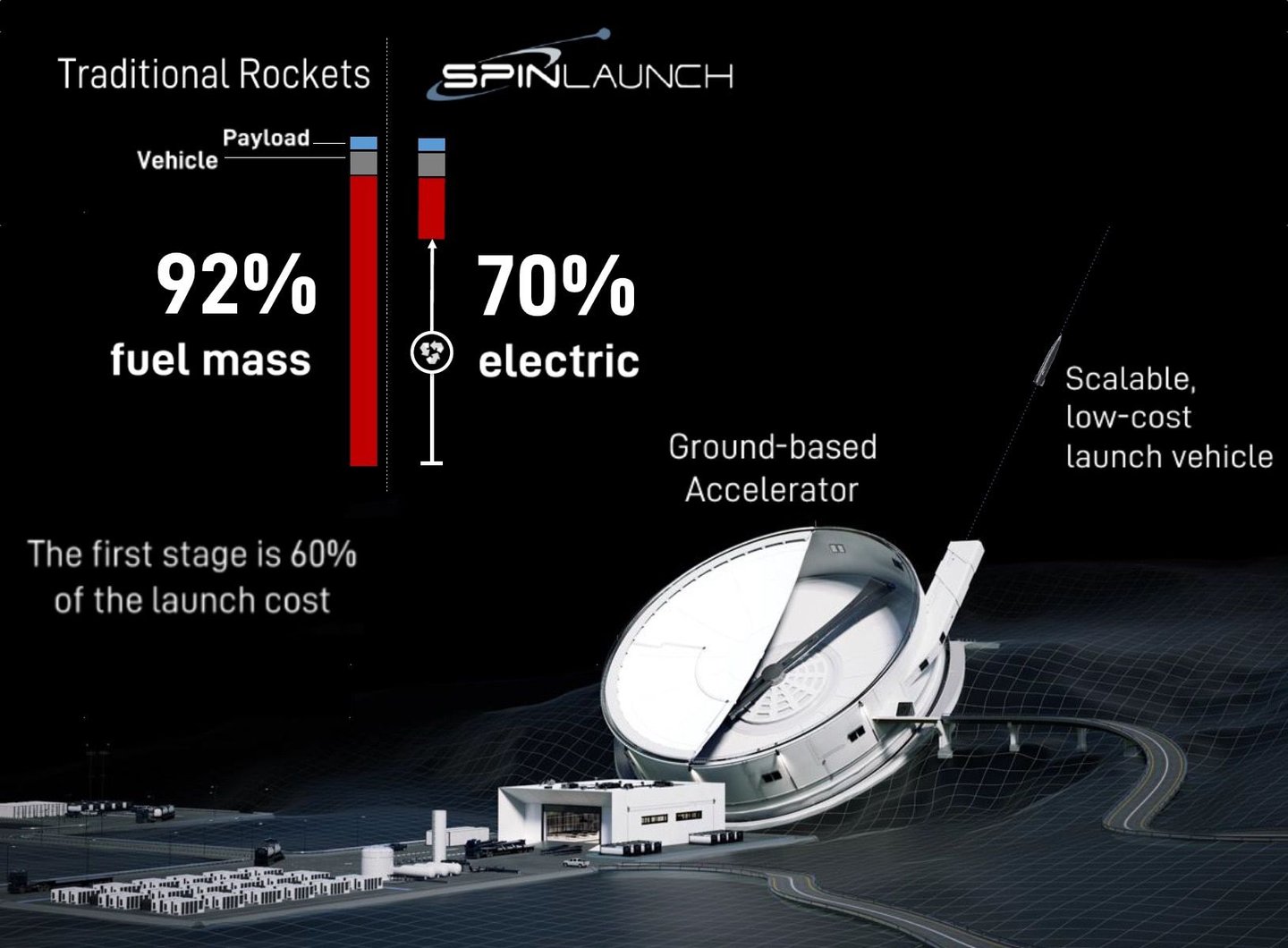
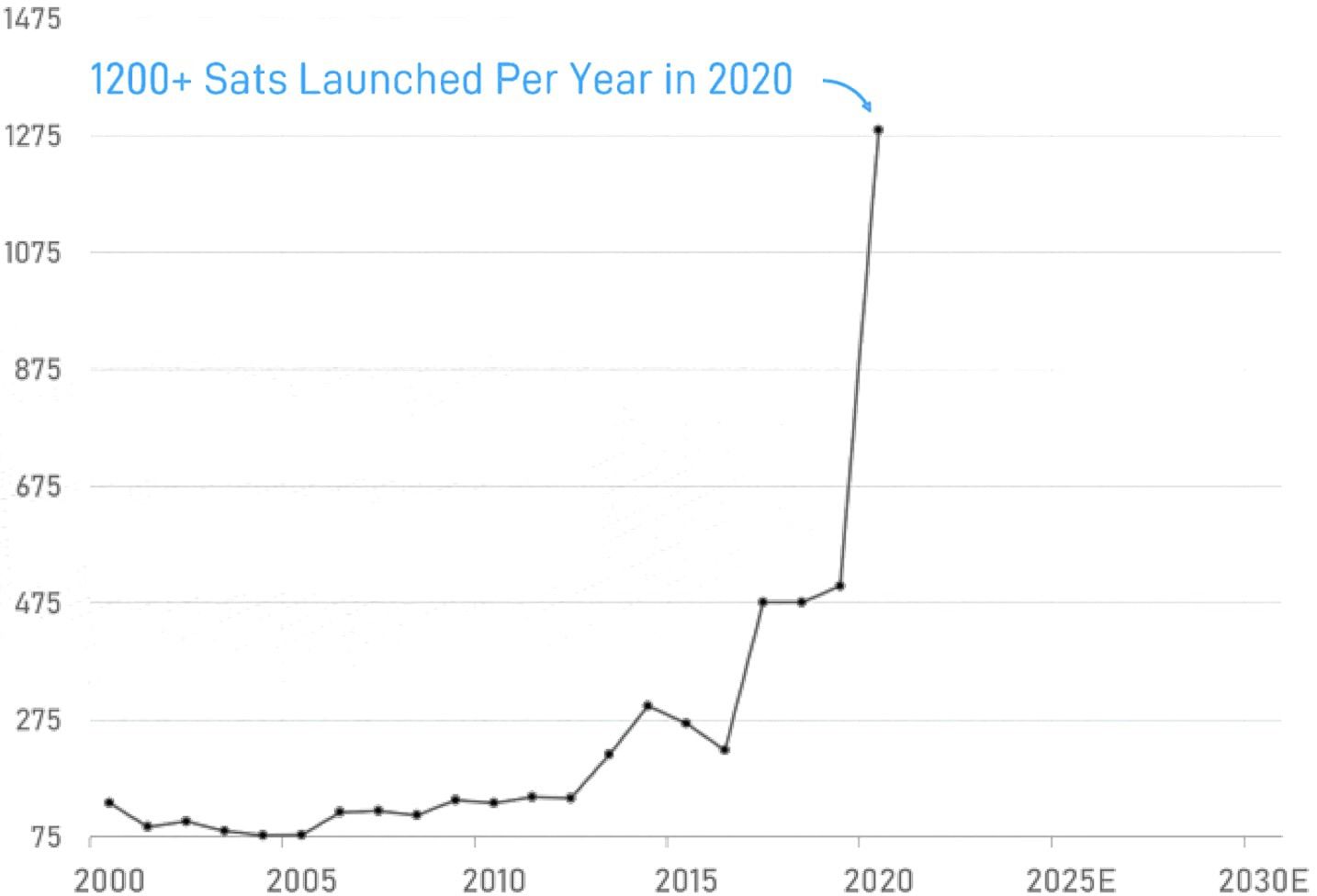
Over the next decade, the number of satellites in space is expected to grow by 200-500x. Of all challenges presented by space travel and satellite deployment, cost and cadence are at the top of the list. (1) Cost: Today, rockets require costly, gas-guzzling engines with fuel accounting for 85% of their entire mass leaving only 2% of the vehicle for monetizable payloads. Traditional rockets cost tens of millions of dollars per launch. (2) Cadence: Due to cost and engineering effort that goes into building rockets, traditional rocket/satellite companies have been capped at 5-50 launches per year.
The new space race:
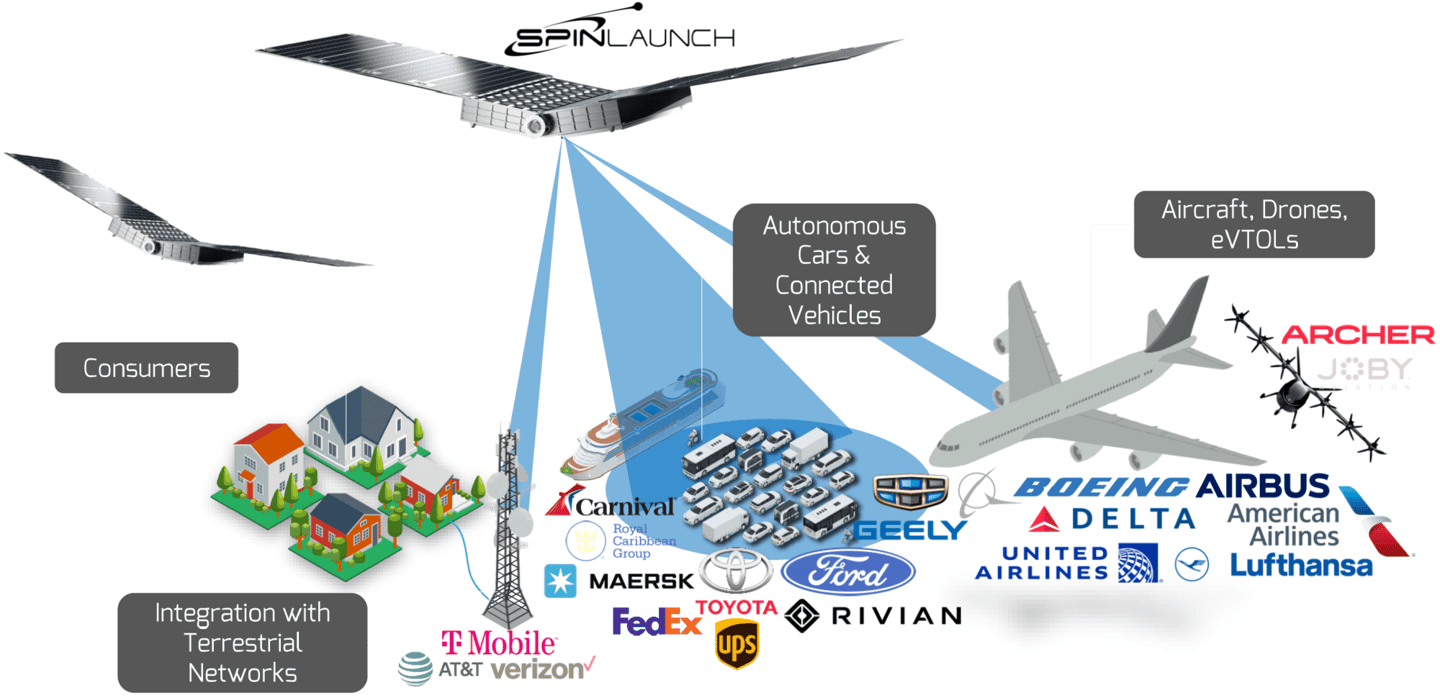
Smaller, cheaper LEO satellite constellations
Despite years of innovation,
launch costs remain high
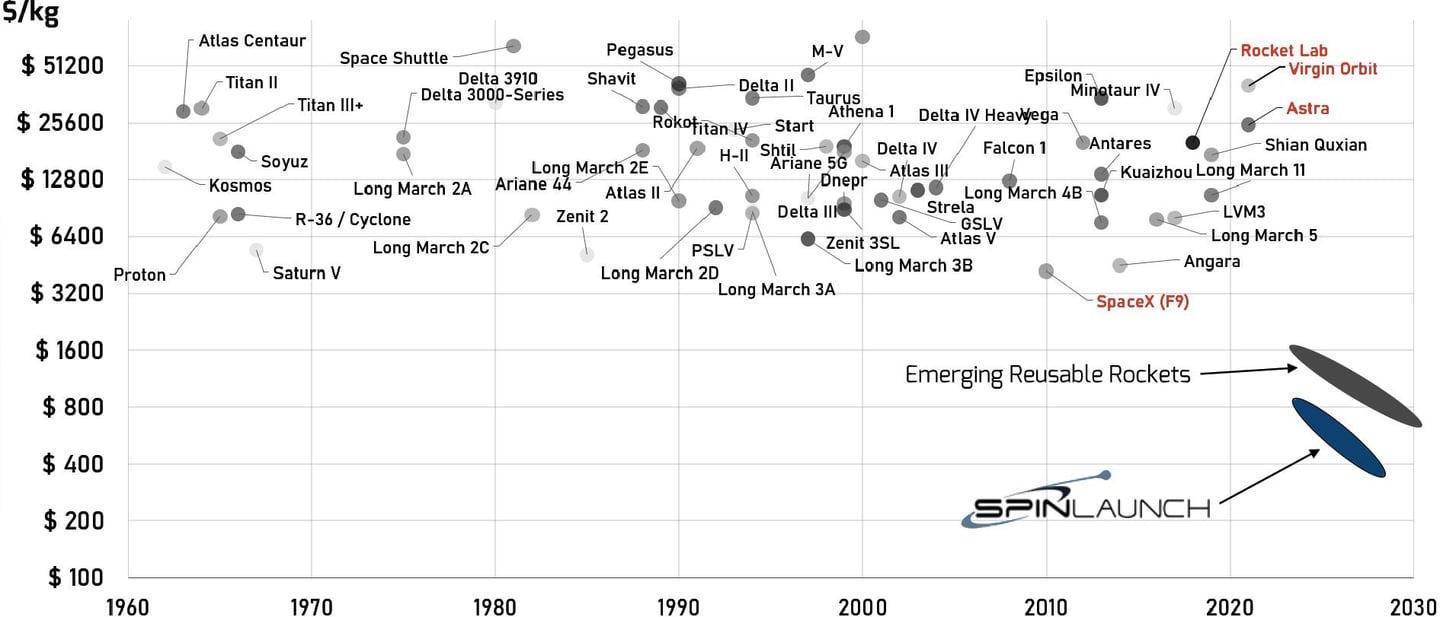
A new approach is needed
Solution
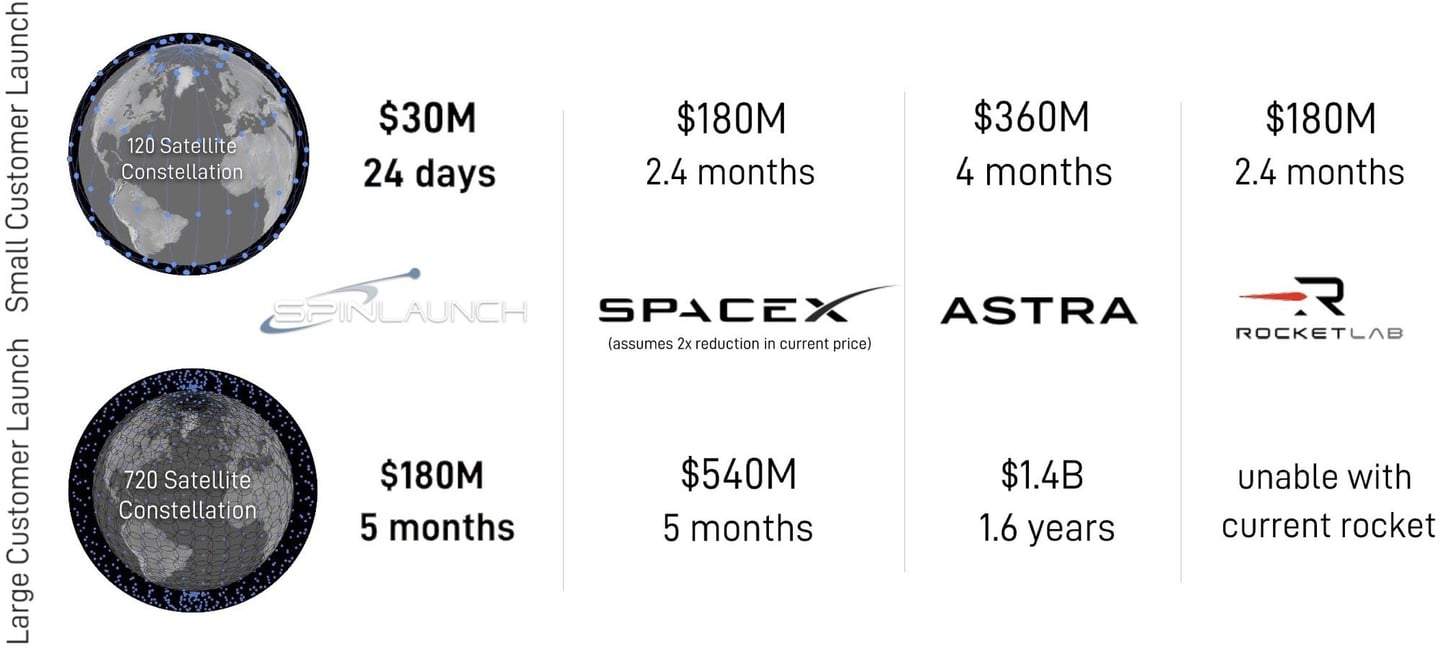
SpinLaunch has developed the world’s lowest cost and most environmentally friendly (all electric) launch system – a suborbital centrifuge accelerator the size of the Statue of Liberty that rapidly spins the rocket in a circular, vacuum-tight chamber for an hour and a half at about 5,000 MPH, generating enough kinetic energy to launch the rocket through the atmosphere at supersonic speeds. About a minute into flight when the rocket reaches 200,000 feet (nearly through the entire atmosphere), a two-stage, fuel-powered rocket kicks in and takes advantage of the thinner atmosphere and shorter distance to propel the satellite the final bit of the journey into space. The result is SpinLaunch is able to launch rockets at 20x less the cost and 60x the cadence of its nearest competitor. At maturity, they project to launch 150 rockets / month (SpaceX @ 4 rockets / month), with launches that cost $250k / launch (SpaceX @ $67M per launch). In addition to building the launch sites, SpinLaunch is also building its own custom mass produced rockets and constellation of satellites (watch rocket / satellite video).
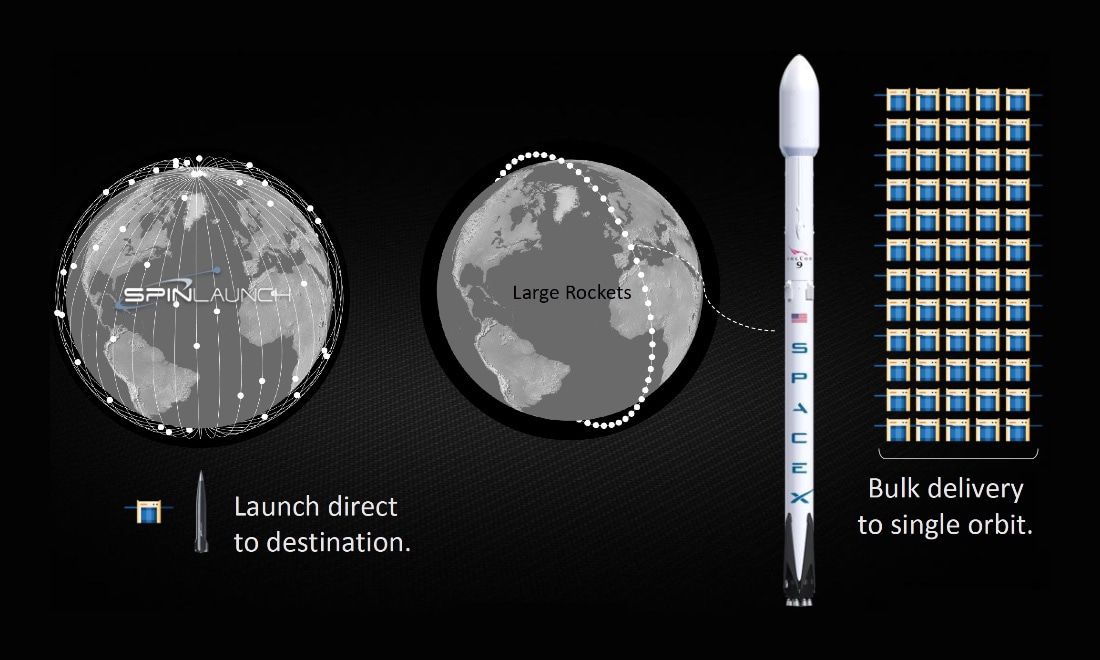
Ground-based accelerators enable Uber-style delivery to space: A dedicated ride, anytime, anywhere.
SpinLaunch vs traditional large rockets
Industry disruptive — inexpensive, high-frequency launch
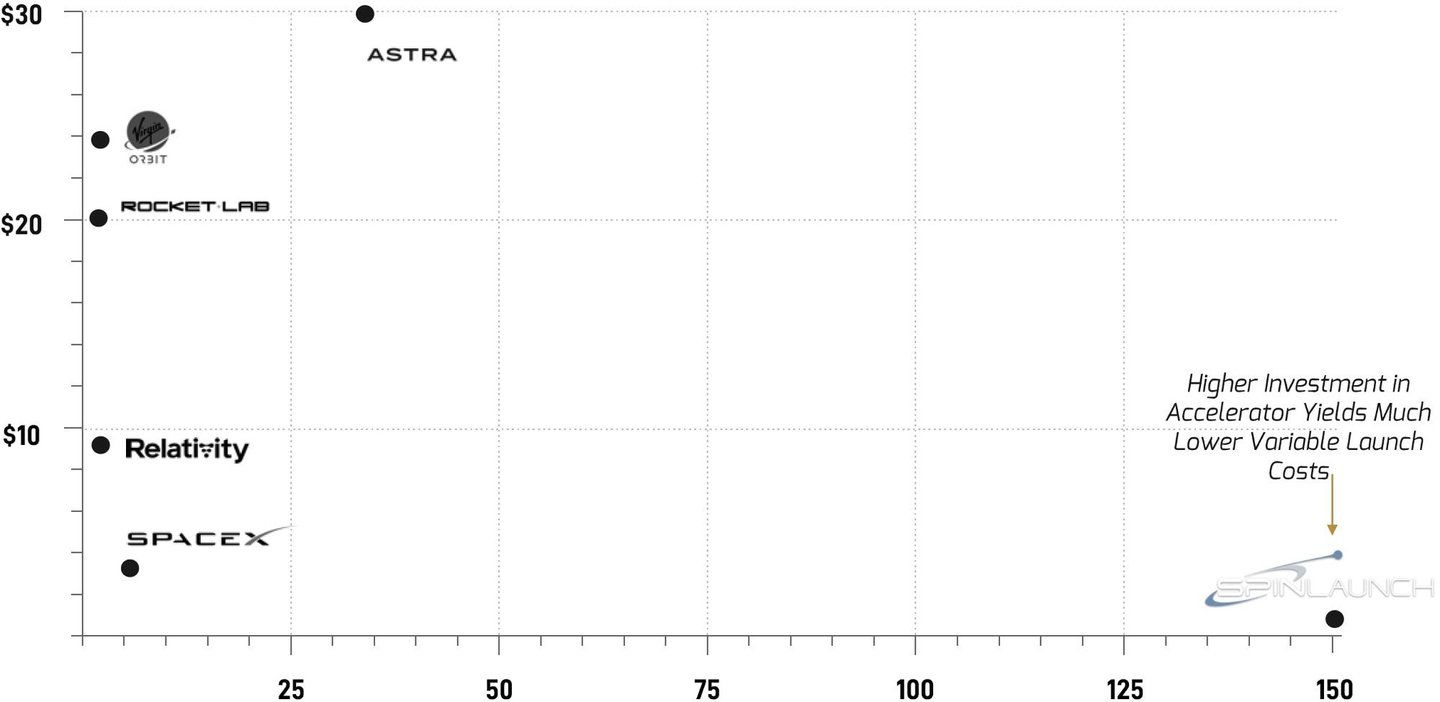 Higher launch cost x Launches per month
Product
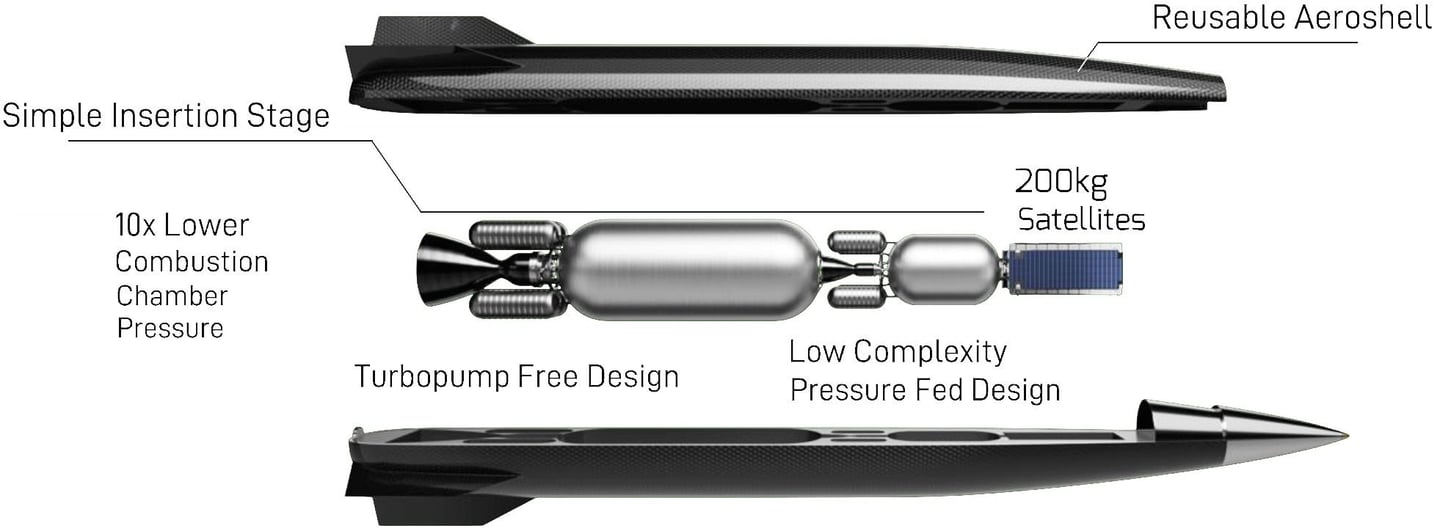
Ground-based accelerators & low-cost, high-cadence launch vehicles
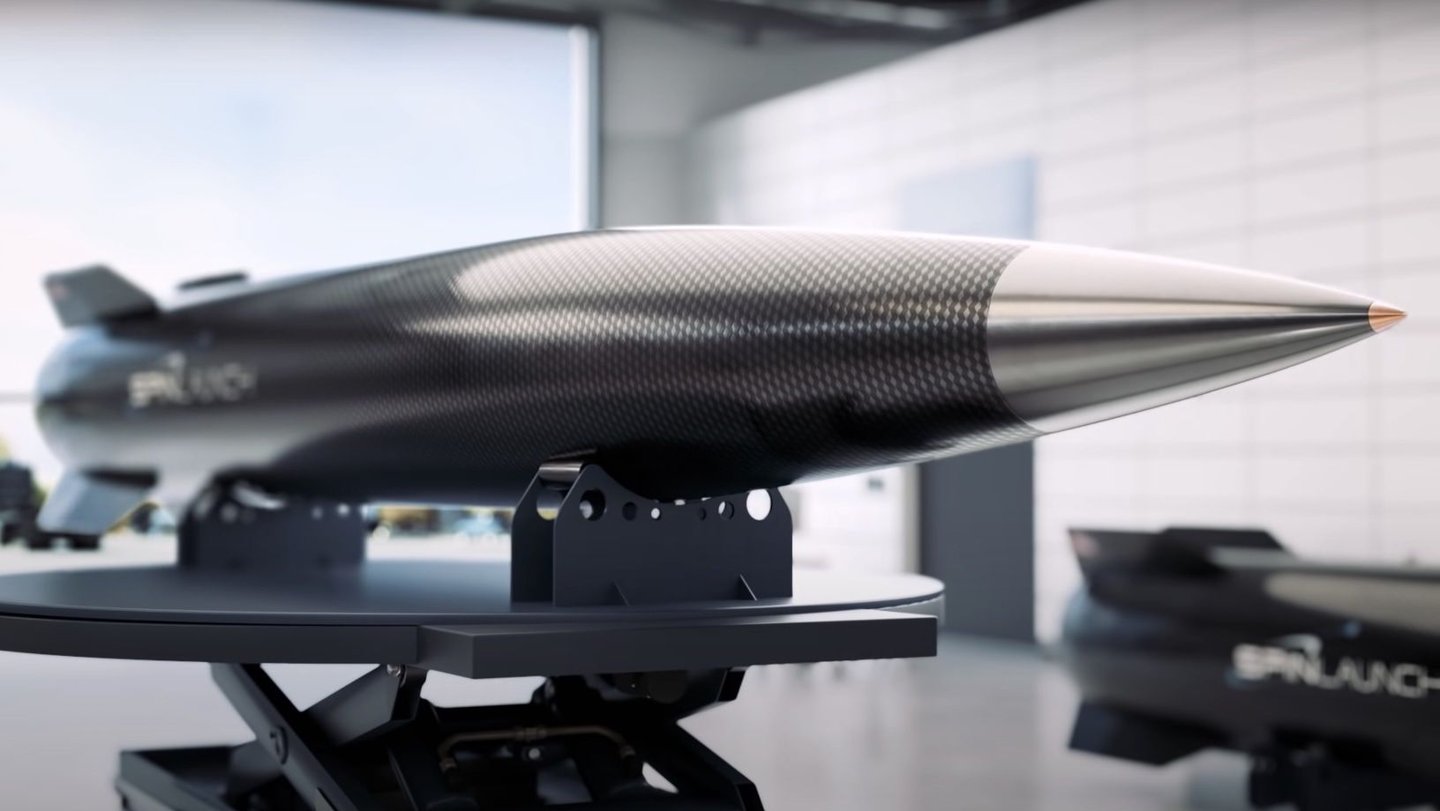
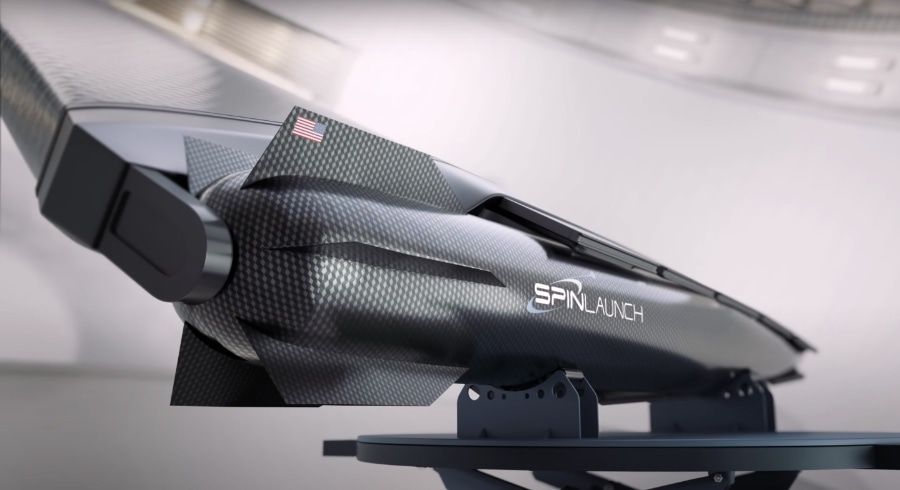
SpinLaunch's Reusable Launch Vehicles are easy to manufacture and are 20x cheaper than conventional rockets.
Traction
Last Fall, the company successfully launched its first rocket at its suborbital Spaceport in New Mexico (watch launch video). They are now working on a new orbital launch site in Alaska. SpinLaunch recently closed on a $2.4M contract with the DIU (Defense Innovation Unit).
They have now moved into commercialization mode as they prepare for their first year of launches in 2026. They have over $1B+ in proposals out right now with very notable technology, telecommunications, and space companies.
SpinLaunch recently closed on a $2.4M contract with the DIU (Defense Innovation Unit). The company has now moved into commercialization mode as they prepare for their first year of launches in 2026.The company is projecting:
- $13M in revenue EO23
- $32.5M EO24
- $688M EO27
- ~$2B EO30.
- At maturity, SpinLaunch predicts each launch site to generate $600M in ARR / year.
Customers
Named as one of the 100 most influential companies.
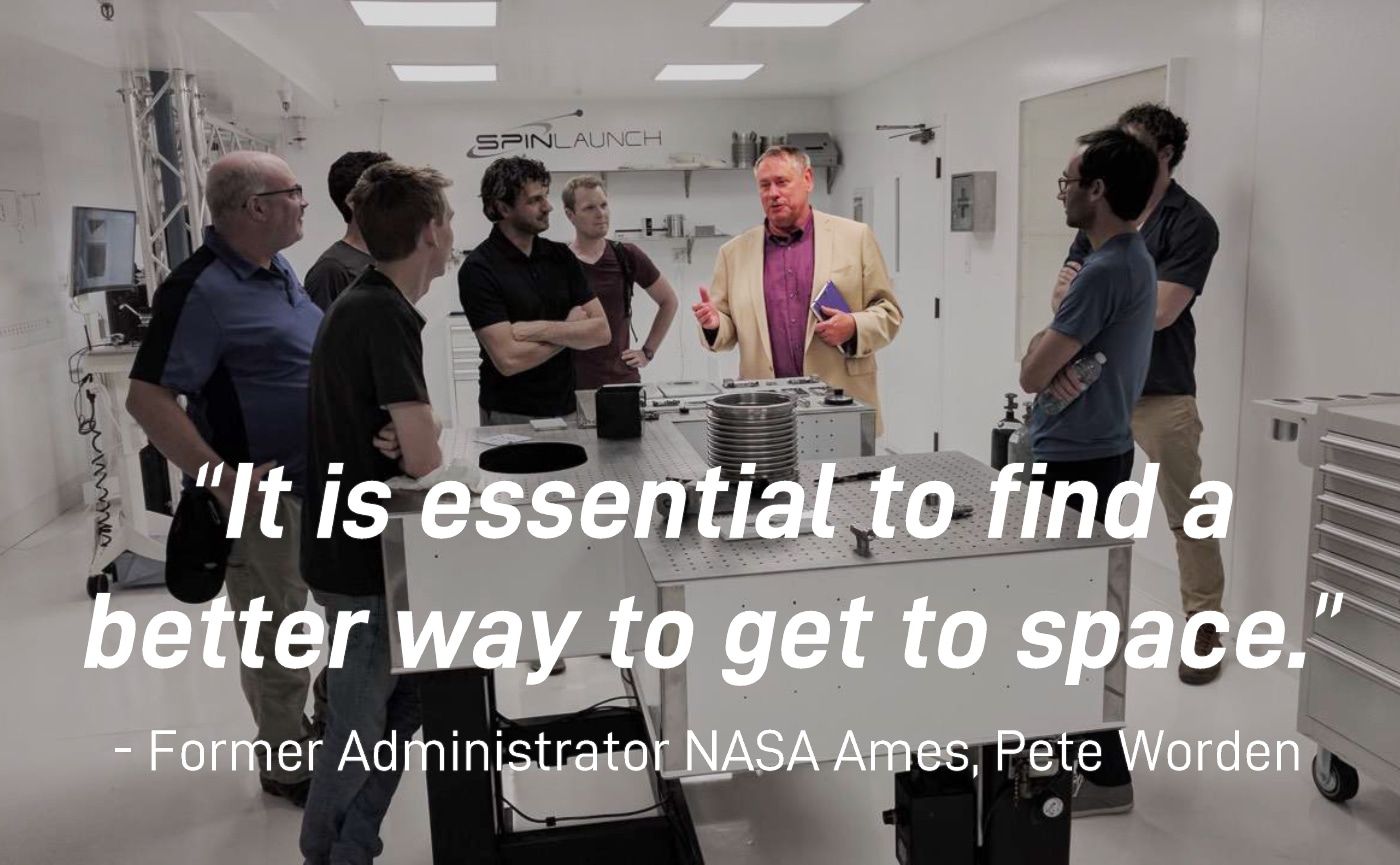
— Pete Worden, former Director of NASA AMES
— The Airforce Research Laboratory
— TechCrunch
— Institute of Mechanical Engineers
Market
"Up to 107,000 satellites
[will be] deployed by 2029"
— Satellite Industry Association
The recently published State of the Space Industrial Base states that the future and growth of the U.S. space economy is “critically dependent on continuing reductions in the costs and risks associated with launch. There is a bifurcation of launch providers between lower-cost, ‘bulk’ carriers...and higher-cost, ‘niche’ providers offering lower lift-mass, but launch to a specific orbit.” There is a promising market surge in the demand for LEO constellations of inexpensive small satellites for disaster monitoring, weather, reconnaissance, communications and other services. Thanks to advancements in high-speed maglev trains, recent attempts to create Hyperloop pods and tracks, and the growth of the commercial aerospace market, the time is ripe to revisit alternative methods to space entry.
The SpaceTech market is expected to grow to $10 trillion by 2030. Over the next decade, the number of satellites in space is expected to grow by 200-500x. Thanks to advancements in high-speed maglev trains, recent attempts to create Hyperloop pods and tracks, and the growth of the commercial aerospace market, the time is ripe to revisit alternative methods to space entry.
Competition
The SpinLaunch
competitive advantage
Vision and strategy
Mission-driven
to revolutionize
access to space
Disruptive launch technology unlocks the
$1T space economy*
*Morgan Stanley Research
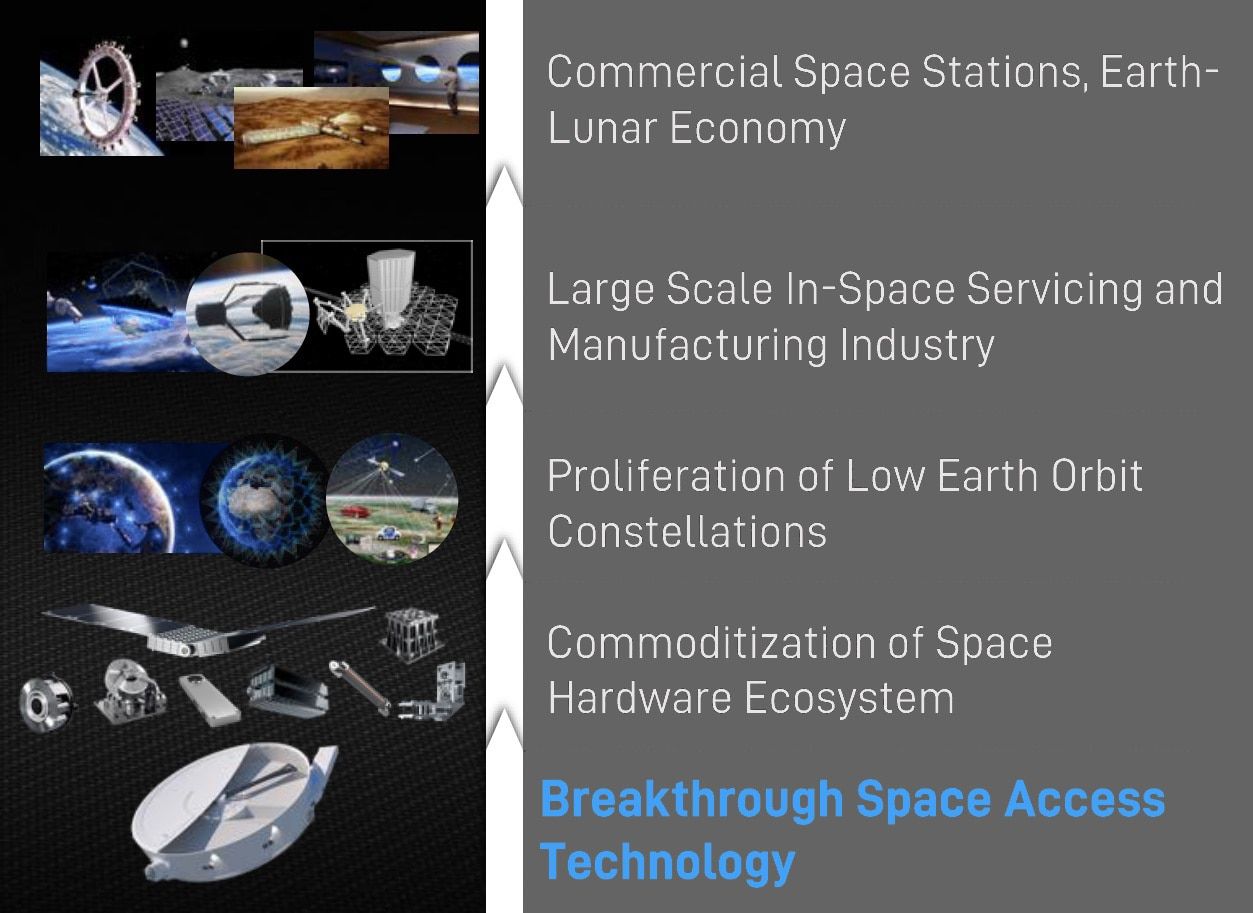
Funding
Select investors
We are investing alongside tier 1 VC firms
- Google Ventures (Uber, Zipline)
- Kleiner Perkins (Amazon, Twitter)
- Airbus Ventures (iSpace Technologies, Isar Aerospace)
Renowned VC John Doeer (early in Amazon, Google, Intuit) - StarLight Ventures (MadeInSpace, Carbon Engineering)
- Bolt Ventures (Orbit Fab, Desktop Metal)
- Lauder Partners (Starry, Palantir)
- Andrew Farkas (CEO C-III Capital Partners)
- Chuck Brady (Founder APOGEE Inc)
- Mckinley Capital
- Wen Hsieh (Kleiner Perkins Partner)
- ATW Partners (Faraday Future, Squawkit.io) among others.
Team
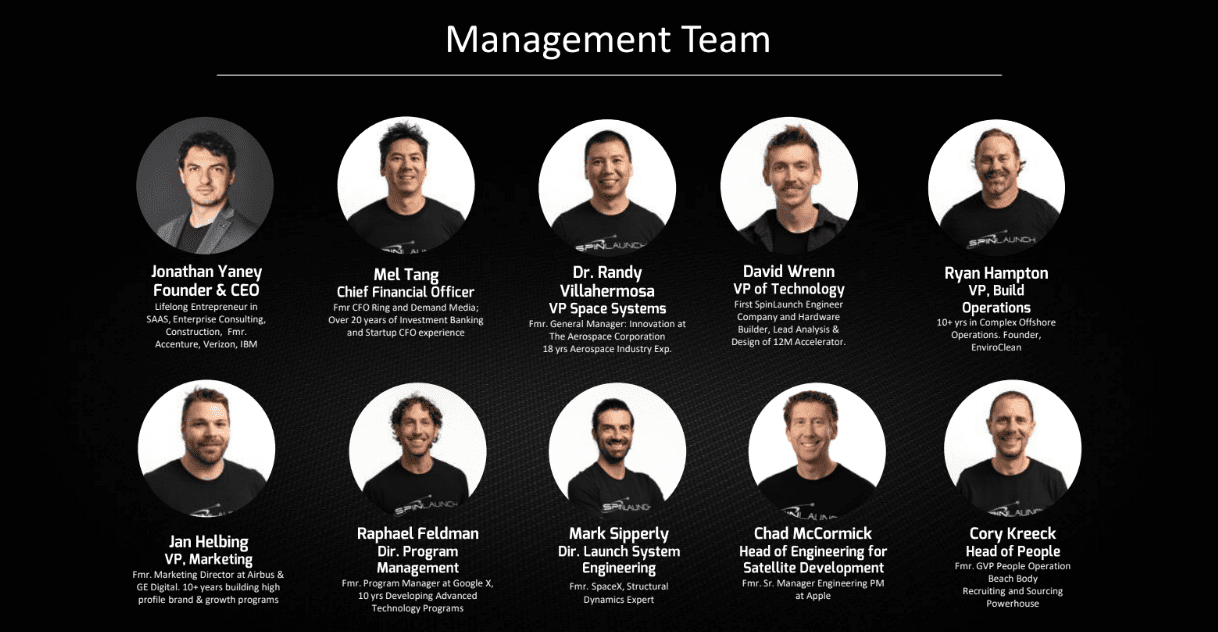
Team Highlights
- Jonathan Yaney (Founder/CEO): Jonathan is a lifelong entrepreneur with 20 years of experience founding companies in, SaaS, IT, enterprise consulting, construction, and aerospace industries. He is a 1,000+ hour pilot, first soloing at age 14, and he is an experimental aircraft builder. In 2014, he conceived of the SpinLaunch concept and founded the company after developing and fabricating the first supersonic prototype in his garage.
- Dr. Randy Villahermosa (VP of Space Systems):
- Randy operates at the intersection of technology, production, and business, and is focused on commercialization of SpinLaunch technology. Randy has 19 years of experience in the space industry developing the most advanced satellite and launch systems in the world. He was formerly the General Manager and Executive Director of Innovation at The Aerospace Corporation, managing an R&D portfolio including plug-n-play satellite technologies, autonomy, robotics, and AI for space.
- Ryan Hampton (VP of Operations): Ryan, SpinLaunch’s first employee, leads build operations at SpinLaunch, spearheading launch site development and managing construction team leadership. He has a background in construction and commercial diving in oil and gas / commercial diving industries and led the construction effort of the first SpinLaunch 12m prototype. He was the Founder of Enviro Clean, an underwater systems engineering company, was a superintendent at Bisso Marine, T&T Bisso, T&T Subsea and as a construction Electrician 3rd class for the US Navy.
- David Wrenn (VP of Technology): David was part of the founding SpinLaunch team joining the company in early 2015. He has been responsible for creating key developments in engineering, system architecture, and business strategy. David was the lead designer and analyst of the company’s novel prototype vacuum chamber and high-performance bearing assemblies. David developed, fabricated, and successfully tested SpinLaunch’s high-g rocket engine and lead prototype test launch operations. He continues to develop SpinLaunch’s technical architecture and vision today.
- Mark Sipperly (Director of engineering): a structural dynamics engineer at SpaceX, and a number of other industry veterans.
- Ninh Le: Ninh is in charge of developing and prototyping advanced space systems concepts. Prior to joining SpinLaunch, Ninh served as the Director of Network Systems and Architecture at Panasonic Avionics Corporation, where he managed networking, software, and microwave engineers to innovate how satellites deliver internet access to passengers on commercial airlines. He holds a BS in Mechanical Engineering from Stanford University, a BA in International Relations from Stanford University, and an MBA (focused on finance and marketing) from the University of Michigan.