

 Oops! We couldn’t find any results...

Opportunity
Global safari is predicted to become a $41.2 billion market next year
Safari tourism is one of travel’s fastest-growing niches. The industry caters to high-net-worth travelers seeking exclusive, experiential adventures.
Which is exactly what Leeu Doring Safaris delivers.
South Africa logged a record 10.5 million international arrivals in 2025, up from 8.9 million the year before. Tourism now contributes close to 5% of national GDP, while Safari & Adventure was the single largest experience type in 2025.
By offering both big-game hunters and eco-travelers year-round access to a revenue-generating property, Leeu Doring Safaris is creating a dual-revenue model to support growing industries.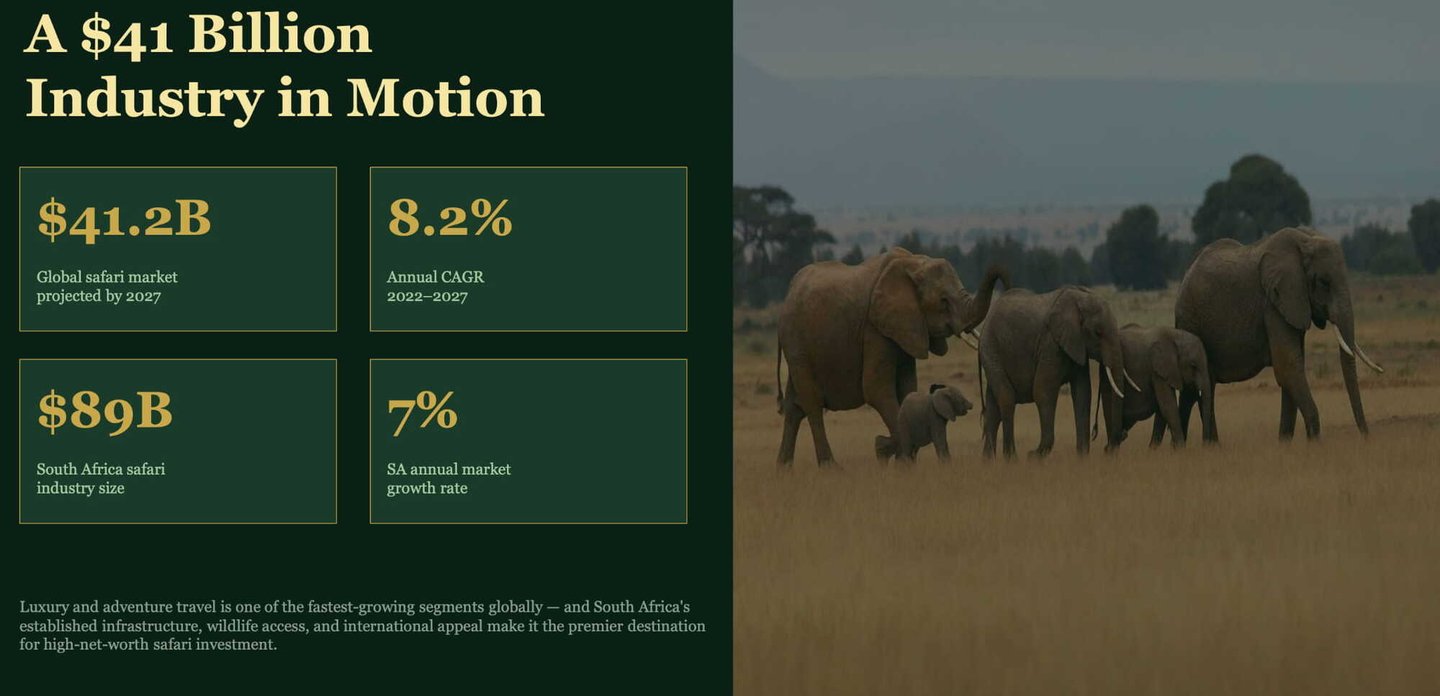
The Luxury Lodge
Luxury adventure location offering two tourist pathways
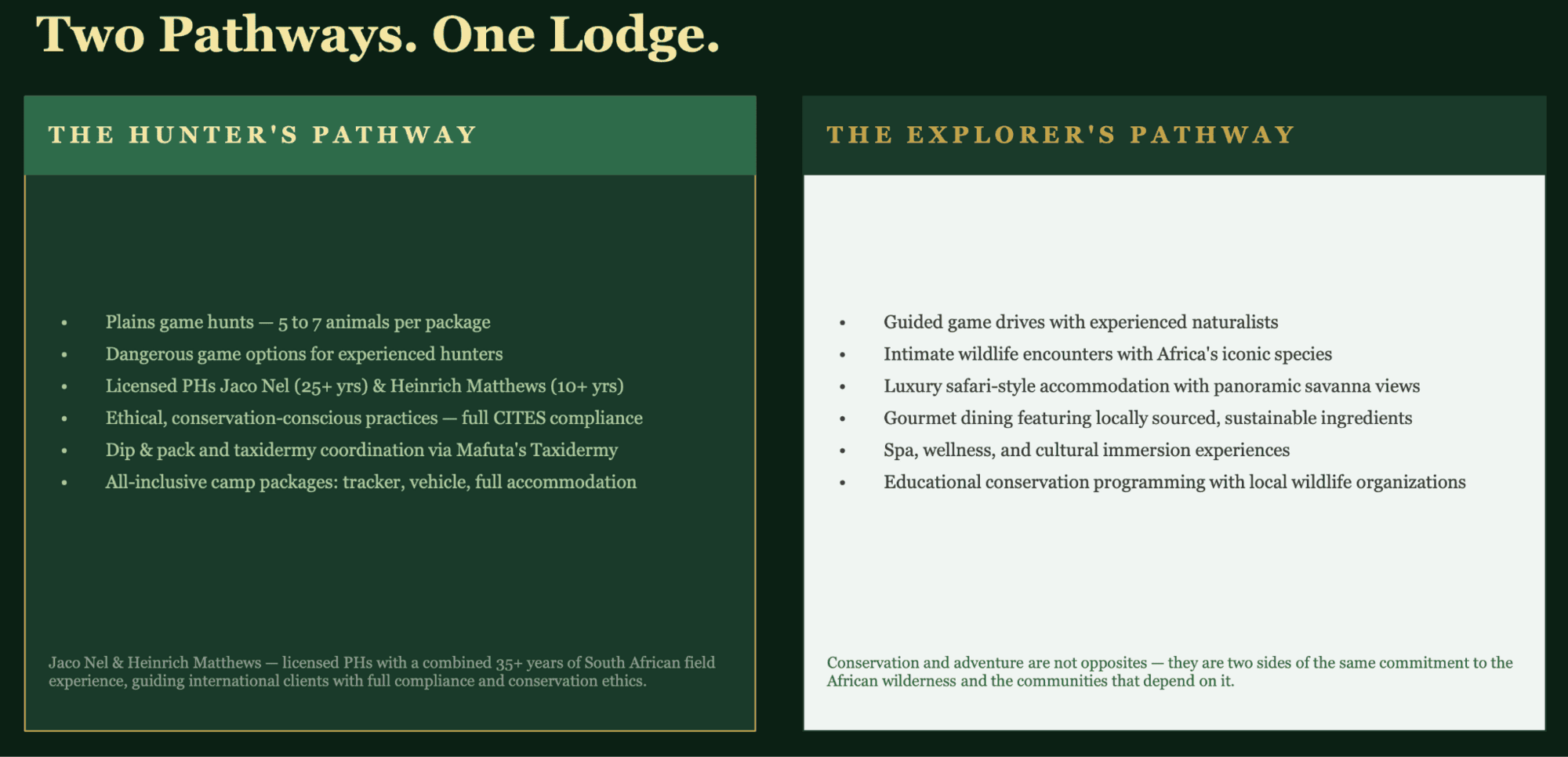
Leeu Doring's Safaris plans to acquire an already-established luxury lodge in South Africa to use as shared infrastructure for two complementary guest pathways:
A hunter’s pathway built around two founders’ combined 35+ years of licensed, CITES-compliant field experience
An explorer’s pathway of guided game drives, wellness, and conservation programming for eco-tourism travelers
Acquiring a functioning property compresses the time-to-revenue compared to ground-up development. The lodge converts the current five-month dead season into rack-rate revenue, brings taxidermy processing in-house, and gives the business a physical venue.
Plus, the ownership-membership structure turns guests into stakeholders, which supports repeat visitation and word-of-mouth growth without added marketing spend.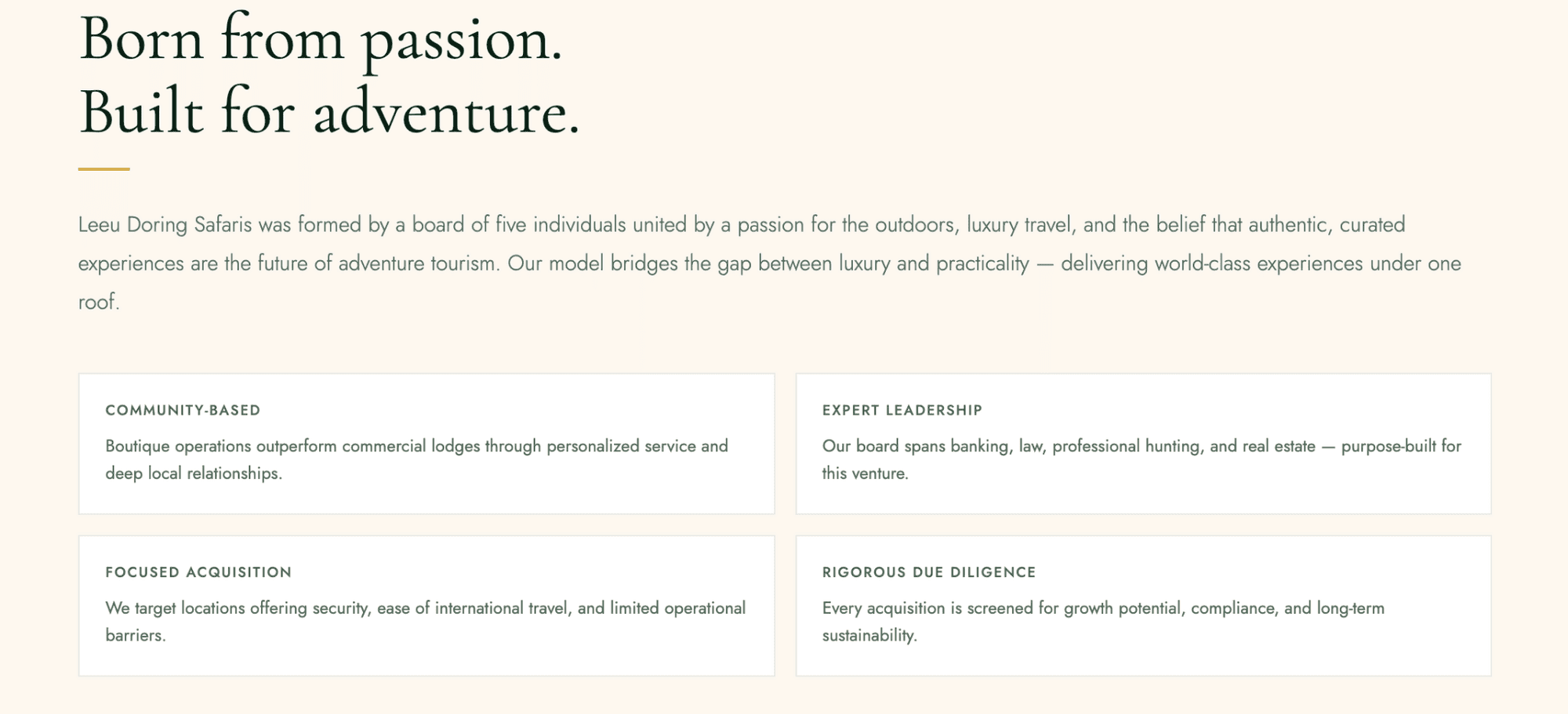
Business model
Year-round revenue generation from two complementary target markets
Revenue comes from two complementary streams:
Large game hunters
Ecotourism getaways

Year-one projections show membership sales driving 83% of gross revenue, with the remainder split across rack-rate public bookings, corporate and trophy fees, and ancillary spend.
This can result in a projected 48.9% EBITDA margin in year one that’s modeled to climb to roughly 54% by year five as fixed costs are absorbed. 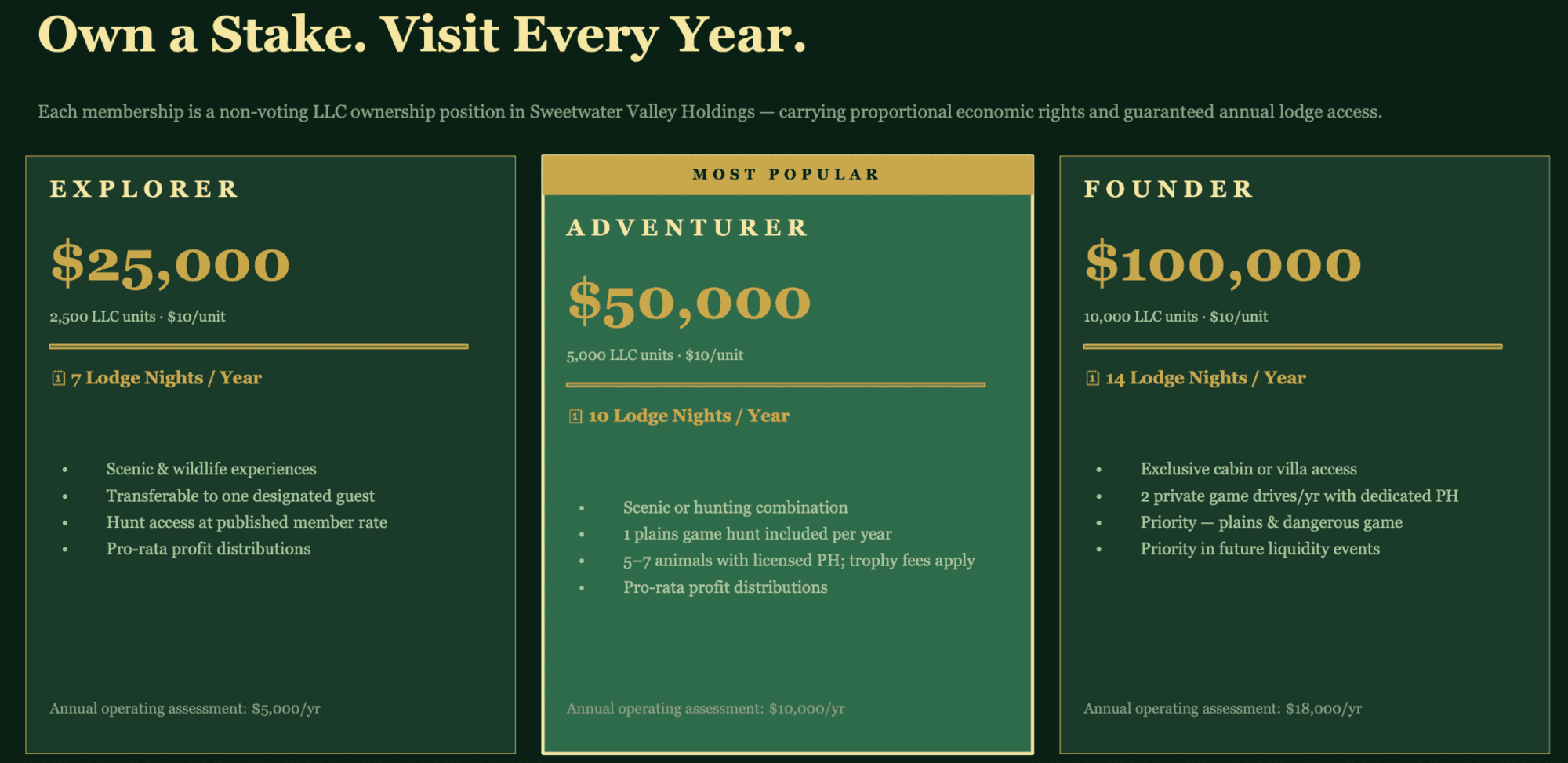
Industry
Booming safari and ecotourism travel industries converge in one place
Safari and luxury adventure travel sit at the intersection of two accelerating trends:
Rising global wealth seeking experiential rather than material luxury
Growing scarcity-driven urgency around visiting wild places
The global safari tourism market is predicted to surpass $41 billion next year, with consistent mid-to-high single-digit annual growth projected through 2033. The high-end segment, including outfitters and lodges catering to affluent travelers, is growing even faster: around 7.7% annually.
South Africa benefits from established aviation infrastructure, a favorable exchange rate, and a diversified wildlife and terrain offering that supports both hunting and eco-tourism itineraries.
A boutique, dual-pathway lodge is well-suited to capture premium pricing in a market that increasingly rewards small-scale, curated experiences over commercial-volume operations.
Traction
The core operation is already turning a profit
Founder and professional hunter Jaco Nel’s existing outfit books roughly 18 hunts per season across 7-day and 14-day packages, generating approximately $300,000 in annual net revenue after field costs. He’s accomplished this entirely through referrals and no paid marketing spend.
The team has screened and shortlisted 19 qualified lodge properties under $2.5 million, with active site evaluation underway. Inbound corporate interest, including a direct approach from Toyota, is likely to accelerate once infrastructure has been secured.
Leadership
Founded by veteran hunters and development experts
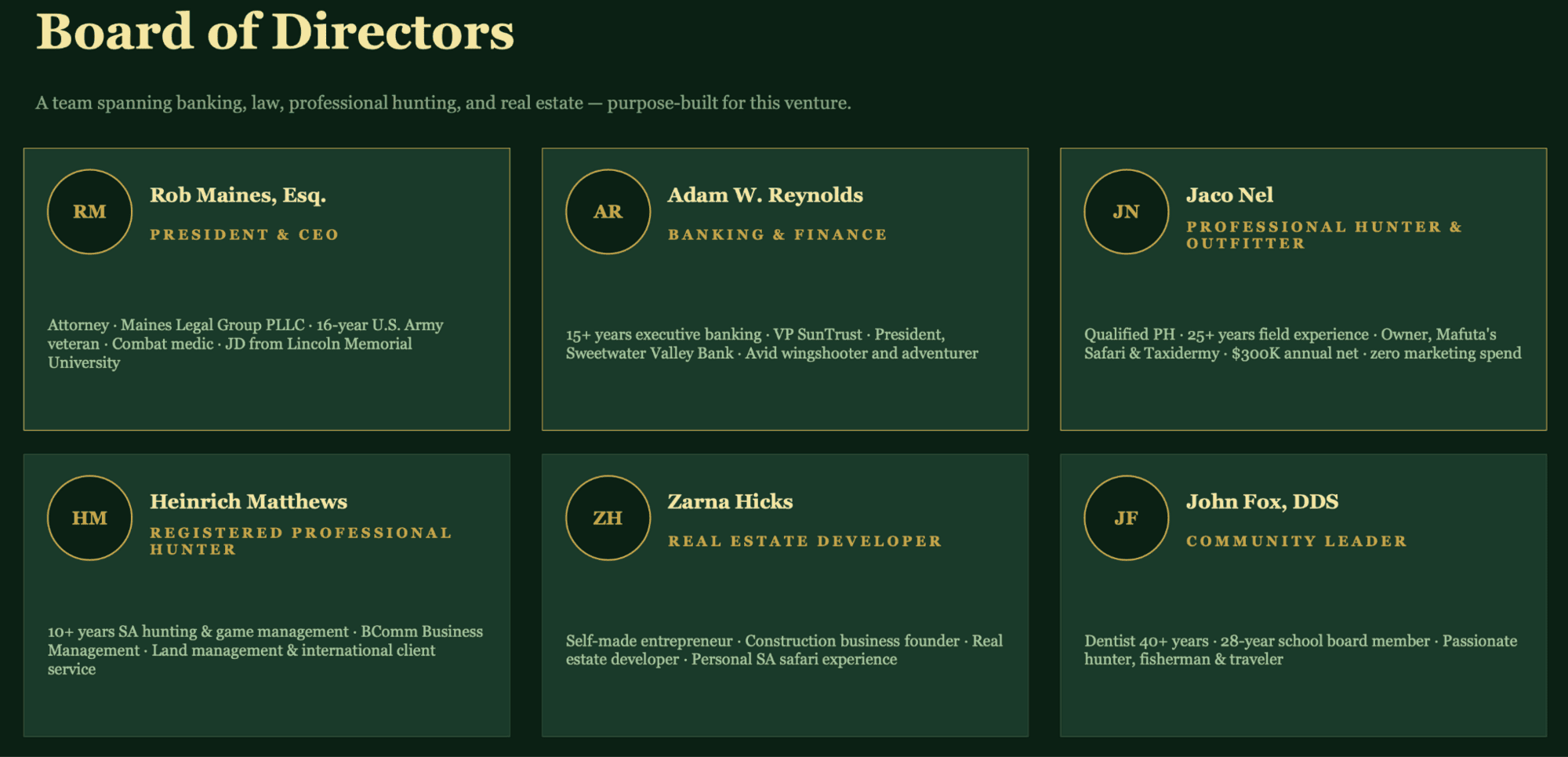
The Board of Directors pairs deep South African field operations experience with the financial, legal, and development expertise needed to run a cross-border hospitality venture.