Republic Republic Republic
  • Log in
Open account
Oops! We couldn’t find any results...
Can’t find a deal? Try advanced search.
Is something missing? Add your suggestion here.
Primary market Live deals Trading Buy and sell Republic Note Own a piece of Republic's upside
Republic Ventures Opportunities for accredited investors
Republic Capital Multi-stage venture firm
Wallet Manage your digital assets Mobile app Available on iOS or Android Learning center Explore investor resources FAQ Get your questions answered
Capital fundraising Raise on Republic Tokenized assets Design, launch, manage tokenized assets Sharedrops Gift equity as a reward Founder Academy A complete guide to raising funds
Advisory Access veteran web3 advisors Infrastructure Stake your digital assets Tokenization Deploy your assets on-chain
Republic Capital In-house Venture Capital fund Broker dealer Regulated capital services
Republic Republic Republic
Oops! We couldn’t find any results...

Can’t find a deal? Try advanced search.
Is something missing? Add your suggestion here.
  • US

  • Log in
  • Open account
All investors
Primary market Live deals Trading Buy and sell
Republic Note Own a piece of Republic's upside
Accredited only
Republic Ventures Opportunities for accredited investors
Institutional
Republic Capital Multi-stage venture firm
More
Wallet Manage your digital assets Mobile app Available on iOS or Android Learning center Explore investor resources FAQ Get your questions answered
Growth capital solutions
Capital fundraising Raise on Republic Tokenized assets Design, launch, manage tokenized assets Sharedrops Gift equity as a reward Founder Academy A complete guide to raising funds
Web3 services
Advisory Access veteran web3 advisors Infrastructure Stake your digital assets
Tokenization Deploy your assets on-chain
Institutional services
Republic Capital In-house Venture Capital fund
Broker dealer Regulated capital services
Logo of Wagyu Factory Miami

Wagyu Factory Miami

Miami-based Wagyu restaurant in large hospitality portfolio
AAPI Founders Drinks Food B2C Apps Security
Facebook Telegram Twitter LinkedIn
Featured image of Wagyu Factory Miami
$500
0% raised of $75K min
1
Investor
89 days
Left to invest
Invest in Wagyu Factory Miami
$100 minimum investment · Deal terms
Pitch Discussion Updates
Invest Invest in Wagyu Factory Miami
Facebook Telegram Twitter LinkedIn
The Concept Biz. model The Market Chubby Group Traction Leadership Competition Vision and strategy Impact Funding Summary
About Team FAQ Risks Discussion

Documents

Republic (OpenDeal Portal LLC, CRD #283874) is hosting this Reg CF securities offering by NIKU X Miami LLC. View the official SEC filing and all updates:
Official SEC Logo Form C SEC.gov
Company documents
Subscription Agreement nikuxmiami.form c.pdf
Loading

Hear from some of the 1 investor in Wagyu Factory Miami


Show more

Highlights


  • Fusion restaurant in Miami Beach launched by $500M valuation group
  • Location targeting $12 million in annual revenue with unique model
  • Chubby Group owns 30+ Asian-inspired brands, aiming for 1,000 locations
  • Chubby Group clears $250 million in annual revenue
  • Operating with $30 million in Wagyu inventory
  • Raised more than $45 million in equity
  • Chubby Club loyalty program driving repeat visits and rewards

The Concept


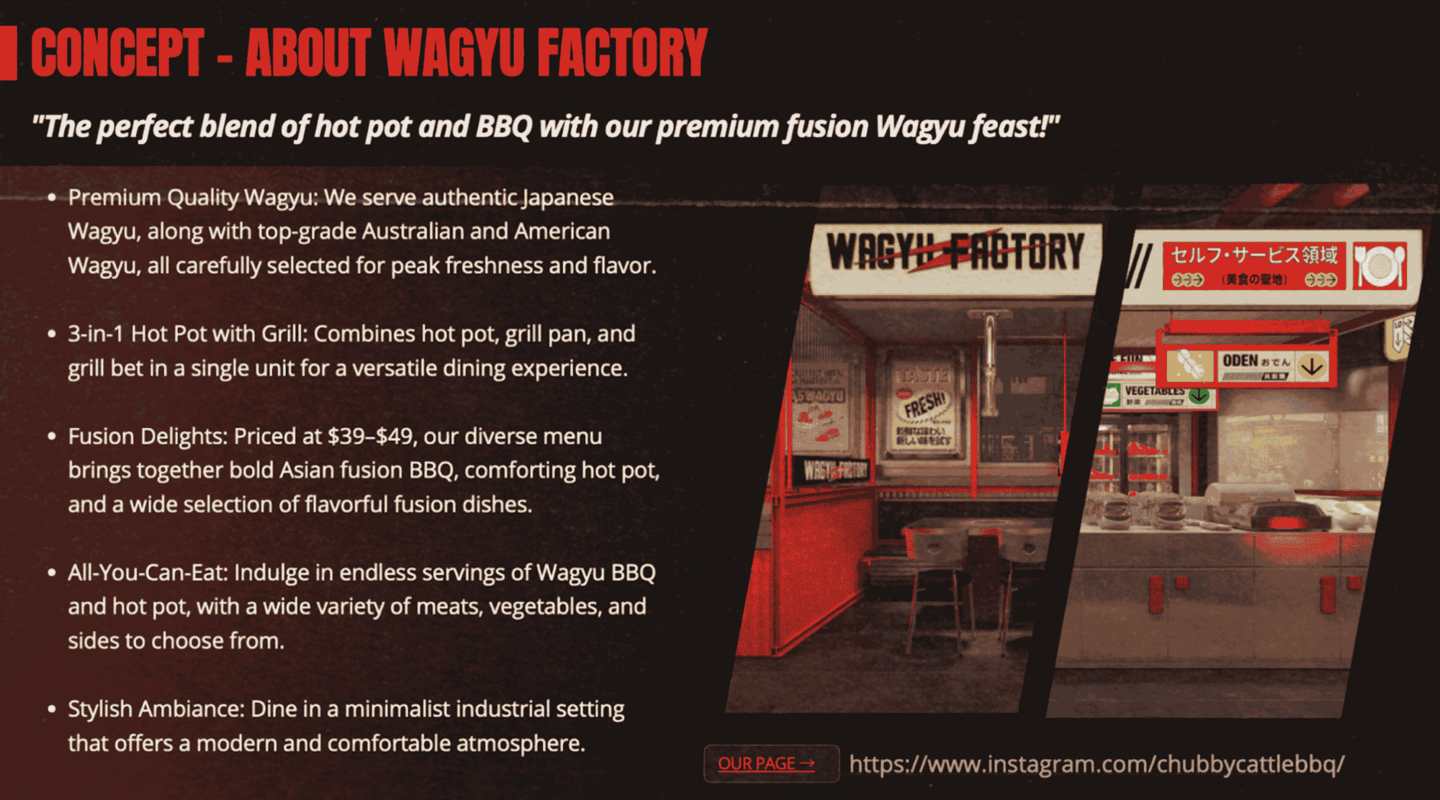
One of the world’s most treasured meats at an affordable price

30+ Asian‑inspired brands. 70+ open locations. An aggressive pipeline targeting 100 locations by 2026 and 1,000 global locations in the future.

That pipeline includes Wagyu Factory Miami Beach, part of Chubby Group’s expanding brand bringing the famed Japanese beef to America.

Wagyu is intensely marbled with fine streaks of fat, giving it a rich, buttery flavor that’s very different from typical steak. Japanese Wagyu is produced in limited quantities under strict breeding, feeding, and grading standards.

Wagyu Factory Miami Beach’s fusion BBQ and hot pot restaurant will offer one of the world’s most expensive meats at an accessible price.

Business Model


High-volume restaurant with unique revenue share

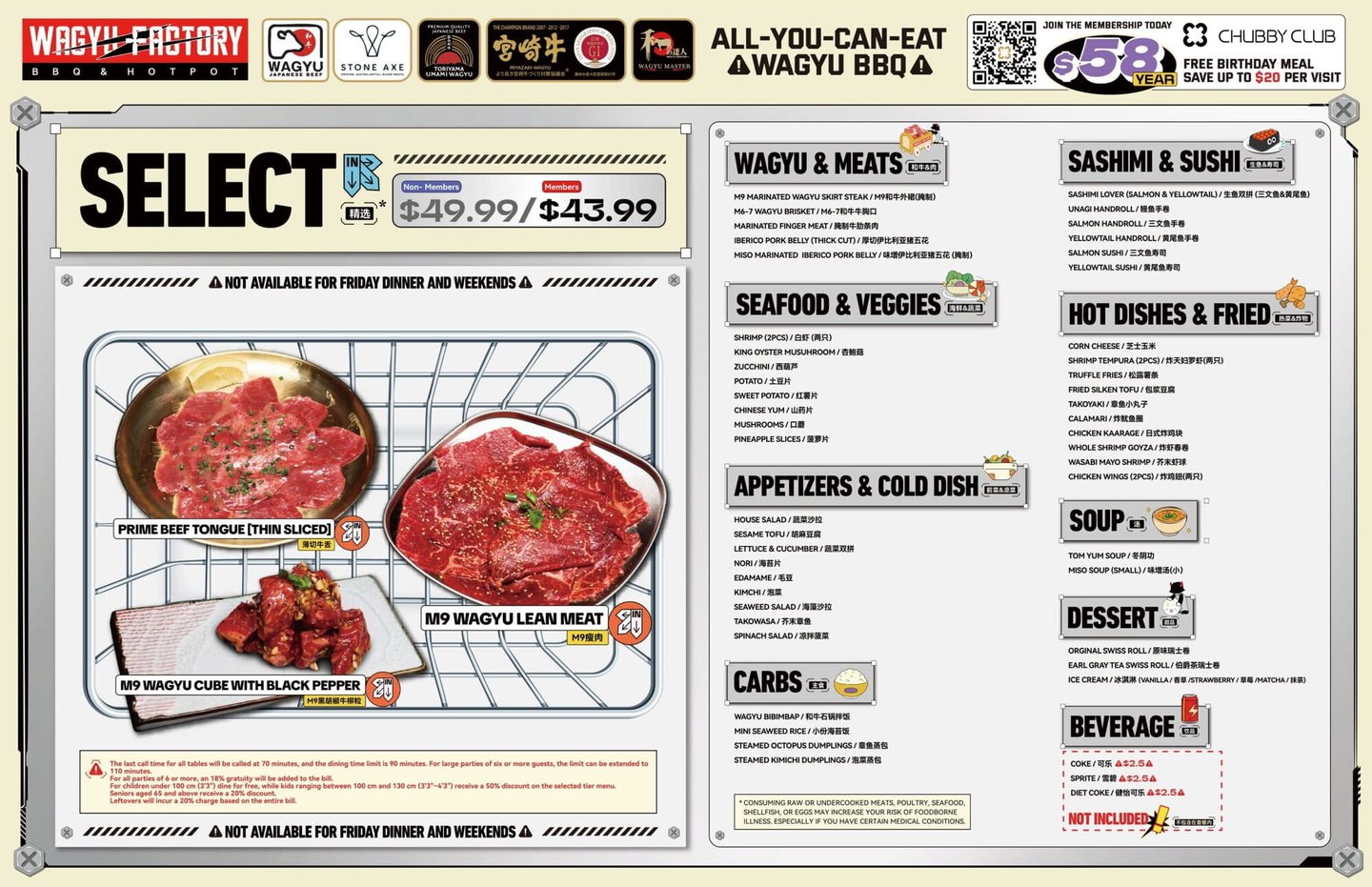
Wagyu Factory Miami is a high-volume restaurant that monetizes through an average check of $39–49 dollars per guest across roughly 200 seats, supplemented by full liquor sales in a lunch-and-dinner service window. 

This project uses a revenue-share financing model. Investors provide up to $1.25 million and receive a fixed percentage of gross revenue until a total of $3.5 million has been paid out, targeting a 2.8x cash-on-cash return depending on actual top-line performance.

The concept leverages Chubby Group’s vertically integrated ecosystem to control food costs and maintain premium Wagyu positioning while driving scale, with projected annual sales of over $12 million dollars and a multi-year ramp of revenue growth.

Operating margins are created by tightly managed food and labor cost structures, standardized build-out and operations across locations, and a loyalty-driven repeat-visit engine via the Chubby Club app.

The Market


Miami’s Asian Dining Market: Growing Demand and Opportunity

Miami Beach is a global destination for culture, tourism, and entertainment, blending beach-town energy with strong international influence from Latin America, the Caribbean, and Europe. Major events such as Art Basel Miami Beach and Miami Art Week attract high-net-worth visitors and global audiences each year, reinforcing the city’s reputation as both an arts hub and a luxury lifestyle destination. Tourism and visitor spending generate billions of dollars annually, creating strong demand for differentiated dining, retail, and entertainment experiences.

At the same time, Asian cuisine continues to grow in popularity among both locals and visitors. Younger consumers and social media culture have accelerated interest in premium ingredients such as wagyu beef and experiential dining formats. With over 27 million annual tourists and a large Gen Z and Millennial consumer base, Miami offers a strong market for interactive dining experiences such as grill-your-own and all-you-can-eat concepts.

Opportunity for Wagyu Factory

Despite the growing demand for Asian dining, Miami still has limited large-scale BBQ & Hotpot concepts, leaving a clear opportunity for new brands to define the category. Wagyu Factory fills this gap by offering premium wagyu BBQ at accessible all-you-can-eat pricing, featuring a curated selection of Japanese A5 Wagyu, American Wagyu, and Australian Wagyu. By combining high-quality ingredients, strong value, and a social grill-your-own dining experience, Wagyu Factory is well positioned to become a leading wagyu BBQ destination in Miami.

Chubby Group


$500 million valuation for its vertically integrated concepts

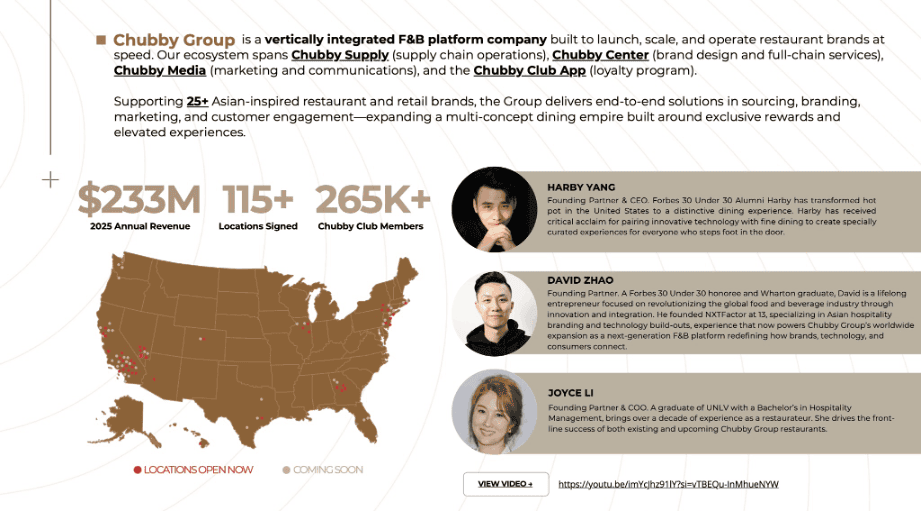
Chubby Group is a US-based food and beverage holding company known for tech-enabled, Wagyu-focused restaurant concepts plus related retail products and loyalty programs.

The concept has grown from a single Las Vegas hot pot restaurant into a multi-brand platform with dozens of locations, nine-figure revenue, and ambitions to scale to hundreds of sites in the next few years.

Chubby Group oversees 70+ locations, with a long‑term target of more than 1,000 locations globally. The group has cleared over $250 million in annual revenue system-wide, operating with more than $30 million in Wagyu inventory. 

The business and its entities have raised more than $45 million in equity across the holding company and individual locations, and has been described as a unicorn‑level venture with a valuation of $500 million.

Chubby Group has built a vertically integrated ecosystem including: 

  • Wagyu supply chain

  • Modular design and materials pipeline

  • Consumer packaged products

  • A media and marketing arm

  • HR, accounting, operational AI & ERP tech stack

Customer engagement centers on Chubby Club, the group’s app-based loyalty ecosystem connecting guests across its restaurant concepts. Diners can scan and earn points with every visit, track rewards, and redeem benefits through the app. Subscription membership tiers offer additional perks such as point multipliers and monthly rewards. The group has set a goal of over 10 million global members, and currently hold 200K+ members only 1 year after its official launch.


Traction


70+ restaurants opened, 1,000 (or so) to go

Chubby Group has already opened more than 70 restaurants across a portfolio of 30+ Asian-inspired concepts, spanning fine dining, casual dining, and fast-casual formats.

The group’s portfolio ranges from luxury dining concepts such as The X Pot—America’s first luxury Hokkaido Seafood & Wagyu hot pot restaurant located at The Venetian Resort Las Vegas—along with premium yakiniku and Wagyu-focused restaurants including NIKU X and Wagyu House, to popular casual dining brands such as Chubby Cattle, Wagyu Factory, and Wagyu Master.

Complementing these restaurants are fast-casual and à la carte concepts including Chubby Curry, Chubby Nori, Chubby Skewers, and Chubby Tan, as well as upcoming brands such as Chubby Bowls, Chubby Don, and Mr Chubby. Beyond restaurants, the group has also expanded into retail through Chubby Foods, offering products such as Wagyu beef bowls and dumplings available online and in stores.

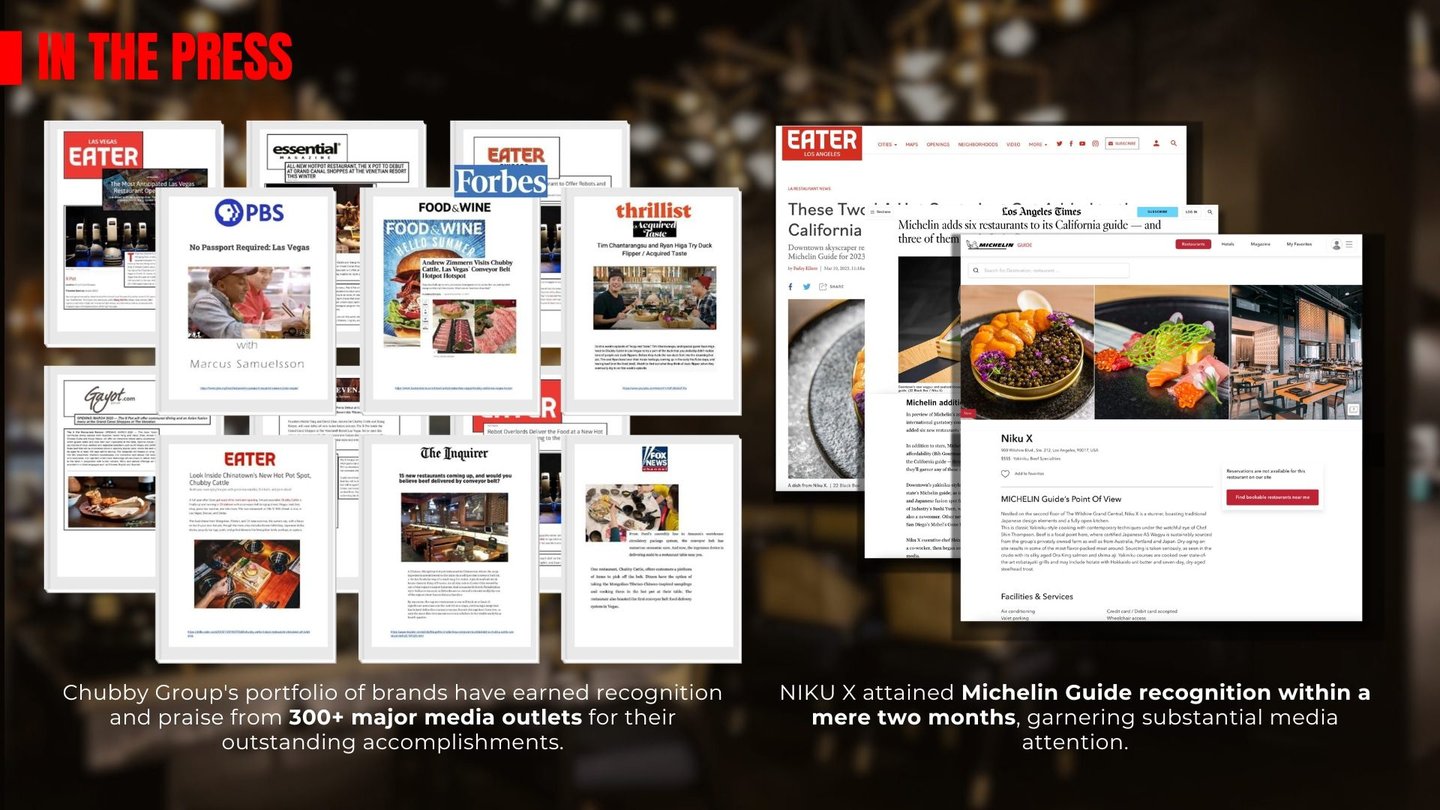
Across its concepts, Chubby Group has secured media coverage from 300+ major outlets and received Michelin Guide recognition within months of opening, reinforcing its growing presence in the global dining landscape.

“There’s 27-year-olds Haibin Yang and David Zhao, who cofounded Chubby Cattle and The X Pot, which pair modern takes on traditional Chinese hot pot with technologies including robotic servers and high-end laser projectors to project custom media for every dish onto customers’ tables.” Forbes 30 Under 30

“At Chubby Cattle, it’s all about over the top options and deliciousness. They call themselves reformers of tradition.”  Food & Wine

“There’s no shortage of stuff to put in the broth, from all types of beef, pork, and chicken to shrimp, calamari, and clams. The noodle selection includes glass, udon, green tea, purple yam, tomato, potato, and taro.” Eater

Leadership


Deep experience in hospitality, F&B, and tech

Chubby Group’s leadership team brings together deep expertise in hospitality operations, restaurant entrepreneurship, technology innovation, and brand development. The team combines experience across F&B operations, finance, technology, marketing, and design, creating a multidisciplinary foundation for building and scaling modern restaurant brands.

The company’s founding partners include CEO Harby Yang, known for pioneering technology-enabled hot pot dining concepts and immersive restaurant experiences; David Zhao, a Forbes 30 Under 30 entrepreneur recognized for building fast-growing restaurant brands and integrating digital strategies into modern hospitality; and COO Joyce Li, a UNLV-trained hospitality operator with more than a decade of experience in restaurant management and multi-location operations.

Together, the founding team has successfully developed and scaled multiple restaurant concepts across the United States. Their collective experience spans restaurant design, supply chain strategy, marketing and media development, technology integration, and large-scale hospitality operations, supported by operational systems designed to enable rapid expansion across markets.

The founders share a long-term vision of bringing high-quality Wagyu and diverse Asian culinary traditions to a global audience. By combining premium ingredients, scalable restaurant concepts, and modern hospitality technology, they aim to expand the Chubby Group platform while introducing elevated Asian dining experiences to new markets worldwide.

Competition


Wagyu Factory’s Competitive Edge
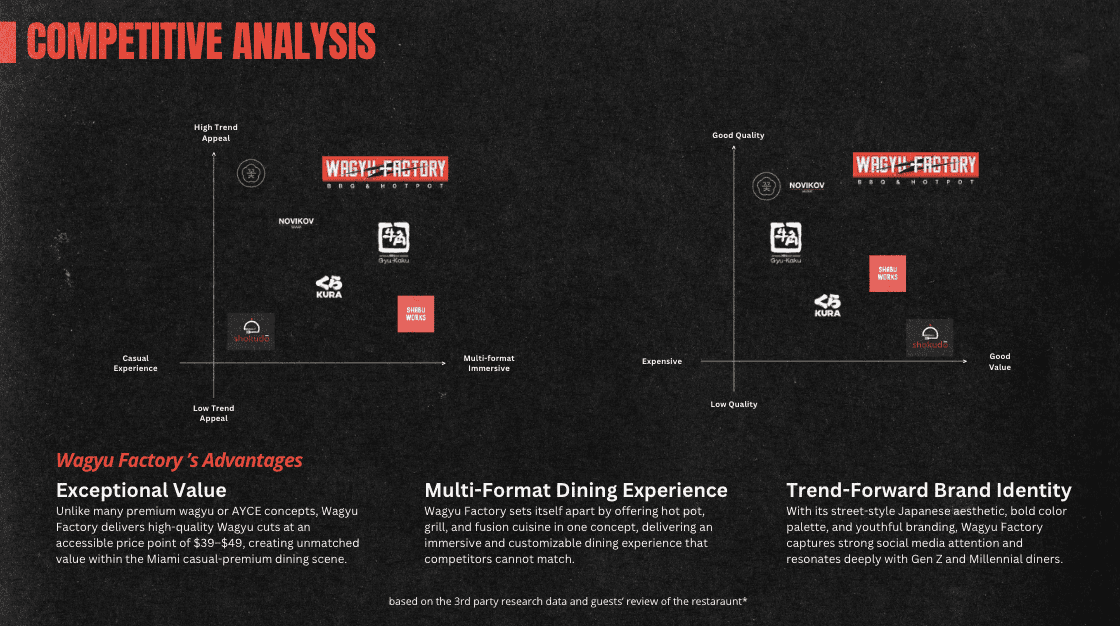
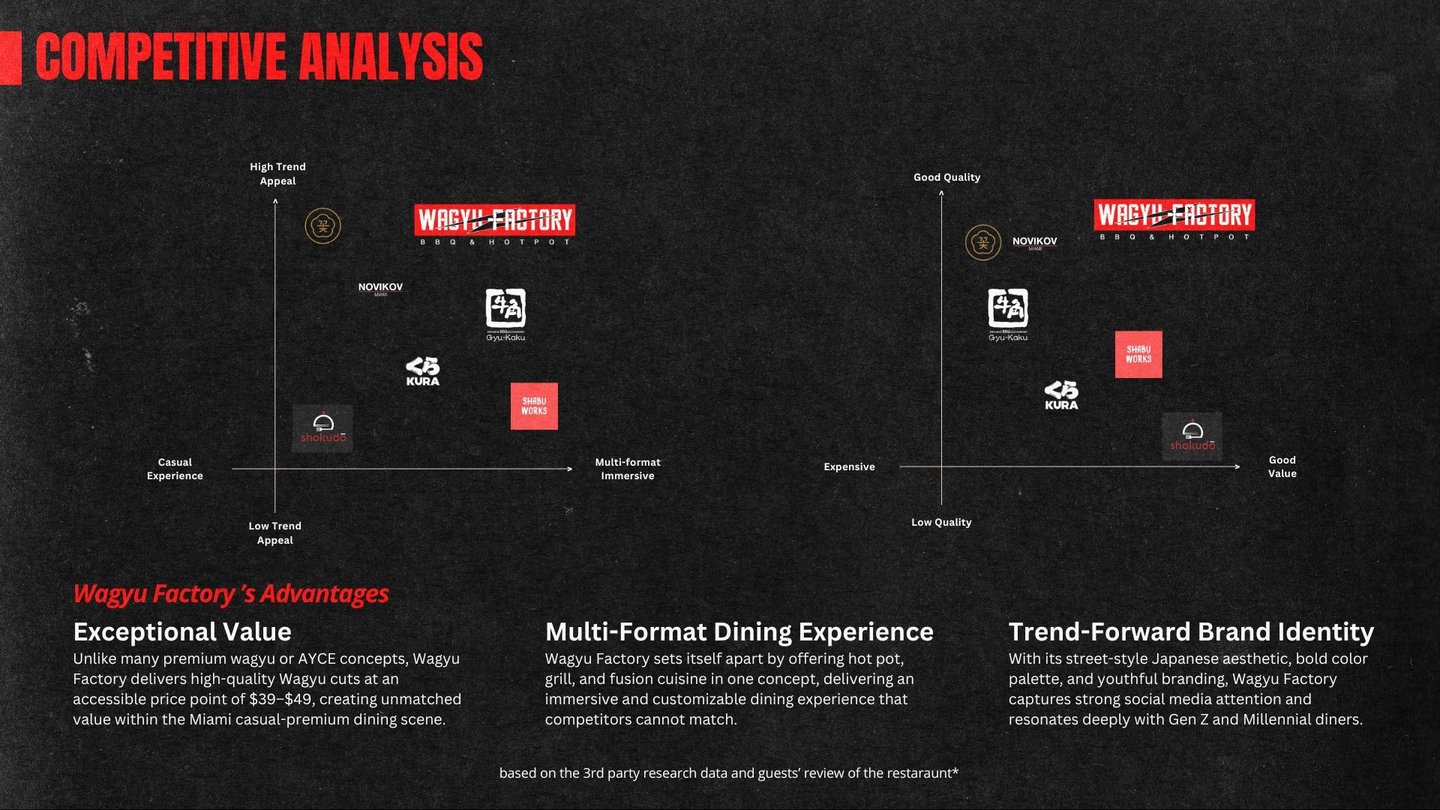
Miami’s Asian restaurant market is largely split between expensive fine dining and casual concepts with limited product differentiation. Wagyu Factory bridges this gap by delivering premium wagyu quality, immersive grill dining, and strong value pricing in one concept.

With $39–$49 AYCE wagyu BBQ, multi-format dining (BBQ + hot pot), and a trend-forward brand built for social media, Wagyu Factory creates a unique positioning that competitors currently do not offer, allowing the brand to capture both experience-driven diners and value-conscious consumers.


Vision and strategy


Vision

Wagyu Factory aims to become the leading destination for premium wagyu BBQ & Hotpot in emerging global dining cities, starting with Miami. Our vision is to make world-class wagyu accessible to a broader audience by combining premium ingredients with an interactive, social dining experience. By bridging the gap between luxury dining and casual affordability, Wagyu Factory seeks to redefine how consumers experience wagyu—transforming it from a rare indulgence into a vibrant, shareable dining culture.

Strategy

Premium Product, Accessible Price
Offer a curated selection of Japanese A5 Wagyu, American Wagyu, and Australian Wagyu in an all-you-can-eat format, delivering exceptional value while maintaining premium quality.

Experience-Driven Dining
Create an immersive dining environment through interactive BBQ grilling, hot pot options, and customizable group dining formats that encourage social engagement and repeat visits.

Brand Built for the Next Generation
Leverage bold branding, social-media-friendly experiences, and strong visual identity to capture the attention of Gen Z and Millennial diners who drive dining trends and online visibility.

Impact


Building a Scalable Wagyu Dining Ecosystem

Chubby Group is building a scalable ecosystem around premium Wagyu dining, combining vertically integrated sourcing, innovative restaurant concepts, and technology-driven customer engagement.

The company has grown from a single hot pot restaurant in Las Vegas into a multi-brand hospitality platform. The group has introduced new dining formats that merge premium ingredients with experiential hospitality.

Chubby Supply

A key differentiator of Chubby Group is its vertically integrated supply chain. The company works closely with Masami Ranch, a Japanese-operated farm in Northern California that raises approximately 200 heads of American Wagyu per month exclusively for Chubby Group. The ranch spans 7,000 acres in California and 3,000 acres in Oregon, allowing for seasonal cattle rotation that optimizes breeding conditions and livestock quality. Through this structure, the company is able to maintain stable access to one of the world’s most sought-after meats while preserving quality and pricing flexibility.

Beyond domestic production, Chubby Group also imports Australian and Japanese Wagyu in large volumes. With a projected 5,000+ heads of Wagyu imported in 2025, the company ensures a consistent supply of premium Wagyu across its restaurant concepts.

Chubby Club

That approach extends beyond the plate. Chubby Group embraces technology and social media to create a modern dining experience designed for today’s tech-savvy guests.

Across our restaurants, innovation plays an important role—from iPad ordering systems and automated woks to robotic servers and conveyor belts—transforming a traditional meal into an interactive and memorable dining experience.

At the center of this ecosystem is Chubby Club, Chubby Group’s gamified loyalty program designed to reward guests for every visit.

All guests can simply scan and earn points through the Chubby Club app whenever they dine at our restaurants. Points accumulate with every purchase and can be redeemed for rewards and exclusive offers across Chubby Group concepts.

For guests who want to unlock more benefits, Chubby Club also offers subscription memberships such as Chubby Club One and Chubby Club Plus. These tiers provide additional perks including point multipliers, monthly rewards, birthday points, and other exclusive benefits available throughout our locations.

By combining technology, rewards, and membership benefits, Chubby Club transforms dining into an engaging ecosystem, where guests can earn, redeem, and discover new experiences across the Chubby Group portfolio.

Through its restaurants, technology platforms, and vertically integrated supply chain, Chubby Group aims to expand the global presence of Asian cuisine while redefining how premium ingredients can be experienced at scale.

Funding


Funding the Wagyu Factory Miami Launch

The funds raised through this offering will primarily be used to support the opening and early growth of the Wagyu Factory Miami Beach location.

Investment will focus on bringing the restaurant to market and establishing a strong launch in the Miami hospitality scene. This includes the development of the physical restaurant location as well as the marketing and digital infrastructure needed to build brand awareness and attract customers.

By concentrating capital on the successful launch and operation of Wagyu Factory Miami, the project aims to establish a high-performing flagship location in one of the most dynamic dining markets in the United States.

Summary


Invest in Wagyu Factory Miami

Wagyu Factory Miami is a new fusion BBQ and hot pot restaurant planned for Miami Beach, backed by Chubby Group, a fast-growing hospitality company with more than 70 restaurant locations across 30 Asian-inspired brands and over $250 million in annual revenue. The concept focuses on serving premium Japanese Wagyu beef at an accessible price, supported by Chubby Group’s vertically integrated supply chain. The restaurant is expected to seat around 200 guests with an average spend of $39 to $49 per person and projected annual revenue of more than $12 million.

The investment uses a revenue-share model rather than traditional equity. Investors collectively contribute up to $1.25 million and receive a percentage of the restaurant’s gross revenue until a total of $3.5 million has been paid out, targeting a 2.8× return over an estimated 7 to 10 years depending on performance. Funds will be used to launch and grow the Miami location, leveraging Chubby Group’s existing brand ecosystem, supply chain, and customer loyalty platform to support long-term expansion.


$

Deal terms


Minimum investment

$100

The smallest investment amount the issuer is accepting in this offering.

Maximum investment

$124,000

The largest investment amount the issuer is accepting in this offering.

Funding goal

$1.24M

Wagyu Factory Miami must achieve its minimum goal of $75K before the deadline. The maximum amount the offering can raise is $1.24M.
Learn more

Deadline
Wagyu Factory Miami campaign will end on .
Type of security

Crowd Revenue Note shares

Common stock issued by NIKU X Miami LLC
Learn more

Price per share

$1

The price of each share of Crowd Revenue Note.

How it works

Documents

Republic (OpenDeal Portal LLC, CRD #283874) is hosting this Reg CF securities offering by NIKU X Miami LLC. View the official SEC filing and all updates:
Official SEC Logo Form C SEC.gov
Company documents
Subscription Agreement nikuxmiami.form c.pdf

Bonus perks

In addition to your Crowd Revenue Note shares, you'll receive perks for investing in Wagyu Factory Miami.
Invest
$500
Receive
  • Free round of drinks
Invest $500
Invest
$2,500
Receive
  • 10% off all visits
Invest $2,500
Invest
$10,000
Receive
  • 15% Off + VIP early booking access
Invest $10,000
Invest
$25,000
Receive
  • 20% Off + Concierge Line
Invest $25,000
Invest
$50,000
Receive
  • Lifetime Gold Status on APP + Invite-only Dinners (permanent)
Invest $50,000

About Wagyu Factory Miami

Legal Name
NIKU X Miami LLC
Founded
Dec 2024
Form
Florida LLC
Employees
3
Website
wagyufactory.com
Social Media
Headquarters
Google Map location of of Wagyu Factory Miami
555 Washington Avenue , Miami Beach, FL
Headquarters
555 Washington Avenue, Miami Beach, FL, United States 33139

Wagyu Factory Miami Team
Everyone helping build Wagyu Factory Miami, not limited to employees

Profile picture of Haibin  Yang
Haibin Yang
Co-Founder/CEO
Profile picture of David Zhao
David Zhao
Co-Founder/Managing Partner
Profile picture of Joyce Li
Joyce Li
Co-Founder/COO
Haibin Yang
Co-Founder/CEO
David Zhao
Co-Founder/Managing Partner
Joyce Li
Co-Founder/COO

FAQ

What are the risks associated with investing?

What are the risks associated with investing?

As with any early-stage investment, there are risks to be aware of. Your return depends on the company's gross revenue performance, so if growth comes in slower than projected, your repayment timeline may extend beyond original estimates. Like any growing business, the company faces normal operational and market risks that could affect revenue over time. We recommend only investing what you're comfortable committing long-term, and reviewing the full offering documents before deciding. Remember, investing always carries risks, and it's essential to conduct thorough research or consult with a financial advisor before making investment decisions.

How do I earn a return?

How do I earn a return?

This offering uses a revenue-share financing model. In exchange for your investment, you receive a fixed percentage of the company's gross revenue, paid out on a recurring basis. Payments continue until you have received a total of 2.8x your invested amount, which represents the return cap under this agreement. There is no equity involved, and your return is not tied to a sale or IPO event. It’s always best to refer to the individual offering documents provided by the company to understand your investment risks.

What is a custodian and what is a custodial account?

What is a custodian and what is a custodial account?

A custodian is a qualified third-party entity that acts as a legal holder of securities. An investor will open a custodial account with the qualified custodian, which is used to hold investments, namely the securities in a company. A custodial account allows you to name a beneficiary and accept payments such as dividends distributions or cash payouts. Custodial accounts are not managed or held by Republic; instead, they are managed by the custodian who works with the issuer raising on the platform. The custodian of this offering is BitGo Trust Company.
Why use a custodial account?

Why use a custodial account?

Companies will utilize a custodian to ensure that all securities they offer in their campaign are in one place. This means if a liquidity event or any other material event in respect to the securities occurs, the company can look to the custodian to service the securities, rather than each individual investor.

For investors, utilizing a custodian safeguards their investment, or security interest, with a qualified financial institution. Having a custodial account allows for easier transfers and creates additional layers of protection for your securities. For companies, it can increase efficiency by reducing their cap table management costs and creating a single-line item, making future funding rounds easier.

Will I have to set up a custodial account? What is the process?

Will I have to set up a custodial account? What is the process?

Yes, since the company is utilizing a custodian, all investors in the offering will be required to create a custodial account with BitGo Trust Company and enter into an omnibus nominee agreement.

The custodial account creation process is hosted in our investment checkout system, meaning you will commit your investment and establish your account with BitGo all at once. During investment checkout, you will be automatically prompted to review and sign certain custodial documents with BitGo. In addition, you may be asked to provide certain information to verify your identity. Once completed, you will receive an email confirming your investment commitment.

I’m being told my custody account is in manual review, what should I do?

I’m being told my custody account is in manual review, what should I do?

BitGo reviews accounts that require manual review on a daily basis. Please expect to receive confirmation of your account being opened or to hear further guidance from our team within 24-48 hours.
Does it cost me anything to open a custodial account with BitGo Trust Company?

Does it cost me anything to open a custodial account with BitGo Trust Company?

Right now, there are no costs for investors to open a custodial account. 

Custodial accounts do sometimes have a low annual cost to maintain; however, such costs are covered for the investor in this offering at this time.

Why would a company use a custodian like BitGo?

Why would a company use a custodian like BitGo?

Companies will utilize a custodian to ensure that all securities they offer in their campaign are in one place. This means if a liquidity event or any other material event in respect to the securities occurs, the company can look to the custodian to service the securities, rather than each individual investor. 

For investors, utilizing a custodian safeguards their investment, or security interest, with a qualified financial institution. Having a custodial account allows for easier transfers and creates additional layers of protection for your securities. For companies, it can increase efficiency by reducing their cap table management costs and creating a single-line item, making future funding rounds easier.

Which countries or states are not permitted to open a Custody Account with BitGo?

Which countries or states are not permitted to open a Custody Account with BitGo?

  • Anguilla

  • Belarus

  • Belgium

  • Bermuda

  • Bonaire, Sint Eustatius and Saba

  • Cuba

  • El Salvador

  • France

  • Grenada

  • Guadeloupe

  • Haiti

  • India

  • Indonesia

  • Iran

  • Israel

  • Jamaica

  • Japan

  • Montserrat

  • North Korea

  • Qatar

  • Russia

  • Saint Kitts and Nevis

  • Syria

  • Turks and Caicos Islands

  • Venezuela

  • Vermont, USA

Still have questions? Check the discussion section.
Show all FAQ

Risks

We have a limited operating history upon which you can evaluate our performance, and accordingly, our prospects must be considered in light of the risks that any new company encounters.

The Issuer is still in an early phase and we are just beginning to implement our business plan. There can be no assurance that we will ever operate profitably. The likelihood of our success should be considered in light of the problems, expenses, difficulties, complications and delays usually encountered by early stage companies. The Issuer may not be successful in attaining the objectives necessary for it to overcome these risks and uncertainties.

Global crises and geopolitical events, including without limitation, COVID-19 can have a significant effect on our business operations and revenue projections.

A significant outbreak of contagious diseases, such as COVID-19, in the human population could result in a widespread health crisis. Additionally, geopolitical events, such as wars or conflicts, could result in global disruptions to supplies, political uncertainty and displacement. Each of these crises could adversely affect the economies and financial markets of many countries, including the United States where we principally operate, resulting in an economic downturn that could reduce the demand for our products and services and impair our business prospects, including as a result of being unable to raise additional capital on acceptable terms, if at all.

The amount of capital the Issuer is attempting to raise in this Offering may not be enough to sustain the Issuer’s current business plan.

In order to achieve the Issuer’s near and long-term goals, the Issuer may need to procure funds in addition to the amount raised in the Offering. There is no guarantee the Issuer will be able to raise such funds on acceptable terms or at all. If we are not able to raise sufficient capital in the future, we may not be able to execute our business plan, our continued operations will be in jeopardy and we may be forced to cease operations and sell or otherwise transfer all or substantially all of our remaining assets, which could cause an Investor to lose all or a portion of their investment.

We may face potential difficulties in obtaining capital.

We may have difficulty raising needed capital in the future as a result of, among other factors, our lack of revenues from sales, as well as the inherent business risks associated with our Issuer and present and future market conditions. Our business currently does not generate any sales and future sources of revenue may not be sufficient to meet our future capital requirements. We will require additional funds to execute our business strategy and conduct our operations. If adequate funds are unavailable, we may be required to delay, reduce the scope of or eliminate one or more of our research, development or commercialization programs, product launches or marketing efforts, any of which may materially harm our business, financial condition and results of operations.

The Issuer's management may have broad discretion in how the Issuer uses the net proceeds of the Offering.

Unless the Issuer has agreed to a specific use of the proceeds from the Offering, the Issuer’s management will have considerable discretion over the use of proceeds from the Offering. You may not have the opportunity, as part of your investment decision, to assess whether the proceeds are being used appropriately.

We may implement new lines of business or offer new products and services within existing lines of business.

As an early-stage company, we may implement new lines of business at any time. There are substantial risks and uncertainties associated with these efforts, particularly in instances where the markets are not fully developed. In developing and marketing new lines of business and/or new products and services, we may invest significant time and resources. Initial timetables for the introduction and development of new lines of business and/or new products or services may not be achieved, and price and profitability targets may not prove feasible. We may not be successful in introducing new products and services in response to industry trends or developments in technology, or those new products may not achieve market acceptance. As a result, we could lose business, be forced to price products and services on less advantageous terms to retain or attract clients or be subject to cost increases. As a result, our business, financial condition or results of operations may be adversely affected.

We rely on other companies to provide components and services for our products.

We depend on suppliers and contractors to meet our contractual obligations to our customers and conduct our operations. Our ability to meet our obligations to our customers may be adversely affected if suppliers or contractors do not provide the agreed-upon supplies or perform the agreed-upon services in compliance with customer requirements and in a timely and cost-effective manner. Likewise, the quality of our products may be adversely impacted if companies to whom we delegate manufacture of major components or subsystems for our products, or from whom we acquire such items, do not provide components which meet required specifications and perform to our and our customers’ expectations. Our suppliers may be unable to quickly recover from natural disasters and other events beyond their control and may be subject to additional risks such as financial problems that limit their ability to conduct their operations. The risk of these adverse effects may be greater in circumstances where we rely on only one or two contractors or suppliers for a particular component. Our products may utilize custom components available from only one source. Continued availability of those components at acceptable prices, or at all, may be affected for any number of reasons, including if those suppliers decide to concentrate on the production of common components instead of components customized to meet our requirements. The supply of components for a new or existing product could be delayed or constrained, or a key manufacturing vendor could delay shipments of completed products to us adversely affecting our business and results of operations.

We rely on various intellectual property rights, including trademarks, in order to operate our business.

The Issuer relies on certain intellectual property rights to operate its business. The Issuer’s intellectual property rights may not be sufficiently broad or otherwise may not provide us a significant competitive advantage. In addition, the steps that we have taken to maintain and protect our intellectual property may not prevent it from being challenged, invalidated, circumvented or designed-around, particularly in countries where intellectual property rights are not highly developed or protected. In some circumstances, enforcement may not be available to us because an infringer has a dominant intellectual property position or for other business reasons, or countries may require compulsory licensing of our intellectual property. Our failure to obtain or maintain intellectual property rights that convey competitive advantage, adequately protect our intellectual property or detect or prevent circumvention or unauthorized use of such property, could adversely impact our competitive position and results of operations. We also rely on nondisclosure and noncompetition agreements with employees, consultants and other parties to protect, in part, trade secrets and other proprietary rights. There can be no assurance that these agreements will adequately protect our trade secrets and other proprietary rights and will not be breached, that we will have adequate remedies for any breach, that others will not independently develop substantially equivalent proprietary information or that third parties will not otherwise gain access to our trade secrets or other proprietary rights. As we expand our business, protecting our intellectual property will become increasingly important. The protective steps we have taken may be inadequate to deter our competitors from using our proprietary information. In order to protect or enforce our patent rights, we may be required to initiate litigation against third parties, such as infringement lawsuits. Also, these third parties may assert claims against us with or without provocation. These lawsuits could be expensive, take significant time and could divert management’s attention from other business concerns. The law relating to the scope and validity of claims in

the technology field in which we operate is still evolving and, consequently, intellectual property positions in our industry are generally uncertain. We cannot assure you that we will prevail in any of these potential suits or that the damages or other remedies awarded, if any, would be commercially valuable.

The Issuer’s success depends on the experience and skill of the manager, its executive officers and key employees.

We are dependent on our manager, executive officers and key employees. These persons may not devote their full time and attention to the matters of the Issuer. The loss of our manager, executive officers and key employees could harm the Issuer’s business, financial condition, cash flow and results of operations.

Although dependent on certain key personnel, the Issuer does not have any key person life insurance policies on any such people.

We are dependent on certain key personnel in order to conduct our operations and execute our business plan, however, the Issuer has not purchased any insurance policies with respect to those individuals in the event of their death or disability. Therefore, if any of these personnel die or become disabled, the Issuer will not receive any compensation to assist with such person’s absence. The loss of such person could negatively affect the Issuer and our operations. We have no way to guarantee key personnel will stay with the Issuer, as many states do not enforce non-competition agreements, and therefore acquiring key man insurance will not ameliorate all of the risk of relying on key personnel.

Damage to our reputation could negatively impact our business, financial condition and results of operations.

Our reputation and the quality of our brand are critical to our business and success in existing markets, and will be critical to our success as we enter new markets. Any incident that erodes consumer loyalty for our brand could significantly reduce its value and damage our business. We may be adversely affected by any negative publicity, regardless of its accuracy. Also, there has been a marked increase in the use of social media platforms and similar devices, including blogs, social media websites and other forms of internet-based communications that provide individuals with access to a broad audience of consumers and other interested persons. The availability of information on social media platforms is virtually immediate as is its impact. Information posted may be adverse to our interests or may be inaccurate, each of which may harm our performance, prospects or business. The harm may be immediate and may disseminate rapidly and broadly, without affording us an opportunity for redress or correction.

The Intermediary Fees paid by the Issuer are subject to change depending on the success of the Offering.

At the conclusion of the Offering, the Issuer shall pay the Intermediary a cash fee equal to the amount determined pursuant to the following schedule: (1) zero percent (0%) of any amounts raised up to $200,000.00 in the Offering,

(2) three percent (3%) of any amounts raised exceeding $200,000.01 but not exceeding $500,000.00 in the Offering, and (3) two percent (2%) of any amounts raised exceeding $500,000.01 in the Offering. The compensation paid by the Issuer to the Intermediary may impact how the Issuer uses the net proceeds of the Offering.

Our business could be negatively impacted by cyber security threats, attacks and other disruptions.

We continue to face advanced and persistent attacks on our information infrastructure where we manage and store various proprietary information and sensitive/confidential data relating to our operations. These attacks may include sophisticated malware (viruses, worms, and other malicious software programs) and phishing emails that attack our products or otherwise exploit any security vulnerabilities. These intrusions sometimes may be zero-day malware that are difficult to identify because they are not included in the signature set of commercially available antivirus scanning programs. Experienced computer programmers and hackers may be able to penetrate our network security and misappropriate or compromise our confidential information or that of our customers or other third-parties, create system disruptions, or cause shutdowns. Additionally, sophisticated software and applications that we produce or procure from third-parties may contain defects in design or manufacture, including “bugs” and other problems that could unexpectedly interfere with the operation of the information infrastructure. A disruption, infiltration or failure of our information infrastructure systems or any of our data centers as a result of software or hardware malfunctions, computer viruses, cyber-attacks, employee theft or misuse, power disruptions, natural disasters or accidents could cause breaches of data security, loss of critical data and performance delays, which in turn could adversely affect our business.

Security breaches of confidential customer information, in connection with our electronic processing of credit and debit card transactions, or confidential employee information may adversely affect our business.

Our business requires the collection, transmission and retention of personally identifiable information, in various information technology systems that we maintain and in those maintained by third parties with whom we contract to provide services. The integrity and protection of that data is critical to us. The information, security and privacy requirements imposed by governmental regulation are increasingly demanding. Our systems may not be able to satisfy these changing requirements and customer and employee expectations, or may require significant additional investments or time in order to do so. A breach in the security of our information technology systems or those of our service providers could lead to an interruption in the operation of our systems, resulting in operational inefficiencies

and a loss of profits. Additionally, a significant theft, loss or misappropriation of, or access to, customers’ or other proprietary data or other breach of our information technology systems could result in fines, legal claims or proceedings.

The use of Individually identifiable data by our business, our business associates and third parties is regulated at the state, federal and international levels.

The regulation of individual data is changing rapidly, and in unpredictable ways. A change in regulation could adversely affect our business, including causing our business model to no longer be viable. Costs associated with information security – such as investment in technology, the costs of compliance with consumer protection laws and costs resulting from consumer fraud – could cause our business and results of operations to suffer materially. Additionally, the success of our online operations depends upon the secure transmission of confidential information over public networks, including the use of cashless payments. The intentional or negligent actions of employees, business associates or third parties may undermine our security measures. As a result, unauthorized parties may obtain access to our data systems and misappropriate confidential data. There can be no assurance that advances in computer capabilities, new discoveries in the field of cryptography or other developments will prevent the compromise of our customer transaction processing capabilities and personal data. If any such compromise of our security or the security of information residing with our business associates or third parties were to occur, it could have a material adverse effect on our reputation, operating results and financial condition. Any compromise of our data security may materially increase the costs we incur to protect against such breaches and could subject us to additional legal risk.

The Issuer is not subject to Sarbanes-Oxley regulations and may lack the financial controls and procedures of public companies.

The Issuer may not have the internal control infrastructure that would meet the standards of a public company, including the requirements of the Sarbanes Oxley Act of 2002. As a privately-held (non-public) issuer, the Issuer is currently not subject to the Sarbanes Oxley Act of 2002, and its financial and disclosure controls and procedures reflect its status as a development stage, non-public company. There can be no guarantee that there are no significant deficiencies or material weaknesses in the quality of the Issuer’s financial and disclosure controls and procedures. If it were necessary to implement such financial and disclosure controls and procedures, the cost to the Issuer of such compliance could be substantial and could have a material adverse effect on the Issuer’s results of operations.

We operate in a highly regulated environment, and if we are found to be in violation of any of the federal, state, or local laws or regulations applicable to us, our business could suffer.

We are also subject to a wide range of federal, state, and local laws and regulations, such as local licensing requirements, and retail financing, debt collection, consumer protection, environmental, health and safety, creditor, wage-hour, anti-discrimination, whistleblower and other employment practices laws and regulations and we expect these costs to increase going forward. The violation of these or future requirements or laws and regulations could result in administrative, civil, or criminal sanctions against us, which may include fines, a cease and desist order against the subject operations or even revocation or suspension of our license to operate the subject business. As a result, we have incurred and will continue to incur capital and operating expenditures and other costs to comply with these requirements and laws and regulations.

The Issuer has the right to limit individual Investor commitment amounts based on the Issuer’s determination of an Investor’s sophistication.

The Issuer may prevent any Investor from committing more than a certain amount in this Offering based on the Issuer’s determination of the Investor’s sophistication and ability to assume the risk of the investment. This means that your desired investment amount may be limited or lowered based solely on the Issuer’s determination and not in line with relevant investment limits set forth by the Regulation CF rules. This also means that other Investors may receive larger allocations of the Offering based solely on the Issuer’s determination.

We operate in a highly competitive industry. Any failure to compete favorably could adversely affect our business, results of operations and financial condition.

The restaurant industry is highly competitive. Key competitive factors in the industry include type of cuisine, food choice, food quality and consistency, quality of service, price, dining experience, restaurant location and the ambiance of the restaurant. There are many restaurants in Los Angeles, New York, and Miami that specialize in Japanese barbecue cuisine, and we also face competition from other players in this market including locally owned restaurants and regional and international chains, particularly within the Japanese barbecue and all-you-can-eat categories. Many of our competitors have greater financial and operational resources and economics of scale, longer operating history, more strategic marketing activities and more established market position and brand recognition than we do. As a result, they may be better positioned to attract customers, identify and respond to their changing preferences and generate greater profits. Any inability to successfully compete with other restaurants in our market segments may prevent us from increasing or sustaining our revenues and profitability and cause us to lose market share, which could have a material adverse effect on our business, results of operations or financial condition. We may also need to modify or refine elements of our food offerings to evolve our concepts in order to compete with popular new restaurant styles or

concepts that develop from time to time. There is no assurance that we will be successful in implementing these modifications or that these modifications will have the intended effect.

Further, the level of competition that we face could also have a material adverse effect on our future growth and profitability if we are not able to maintain our competitive edge and distinguish our restaurants from those of our competitors. Our competitors may develop new restaurants that operate along the same concepts that are similar to those that we operate or intend to operate.

Global and domestic economic conditions negatively impact consumer discretionary spending and our business operations and could have a material negative effect on our financial performance.

The restaurant industry is dependent upon consumer discretionary spending, which is negatively affected by global and domestic economic conditions, such as: fluctuations in disposable income and changes in consumer confidence, the price of gasoline, slow or negative growth, unemployment, credit conditions and availability, volatility in financial markets, inflationary pressures, weakness in the housing market, tariffs and trade barriers, wars or conflict in certain regions, pandemics or public health concerns, and changes in government and central bank monetary policies. When economic conditions negatively affect consumer spending, discretionary spending for restaurant visits will be challenged, our guest traffic may deteriorate, and the average amount guests spend in our restaurants may be reduced. This will negatively impact our revenues and cause downward pressure on our profitability. This could result in further reductions in staff levels, asset impairment charges and potential restaurant closures.

On a broader scale, shifts in U.S. trade policy and retaliatory measures by global trade partners may lead to widespread economic effects, including increased consumer prices and a reduction in discretionary income. As a result, consumer spending on non-essential categories such as dining out may decline.

We have been adversely impacted by, and may continue to be adversely impacted by, ongoing macroeconomic challenges in the U.S., including recent labor, commodity, transportation and other inflationary pressures, supply chain disruptions, and military conflicts.

Impact of seasonal fluctuations in tourism, weather conditions, and local events on revenue and operational planning in our business.

Our business is significantly affected by seasonal fluctuations in revenue, driven by factors such as tourism patterns, weather conditions, and local events. Miami experiences a notable influx of tourists during the winter and spring months, contributing to increased customer traffic, particularly in regions with popular attractions, outdoor activities, and vibrant dining scenes. Festivals, holiday gatherings, and favorable weather conditions further enhance customer activity, presenting opportunities for growth and higher sales.

Conversely, the summer and fall season often brings challenges due to weather and reduced tourist activity. Adverse weather conditions can discourage travel and dining, leading to diminished customer patronage. Additionally, local events during these months tend to be less frequent, reducing opportunities for increased restaurant traffic. These seasonal trends create variability in revenue streams, with some periods being exceptionally profitable and others requiring careful cost management to offset slower business. These seasonal trends may result in uneven revenue streams, requiring strategic planning to manage operational costs and maintain profitability during slower periods.

Changes in consumer tastes and preferences or in consumer spending and other economic or financial market conditions could materially adversely affect our business.

Our operating results may be materially adversely affected by changes in consumer tastes and preferences. Our future success depends in part on our ability to anticipate the tastes, eating habits and lifestyle preferences of consumers and to offer products in our restaurants that appeal to consumer tastes and preferences. Consumer tastes and preferences may change from time to time and can be affected by a number of different trends and other factors that are beyond our control. Our competitors may react more efficiently and effectively to these changes than we can. We cannot provide any assurances regarding our ability to respond effectively to changes in consumer health perceptions or our ability to adapt our restaurants to trends in eating habits. If we fail to anticipate, identify or react to these changes and trends, or to introduce new and improved products in our restaurants on a timely basis, we may experience reduced demand for our products and reduced attendance in our restaurants, which could materially adversely affect our business, financial condition and operating results.

Furthermore, preferences and overall economic conditions that impact consumer confidence and spending, including discretionary spending, could have a material impact on our business. Economic conditions affecting disposable consumer income such as employment levels, business conditions, higher rates of inflation, slower growth or recession, market volatility, negative impacts on the economy and related uncertainty, negative financial news, changes in housing market conditions, the availability of credit, interest rates, tax rates, new or increased tariffs, fuel and energy costs, the effect of natural disasters or acts of terrorism, and other matters, could reduce consumer spending or cause consumers to shift their spending to lower-priced alternatives, each of which could materially adversely affect our business, financial condition and operating results.

In addition to an adverse impact on demand for our products, uncertainty about, or a decline in, economic conditions could have a significant impact on our suppliers, logistics providers and other business partners, including resulting in financial instability, inability to obtain credit to finance operations and insolvency. Certain of our suppliers are located outside the United States, and as a result our operations and performance depend on both global and regional economic conditions. These and other economic factors could materially adversely affect our business, financial condition and operating results.

Our ability to source quality ingredients and other products is critical to our business, and any disruption to our supply or supply chain could materially adversely affect our business.

We depend on frequent deliveries of ingredients and other products from a variety of local, regional, national and international suppliers, and some of our suppliers may depend on a variety of other local, regional, national and international suppliers to fulfill the purchase orders we place with them. The availability of such ingredients and other products at competitive prices depends on many factors beyond our control, including the number and size of farms, ranches, and other suppliers that provide crops, livestock and other raw materials that meet our quality and production standards.

We rely on our suppliers, and their supply chains, to meet our quality and production standards and specifications and supply ingredients and other products in a timely and safe manner. We have developed and implemented a series of measures to ensure the safety and quality of our third-party supplied products. However, no safety and quality measures can eliminate the possibility that suppliers may provide us with defective or out-of-specification products against which regulators may take action or which may subject us to litigation or require a recall. Suppliers may provide us with food that is or may be unsafe, food that is below our quality standards or food that is improperly labeled. In addition to a negative customer experience, we could face possible seizure or recall of our products and the imposition of civil or criminal sanctions if we incorporate a defective or out-of-specification item into one of our deliveries.

Furthermore, there are many factors beyond our control which could cause shortages or interruptions in the supply of our ingredients and other products, including adverse weather, environmental factors, natural disasters, unanticipated demand, labor or distribution problems, public health crises, such as pandemics and epidemics, changes in law or policy, food safety issues by our suppliers and their supply chains, and the financial health of our suppliers and their supply chains. Production of the agricultural products used in our business may also be materially adversely affected by drought, water scarcity, temperature extremes, scarcity of agricultural labor, changes in government agricultural programs or subsidies, import restrictions, scarcity of suitable agricultural land, crop conditions, crop or animal diseases or crop pests. Failure to take adequate steps to mitigate the likelihood or potential effect of such events, or to effectively manage such events if they occur, may materially adversely affect our business, financial condition and operating results, particularly in circumstances where an ingredient or product is sourced from a single supplier or location.

In addition, unexpected delays in deliveries from suppliers that ship directly to our fulfillment center or increases in transportation costs, including through increased fuel costs, could materially adversely affect our business, financial condition and operating results. Labor shortages or work stoppages in the transportation industry, long-term disruptions to the national transportation infrastructure, reduction in capacity and industry-specific regulations such as hours-of-service rules that lead to delays or interruptions of deliveries could also materially adversely affect our business, financial condition and operating results.

We currently source certain of our ingredients from suppliers located outside of the United States. Any event causing a disruption or delay of imports from suppliers located outside of the United States, including weather, drought, crop-related diseases, the imposition of import or export restrictions, restrictions on the transfer of funds or increased tariffs, destination-based taxes, value-added taxes, quotas or increased regulatory requirements, could increase the cost or

reduce the supply of our ingredients and the other materials required by our product offerings, which could materially adversely affect our business, financial condition and operating results. Furthermore, our suppliers’ operations may be adversely affected by political and financial instability, resulting in the disruption of trade from exporting countries, restrictions on the transfer of funds or other trade disruptions, each of which could adversely affect our access or ability to source ingredients and other materials used in our product offerings on a timely or cost-effective basis.

A decrease in consumer demand for Japanese barbecue, buffet and all-you-can-eat dining could significantly and negatively impact our business, operations, and financial performance.

Our performance depends on consumers’ demand for our products. Various factors can cause shifts in consumer preferences, such as:

  • Changes in demographic or social trends;

  • Fluctuations in discretionary income;

  • Inflation-driven price changes in consumer products;

  • Evolving laws, regulations, and public health policies;

  • Altered leisure, dining, and beverage consumption patterns

To succeed, we must anticipate and effectively respond to these shifts. If consumer preferences move away from our products, our operations and financial results would be materially and adversely affected. Our restaurants are especially vulnerable to changing economic conditions and consumer tastes, spending habits, and preferences. This could reduce sales and profitability. Unanticipated changes in demand or preference could also impair our ability to forecast production needs and adapt to shifting consumer preferences, further negatively affecting our business, operations, and financial results.

Our inability to effectively manage growth or prepare for the scalability of our restaurants could negatively impact our employee efficiency, product quality, working capital levels, and results of operations.

Significant market growth for our restaurants or our expansion into new markets may require an increase in our workforce for managerial, operational, financial and other functions. During periods of growth, we may experience challenges related to our operational and financial systems and controls, including quality control and delivery and service capabilities. We will also need to continue to expand, train and manage our employee base. Future growth will place significant additional responsibilities on our management team to identify, recruit, retain, integrate and motivate new employees.

Beyond the complexities of human resource management, we may also face working capital issues. We will require increased liquidity to finance the marketing of our restaurants and the hiring of additional staff. To manage growth effectively, we must continually improve our operational, management and financial systems and controls. Failure to do so could result in operational and financial inefficiencies that could adversely affect our profitability. We cannot guarantee that we will be able to timely and effectively meet increased demand while maintaining the quality standards expected by our existing and potential customers.

Our ability to successfully introduce new restaurants, products and services is uncertain.

The success of developing, launching, selling, and supporting new or enhanced restaurants, products or services hinges on various factors. These include the timely and efficient completion of marketing, product design, development, and approval processes, as well as the effective implementation of these offerings in the market. Since commitments for new restaurants, products and services are often made well in advance of actual sales, decisions must accurately anticipate shifts in the restaurant industry. There is no guarantee that we will be successful in selecting, developing and marketing new restaurants, products and services or in enhancing our existing offerings. A failure in this regard could have a negative impact on our business, financial condition, and results of operations.

Moreover, the introduction of new restaurants, products or enhancements by our competitors, or their adoption of innovative technologies, could lead to a decline in sales or a loss of market acceptance for our restaurants, products and services. Specifically, competitors may introduce systems, products, or services that directly compete with our offerings, leveraging newer technology or pricing strategies that we cannot match. Depending on our existing customer arrangements, this could result in the loss of customers.

If we are unable to offer premium products and services at attractive prices to meet customer needs and preferences, our business, financial condition, and results of operations may be materially and adversely affected.

Our future growth depends on our ability to continue to attract new customers and increase the spending levels of existing customers. Ever-changing consumer preferences have affected and will continue to affect the restaurant market. We must stay abreast of emerging lifestyles and consumer preferences and anticipate product and service trends that will appeal to existing and potential future customers.

Our customers choose to visit our restaurants due in part to the attractive prices and premium products that we offer. They may choose to dine elsewhere if we cannot match the prices, products, or services offered by our competitors. If our customers cannot find their desired products or services within our restaurants, they may stop visiting our restaurants, which in turn may materially and adversely affect our business, financial condition, and results of operations.

Our financial statements have been prepared on a going concern basis and we must raise additional capital to fund our operations in order to continue as a going concern.

Our independent registered public accounting firm has included an explanatory paragraph in its opinion that accompanies our unaudited financial statements as of the years ended December 31, 2025 and 2024, indicating we lack significant working capital and have only recently commenced operations, that we will incur substantial additional costs before significant revenue is achieved, and that these matters raise substantial doubt about our ability to continue as a going concern. It further notes that, during the next 12 months, we intend to fund our operations with funding from this Offering, and additional debt and/or equity financing as determined to be necessary. There are no assurances that we and our management will be able to raise capital on terms acceptable to us. If we are unable to obtain sufficient amounts of additional capital, we may be required to reduce the scope of our planned development, which could harm our business, financial condition and operating results. The balance sheet and related financial statements do not include any adjustments that might result from these uncertainties.

State and federal securities laws are complex, and the Issuer could potentially be found to have not complied with all relevant state and federal securities law in prior offerings of securities.

The Issuer has conducted previous offerings of securities and may not have complied with all relevant state and federal securities laws. If a court or regulatory body with the required jurisdiction ever concluded that the Issuer may have violated state or federal securities laws, any such violation could result in the Issuer being required to offer rescission rights to investors in such offering. If such investors exercised their rescission rights, the Issuer would have to pay to such investors an amount of funds equal to the purchase price paid by such investors plus interest from the date of any such purchase. No assurances can be given the Issuer will, if it is required to offer such investors a rescission right, have sufficient funds to pay the prior investors the amounts required or that proceeds from this Offering would not be used to pay such amounts.

In addition, if the Issuer violated federal or state securities laws in connection with a prior offering and/or sale of its securities, federal or state regulators could bring an enforcement, regulatory and/or other legal action against the Issuer which, among other things, could result in the Issuer having to pay substantial fines and be prohibited from selling securities in the future.

The U.S. Securities and Exchange Commission does not pass upon the merits of the Securities or the terms of the Offering, nor does it pass upon the accuracy or completeness of any Offering document or literature.

You should not rely on the fact that our Form C is accessible through the U.S. Securities and Exchange Commission’s EDGAR filing system as an approval, endorsement or guarantee of compliance as it relates to this Offering. The U.S. Securities and Exchange Commission has not reviewed this Form C, nor any document or literature related to this Offering.

Neither the Offering nor the Securities have been registered under federal or state securities laws.

No governmental agency has reviewed or passed upon this Offering or the Securities. Neither the Offering nor the Securities have been registered under federal or state securities laws. Investors will not receive any of the benefits

available in registered offerings, which may include access to quarterly and annual financial statements that have been audited by an independent accounting firm. Investors must therefore assess the adequacy of disclosure and the fairness of the terms of this Offering based on the information provided in this Form C and the accompanying exhibits.

The Issuer has the right to extend the Offering Deadline.

The Issuer may extend the Offering Deadline beyond what is currently stated herein. This means that your investment may continue to be held in escrow while the Issuer attempts to raise the Target Offering Amount even after the Offering Deadline stated herein is reached. While you have the right to cancel your investment in the event the Issuer extends the Offering Deadline, if you choose to reconfirm your investment, your investment will not be accruing interest during this time and will simply be held until such time as the new Offering Deadline is reached without the Issuer receiving the Target Offering Amount, at which time it will be returned to you without interest or deduction, or the Issuer receives the Target Offering Amount, at which time it will be released to the Issuer to be used as set forth herein. Upon or shortly after the release of such funds to the Issuer, the Securities will be issued and distributed to you.

The Issuer may also end the Offering early.

If the Target Offering Amount is met after 21 calendar days, but before the Offering Deadline, the Issuer can end the Offering by providing notice to Investors at least 5 business days prior to the end of the Offering. This means your failure to participate in the Offering in a timely manner, may prevent you from being able to invest in this Offering – it also means the Issuer may limit the amount of capital it can raise during the Offering by ending the Offering early.

The Issuer has the right to conduct multiple closings during the Offering.

If the Issuer meets certain terms and conditions, an intermediate close (also known as a rolling close) of the Offering can occur, which will allow the Issuer to draw down on seventy percent (70%) of Investor proceeds committed and captured in the Offering during the relevant period. The Issuer may choose to continue the Offering thereafter. Investors should be mindful that this means they can make multiple investment commitments in the Offering, which may be subject to different cancellation rights. For example, if an intermediate close occurs and later a material change occurs as the Offering continues, Investors whose investment commitments were previously closed upon will not have the right to re-confirm their investment as it will be deemed to have been completed prior to the material change.

Investors will not have voting rights.

Investors are not equity holders of the Issuer and, therefore, have no voting rights. Thus, by participating in the Offering, Investors will not be able to vote upon matters related to the governance and affairs of the Issuer nor take or effect actions that might otherwise be available to holders of the equity securities of the Issuer.

The Securities purchased by an Investor in the Offering will be registered in the name of, and held of record by, the Custodian. If an Investor wishes to sell or transfer its Securities, such Investor must provide notice to the Custodian.

The Securities purchased by Investors in the Offering through the Intermediary will be registered in the name of, and held of record by, the Custodian. Pursuant to each Investor’s agreements with the Custodian, the Custodian is the legal holder of record for the Securities purchased through the Intermediary via Regulation Crowdfunding offerings. The Issuer, its agents or representatives shall deliver the Securities to the Custodian. Investors will sign an Omnibus Nominee Trust Agreement (attached as Exhibit D) and new account forms with the Custodian to designate the Custodian as the legal holder of record for the Securities.

The Issuer and the Investor authorize the Custodian to hold the Securities in registered form in the Custodian’s name or the name of its nominees for the benefit of the Investor and the Investor’s permitted assigns. The Issuer and Investor acknowledge and agree that the Custodian may assign any and all of its agreements with Investor, delegate its duties thereunder, and transfer Investor’s Securities to any of its affiliates or to its successors and assigns, whether by merger, consolidation, or otherwise, in each case, without the consent of the Investor or the Issuer. When an Investor wishes to sell or transfer their Securities, they must provide notice to the Custodian, which, subject to any applicable restrictions on transfers, will facilitate the transfer.

The Securities will not be freely tradable under the Securities Act until one year from when the securities are issued. Although the Securities may be tradable under federal securities law, state securities regulations may apply, and each Investor should consult with their attorney.

You should be aware of the long-term nature of this investment. There is not now and likely will not ever be a public market for the Securities. Because the Securities have not been registered under the Securities Act or under the securities laws of any state or foreign jurisdiction, the Securities have transfer restrictions and cannot be resold in the United States except pursuant to Rule 501 of Regulation CF. It is not currently contemplated that registration under the Securities Act or other securities laws will be effected. Limitations on the transfer of the Securities may also adversely affect the price that you might be able to obtain for the Securities in a private sale. Investors should be aware of the long-term nature of their investment in the Issuer. Each Investor in this Offering will be required to represent that they are purchasing the Securities for their own account, for investment purposes and not with a view to resale or distribution thereof. If a transfer, resale, assignment or distribution of the Security should occur, the transferee, purchaser, assignee or distribute, as relevant, will be required to sign a new Omnibus Nominee Trust Agreement (attached as Exhibit D). Additionally, Investors will only have a beneficial interest in the Securities, not legal ownership, which may make their resale more difficult as it will require coordination with the Custodian.

Each Investor must purchase the Securities in the Offering for Investor’s own account for investment.

Each Investor must purchase the Securities for its own account for investment, not as a nominee or agent, and not with a view to, or for resale in connection with, the distribution thereof, and each Investor must represent it has no present intention of selling, granting any participation in, or otherwise distributing the same. Each Investor must acknowledge and agree that the Instrument and the underlying securities have not been, and will not be, registered under the Securities Act or any state securities laws, by reason of specific exemptions under the provisions thereof which depend upon, among other things, the bona fide nature of the investment intent and the accuracy of the Investor representations.

Investors will not be entitled to any inspection or information rights other than those required by law.

Investors will not have the right to inspect the books and records of the Issuer or to receive financial or other information from the Issuer, other than as required by law. Other security holders of the Issuer may have such rights. Regulation CF requires only the provision of an annual report on Form C and no additional information. Additionally, there are numerous methods by which the Issuer can terminate annual report obligations, resulting in no information rights, contractual, statutory or otherwise, owed to Investors. This lack of information could put Investors at a disadvantage in general and with respect to other security holders, including certain security holders who have rights

to periodic financial statements and updates from the Issuer such as quarterly unaudited financials, annual projections and budgets, and monthly progress reports, among other things.

Investors will not become equity holders of the Issuer.

Investors will not have an ownership claim to the Issuer or to any of its assets. In certain instances, such as a sale of the Issuer or substantially all of its assets, an initial public offering or a dissolution or bankruptcy, the Investors may only have a right to receive cash, to the extent available.

A Crowd Revenue Note holder may lose their right to any appreciation or return on investment due to defaulting on certain notice and require action requirements in such Securities; failure to claim cash set aside in this case may result in a total loss of principal.

The Securities offered requires a holder to complete, execute and deliver any reasonable or necessary information and documentation requested by the Issuer or the Custodian in order to effect the conversion or termination of the Securities, in connection with an Equity Financing or Liquidity Event, within thirty (30) calendar days of receipt of notice (whether actual or constructive) from the Issuer. Failure to make a timely action may result in the Issuer declaring that the Investor is only eligible to receive a cash payment equal to their Purchase Amount (or a lesser amount in certain events). While the Issuer will set aside such payment for the Investor, such payment may be subject to escheatment laws, resulting in a total loss of principal if the Investor never claims their payment.

Debt Financing is inherently risky.

The Issuer’s debt service obligations may adversely affect cash flow. As a result of any future debt obligations, we may be subject to: (i) the risk that cash flow from operations will be insufficient to meet required payments of principal and interest, (ii) restrictive covenants, including covenants relating to certain financial ratios, and (iii) interest rate risk. The Issuer will carefully evaluate such future debt obligations and respective covenants to ensure alignment with its business objectives and growth strategies.

The Securities are not secured by collateral and may become subordinated to any future secured liabilities.

The Securities are equal in right of payment to any of the Issuer’s existing liabilities, are not secured by collateral and may become subordinated to any future secured liabilities. In the event we default on any of senior debt or in the event we undergo a bankruptcy, liquidation, dissolution, reorganization or similar proceeding, the proceeds of the sale of our assets would first be applied to the repayment of our senior debt before any of those proceeds would be available to make payments on our subordinated debt, including the Securities. In addition, the Issuer’s assets that secure debt ranking senior or equal in right of payment to the Securities will be available to pay obligations on the Investors only after the secured debt has been repaid in full from these assets. Accordingly, there may be no assets remaining from which claims of the Investors could be satisfied, or if any assets remained, they might be insufficient to satisfy those claims in full.

Neither the Instrument nor the Security materially restrict our ability to incur additional debt, repurchase our securities or to take other actions that could negatively impact Investors.

Although we presently have no intent to issue any additional debt, neither the Instrument nor the Security restrict us from incurring any indebtedness. In addition, any covenants contained in the Instrument nor the Security do not require us to achieve or maintain any minimum financial ratios relating to our financial position or results of operations. Our ability to recapitalize, incur additional debt and take a number of other actions are not materially limited by the Instrument nor the Security.

The Securities will not be rated.

We do not intend to seek a rating on the Securities. Accordingly, there is no third party which will express any opinion as to the value of the Securities or their terms.

Servicing our debt requires a significant amount of cash, and we may not have sufficient cash flow from our business to pay our substantial debt and continue operations.

Our ability to make scheduled payments of the principal of, to pay interest on or to refinance our indebtedness, depends on our future performance, which to a certain extent is subject to economic, financial, competitive and other factors beyond our control. Our business may not continue to generate cash flow from operations in the future sufficient to service our debt and make necessary capital expenditures. If unable to generate such cash flow, we may be required to adopt one or more alternatives, such as selling assets, restructuring debt or obtaining additional equity capital on terms that may be onerous or highly dilutive. Our ability to refinance our indebtedness will depend on the capital markets and our financial condition at such time. We may not be able to engage in any of these activities or engage in these activities on desirable terms, which could result in a default on our debt obligations.

A change in control or fundamental change may adversely affect us or the Securities.

The Instrument and the Security provide that certain change in control events with respect to us will constitute a default. In addition, future debt we incur may limit our ability to repurchase the Securities upon a designated event or require us to offer to redeem that future debt upon specified events, including a designated event. Furthermore, the Issuer may believe it is in the best interests of its members and the Investors to engage in a line of business substantially different from the primary line of business carried on by the Issuer as of the date of this Form C, but the Instrument materially impairs the Issuer’s right to engage in such business. As a result, the Issuer’s operations are limited to the line of business set forth in the Form C, and any business reasonably complementary or ancillary thereto. Accordingly, we may lose opportunities to grow our business and, as a result, the value of and cash flow for the business may become impaired which increases the default risk under the Instrument and the Security.

If we sell additional equity or debt securities to fund our operations, restrictions may be imposed on our business.

In order to raise additional funds to support our operations, we may sell additional equity or debt securities, which may impose restrictive covenants that adversely impact our business. The incurrence of indebtedness would result in increased fixed payment obligations and could also result in restrictive covenants, such as limitations on our ability to incur additional debt, limitations on our ability to acquire, sell or license intellectual property rights and other operating restrictions that could adversely impact our ability to conduct our business. If we are unable to expand our operations or otherwise capitalize on our business opportunities as a result of such restrictions, our business, financial condition and results of operations could be materially adversely affected.

To service our indebtedness, we will require a significant amount of cash. Our ability to generate cash depends on many factors beyond our control, and any failure to meet our debt service obligations could have a material adverse effect on our business, prospects, results of operations and financial condition.

Our ability to pay interest on and principal of our debt obligations principally depends upon our operating performance. As a result, prevailing economic conditions and financial, business and other factors, many of which are beyond our control, will affect our ability to make these payments. If we do not generate sufficient cash flow from operations to satisfy our debt service obligations, we may have to undertake alternative financing plans, such as refinancing or restructuring our indebtedness, selling assets, reducing or delaying capital investments or capital expenditures or seeking to raise additional capital. Our ability to restructure or refinance our debt, if at all, will depend on the condition of the capital markets and our financial condition at such time. Any refinancing of our debt could be at higher interest rates and may require us to comply with more onerous covenants, which could further restrict our business operations. In addition, the terms of existing or future debt instruments may restrict us from adopting some of these alternatives. Our inability to generate sufficient cash flow to satisfy our debt service obligations, or to refinance.

If, after we make payments to Investors under the Security, we file a bankruptcy or insolvency petition or an involuntary bankruptcy or insolvency petition is filed against us that is not dismissed, a bankruptcy or insolvency court may seek to recover such proceeds from the Investors.

If, after we make payments to Investors under the Security, we file a bankruptcy or insolvency petition or an involuntary bankruptcy or insolvency petition is filed against us that is not dismissed, any payments received by Investors could be viewed under applicable debtor/creditor and/or bankruptcy laws as either a “preferential transfer” or a “fraudulent conveyance.” As a result, a bankruptcy or insolvency court could seek to recover some or all amounts received by you. In addition, our managing member may be viewed as having breached its fiduciary duty to creditors and/or having acted in bad faith, thereby exposing such member and the Issuer to claims of punitive damages.

Investors should consult their respective tax advisers with respect to the Instrument and the Security.

If you are considering the purchase of a debenture, you should consult your own tax advisors as to the particular tax consequences to you of acquiring, holding or otherwise disposing of the debentures, including the effect and applicability of state, local or foreign tax laws, or any U.S. estate and gift tax laws. The Issuer makes no representations or warranties about the tax treatment thereof.

There is no guarantee of a return on an Investor’s investment.

There is no assurance that an Investor will realize a return on their investment or that they will not lose their entire investment. For this reason, each Investor should read this Form C and all exhibits carefully and should consult with their attorney and business advisor prior to making any investment decision.

Show all Risks

Discussion

Ask questions and share feedback with the Wagyu Factory Miami team below. If you have support related questions for Republic, please contact investors@republic.co.
Loading
Logo of Wagyu Factory Miami

Wagyu Factory Miami

Invest in Wagyu Factory Miami
Republic

Giving everyone access to early-stage startup investing

For investors
  • Why invest
  • How it works
  • FAQ
  • Risks
  • Privacy policy
  • Accessibility
  • Cookie Preferences
  • Form CRS
For startups
  • Why raise
  • Learn
  • FAQ
  • Tokenized assets
Company
  • About
  • Insights
  • Events
  • Contact
  • Security
  • We're hiring!
Dollar Refer a startup, get $2,500

Invest in the app

Android app iOS app

Invest in the app

Android app iOS app

This site (the "Site") is owned and maintained by OpenDeal Inc., which is not a registered broker-dealer. OpenDeal Inc. does not give investment advice, endorsement, analysis or recommendations with respect to any securities. All securities listed here are being offered by, and all information included on this Site is the responsibility of, the applicable issuer of such securities. The intermediary facilitating the offering will be identified in such offering’s documentation.

All related securities activity is conducted by OpenDeal Broker LLC a registered broker-dealer, Member of FINRA and SiPC, an affiliate of OpenDeal Inc. and OpenDeal Portal LLC, located at 149 5th Avenue, 10th Floor, New York, NY 10010. Please check our background on FINRA’s BrokerCheck.

Certain pages discussing the mechanics and providing educational materials regarding regulation crowdfunding offerings may refer to OpenDeal Broker LLC and OpenDeal Portal LLC collectively as “Republic”, solely for explanatory purposes.

Neither OpenDeal Inc., OpenDeal Portal LLC nor OpenDeal Broker LLC make investment recommendations and no communication, through this Site, or in any other medium, should be construed as a recommendation for any security offered on or off this investment platform. Investment opportunities posted on this Site are private placements of securities that are not publicly traded, involve a high degree of risk, may lose value including the total loss of invested capital, are subject to holding period requirements and are intended for investors who do not need a liquid investment. Past performance is not indicative of future results. Investors must be able to afford the loss of their entire investment. Only qualified investors, who understand the risks of early-stage investment and who meet the Republic's investment criteria may invest. Investors may be restricted to only Accredited Investors or non-U.S. persons, to invest in offerings hosted by OpenDeal Broker. Neither OpenDeal Inc., OpenDeal Portal LLC nor OpenDeal Broker LLC, nor any of their officers, directors, agents and employees make any warranty, express or implied, of any kind whatsoever related to the adequacy, accuracy or completeness of any information on this Site or the use of information on this site. Offers to sell securities can only be made through official offering documents that contain important information about the investment and the issuers, including risks. Investors should carefully read the offering documents. Investors should conduct their own due diligence and are encouraged to consult with their tax, legal and financial advisors.

By accessing the Site and any pages thereof, you agree to be bound by the Terms of Use and Privacy Policy. Please also see OpenDeal Broker’s Business Continuity Plan and Additional Risk Disclosures. All issuers offering securities under regulation crowdfunding as hosted by OpenDeal Portal LLC are listed on the All Companies Page. The inclusion or exclusion of an issuer on the Platform Page and/or Republic’s Homepage, which includes offerings conducted under regulation crowdfunding as well as other exemptions from registration, is not based upon any endorsement or recommendation by OpenDeal Inc, OpenDeal Portal LLC, or OpenDeal Broker LLC, nor any of their affiliates, officers, directors, agents, and employees. Rather, issuers of securities may, in their sole discretion, opt-out of being listed on the Platform Page and Homepage.

Investors should verify any issuer information they consider important before making an investment.

Investments in private companies are particularly risky and may result in total loss of invested capital. Past performance of a security or a company does not guarantee future results or returns. Only investors who understand the risks of early stage investment and who meet the Republic's investment criteria may invest.

Neither OpenDeal Inc., OpenDeal Portal LLC nor OpenDeal Broker LLC verify information provided by companies on this Site and makes no assurance as to the completeness or accuracy of any such information. Additional information about companies fundraising on the Site can be found by searching the EDGAR database, or the offering documentation located on the Site when the offering does not require an EDGAR filing.

To help the government fight the funding of terrorism and money laundering activities, Federal law requires all financial institutions to obtain, verify, and record information that identifies each person who opens an account. Therefore, when you use the Services we will ask for your name, address, date of birth, and other information that will allow us to identify you. We may also ask to see your driver's license, passport or other identifying documents.

Republic and its affiliates are not and do not operate or act as a bank. Certain banking services are provided by BitGo Trust Company, a South Dakota-chartered trust company and registered money services business. BitGo Trust Company is not an FDIC member. Digital (crypto) assets and investment products are not insured by the FDIC, may lose value, and are not deposits or other obligations of BitGo Trust Company and are not guaranteed by BitGo Trust Company. Terms and conditions apply.

Invest in startups using your credit card
You can invest using your credit card

Made in SF/NYC