Republic Republic Republic
  • Log in
Open account
Oops! We couldn’t find any results...
Can’t find a deal? Try advanced search.
Is something missing? Add your suggestion here.
Live deals Investment opportunities Trading Buy and sell Republic Note Own a piece of Republic's upside
Republic Ventures Opportunities for accredited investors
Republic Capital Multi-stage venture firm
Wallet Manage your digital assets Mobile app Available on iOS or Android Learning center Explore investor resources FAQ Get your questions answered
Capital fundraising Raise on Republic Tokenized assets Design, launch, manage tokenized assets Sharedrops Gift equity as a reward Founder Academy A complete guide to raising funds
Advisory Access veteran web3 advisors Infrastructure Stake your digital assets Tokenization Deploy your assets on-chain
Republic Capital In-house Venture Capital fund Broker dealer Regulated capital services
Republic Republic Republic
Oops! We couldn’t find any results...
Can’t find a deal? Try advanced search.
Is something missing? Add your suggestion here.
  • US

  • Log in
  • Open account
All investors
Live deals Investment opportunities Trading Buy and sell
Republic Note Own a piece of Republic's upside
Accredited only
Republic Ventures Opportunities for accredited investors
Institutional
Republic Capital Multi-stage venture firm
More
Wallet Manage your digital assets Mobile app Available on iOS or Android Learning center Explore investor resources FAQ Get your questions answered
Spotlight deal
Grayscale DeFI Fund (Reg D)
Invests in the tokenized infrastructure of onchain finance
Growth capital solutions
Capital fundraising Raise on Republic Tokenized assets Design, launch, manage tokenized assets Sharedrops Gift equity as a reward Founder Academy A complete guide to raising funds
Web3 services
Advisory Access veteran web3 advisors Infrastructure Stake your digital assets
Tokenization Deploy your assets on-chain
Institutional services
Republic Capital In-house Venture Capital fund
Broker dealer Regulated capital services

This offering is hosted by Republic for LevelUp — a platform for investing in Collectible Digital Cards backed by athlete's earnings.

Logo of LevelUp: Xavier Stinson

LevelUp: Xavier Stinson first drop by LevelUp — collectible sports cards backed by athlete’s future revenue

Sports B2C
Facebook Telegram Twitter LinkedIn
Featured image of LevelUp: Xavier Stinson
Trending
$15,950
31% raised of $50K max
70
Investors
41 days
Left to invest
Invest in LevelUp: Xavier Stinson
$50 minimum investment · Deal terms
Pitch Discussion 9 Updates
Invest Invest in LevelUp: Xavier Stinson
Facebook Telegram Twitter LinkedIn
Why Xavier The Player The Cards The Offering Collect Summary
About Team Press FAQ Risks Discussion

Documents

Republic (OpenDeal Portal LLC, CRD #283874) is hosting this Reg CF securities offering by Level Up Collectibles, LLC. View the official SEC filing and all updates:
Official SEC Logo Form C SEC.gov
Company documents
Revenue Participation Agreement Form C- LevelUp Collectibles 2026.pdf
Loading

Highlights


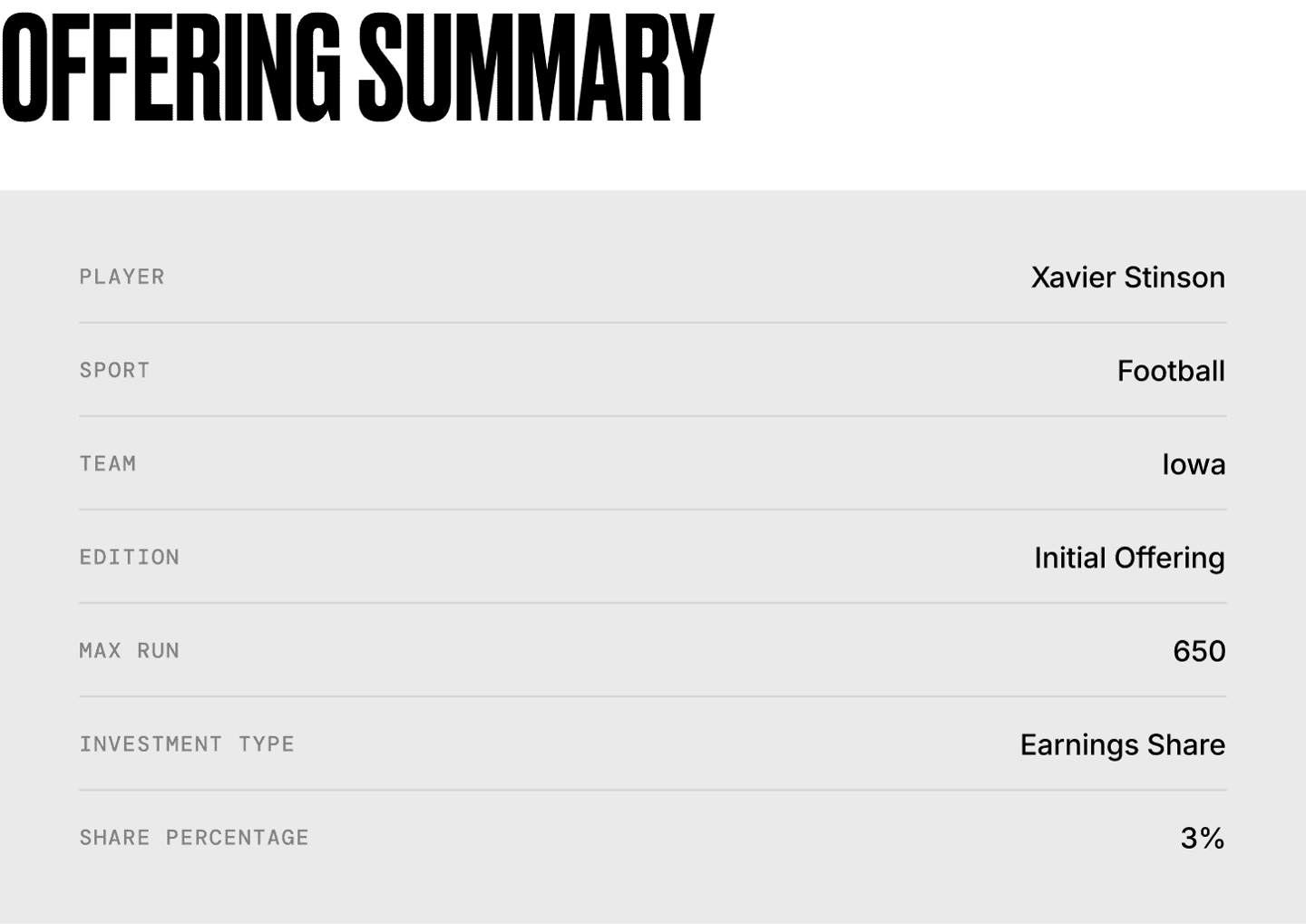
LevelUp is a new kind of sports card: a digital collectible card of a college athlete that entitles holders to a share in the athlete's future revenue. Drop 1 is a limited run of 650 cards, representing a 3% share of college career earnings of Xavier Stinson, a freshman wide receiver at Iowa. More athletes across multiple sports are already signed, with their drops to follow.

  • A new kind of sports card that shares in the athlete’s earnings
  • First limited drop: 650 cards of Iowa WR Xavier Stinson
  • Every card has a shot at pulling a numbered parallel
  • Early buyers get the lowest serials and best parallel odds
  • Founder Bud Elliott, top college football voice, creator of Blue Chip ratio
  • College athletes are estimated to earn $4.5B this season

Why Xavier


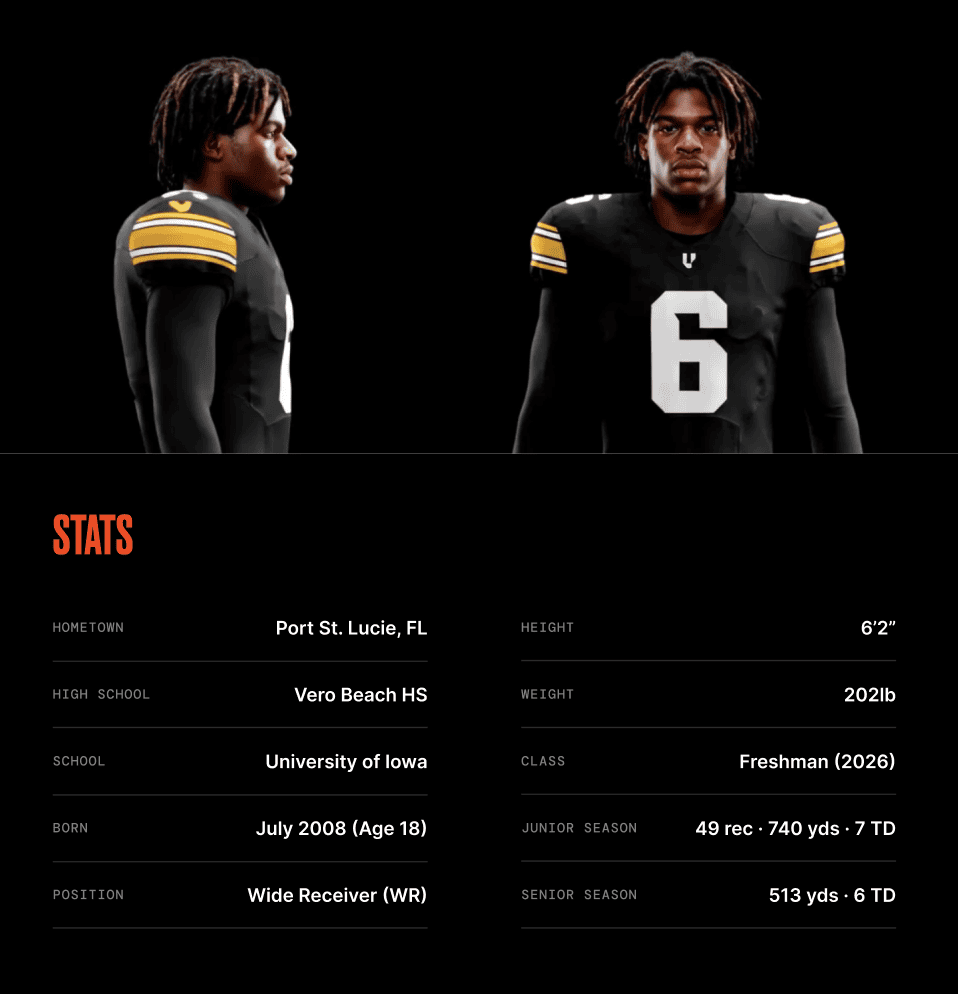
“Our data model picked out Xavier Stinson before most people were looking. He was a three-star, around the 88th receiver in his class. What the rankings didn't account for was his birthday. Xavier was born in July 2008 and was 17 for his entire first semester at Iowa, in a class where plenty of kids enroll at 19. The services grade a player on the day they watch him, so the older kid looks better and the younger kid has more left. Almost nobody prices that difference.

Our scouts saw the rest. He captained a Vero Beach team that went 14-1 and played for the Florida state title, put up 740 receiving yards as a junior and 513 as a senior, and lettered in basketball and track. He's filled out to 6-2, 202 in Iowa's strength program. Iowa has a veteran receiver room, so I'm not expecting a big 2026 from him. I think he can be a major contributor at the highest level of college football, and I'd rather be early and right than loud and wrong.”

The Player


The Cards


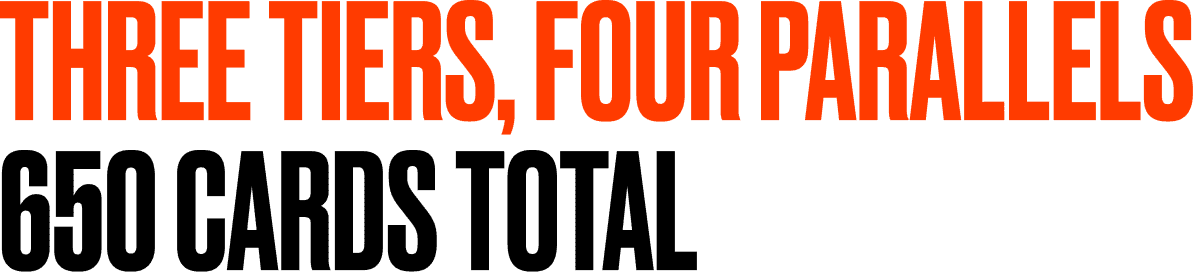
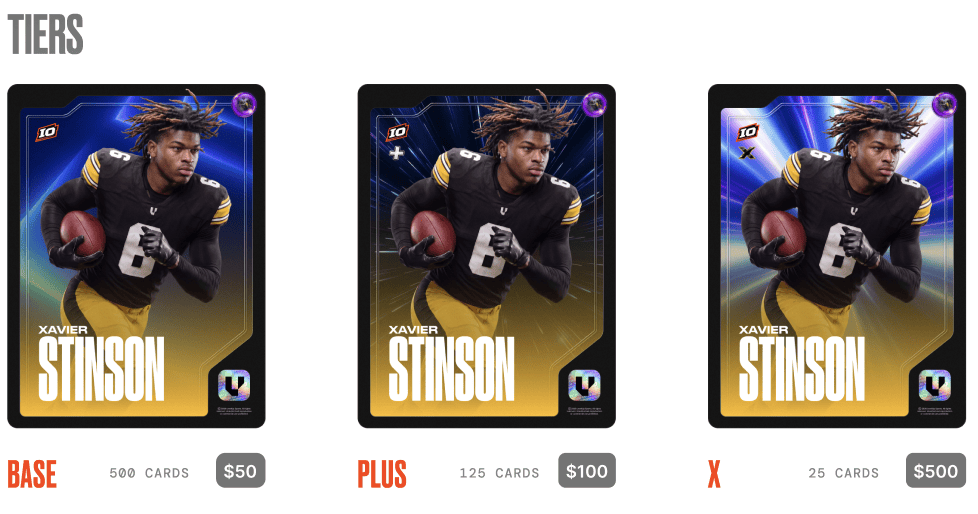
Cards will be sold in three fixed denominations: (1) BASE: a $50.00 Card representing 50 Participation Interests (up to 500 Cards, $25,000 gross at level), (2) PLUS: a $100.00 Card representing 100 Participation Interests (up to 125 Cards, $12,500 gross at level), and (3) X: a $500.00 Card representing 500 Participation Interests (up to 25 Cards, $12,500 gross at level).


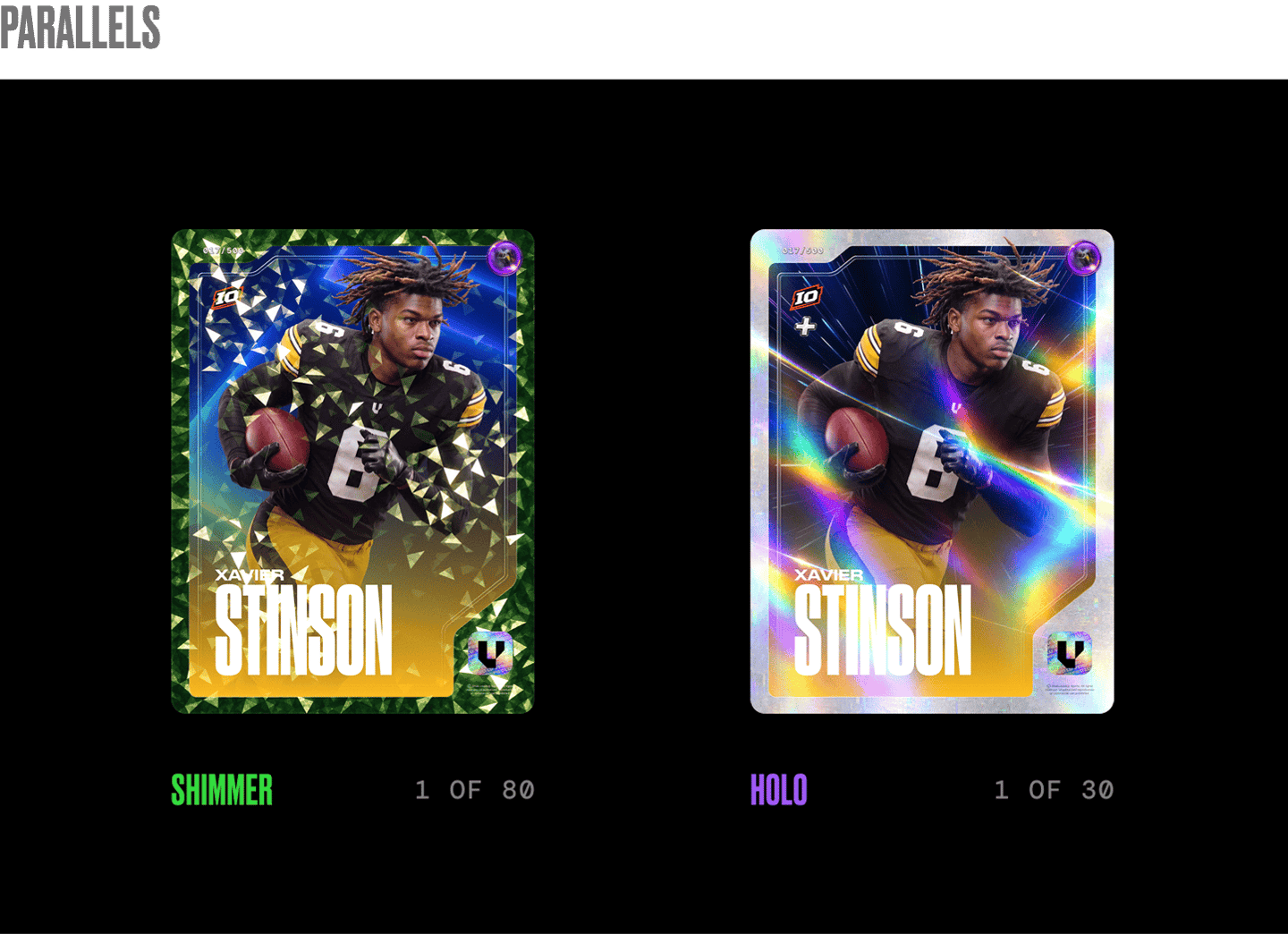
Parallels are rarer editions of the same card with their own finish and serial count: 

  • Shimmer /80
  • Holo /30
  • Eclipse /13 
  • Plate 1/1 (four made)

Every card has a shot at pulling a numbered parallel, and higher tiers pull them more often. A parallel changes the look of the card and carries the same economics as a standard card of its tier.

Every serial and parallel is fixed in a sealed deck before the drop opens and revealed after checkout. Early buyers get the lowest serials and better odds of pulling a parallel.

The Offering


Each card is a digital collectible paired with a security: a contractual revenue participation interest in Xavier's earnings.

Collect


More athletes across multiple sports are already signed, with their drops to follow. 

Join the waitlist at levelupsports.com


$

Deal terms


Minimum investment

$50

The smallest investment amount that LevelUp: Xavier Stinson is accepting.
Learn more

Maximum investment

$5,000

The largest investment amount that LevelUp: Xavier Stinson is accepting.
Learn more

Funding goal

$50K

The maximum amount the offering can raise is $50K.
Learn more

Deadline
LevelUp: Xavier Stinson needs to reach their minimum funding goal before the deadline ( ). If they don’t, all investments will be refunded.
Learn more
Type of security

Revenue Participation Agreement

Price per share

$1

How it works

Documents

Republic (OpenDeal Portal LLC, CRD #283874) is hosting this Reg CF securities offering by Level Up Collectibles, LLC. View the official SEC filing and all updates:
Official SEC Logo Form C SEC.gov
Company documents
Revenue Participation Agreement Form C- LevelUp Collectibles 2026.pdf

About LevelUp: Xavier Stinson

Legal Name
Level Up Collectibles, LLC
Founded
Aug 2026
Form
Delaware LLC
Employees
0
Website
levelupsports.com
Social Media
Headquarters
Google Map location of of LevelUp: Xavier Stinson
24 Bluewater Point Dr , Niceville, FL
Headquarters
24 Bluewater Point Dr, Niceville, FL, United States 32578

LevelUp: Xavier Stinson Team
Everyone helping build LevelUp: Xavier Stinson, not limited to employees

Profile picture of Bud Elliot
Bud Elliot
Founder & CEO
Co-host of CBS Sports' Cover 3, one of the top college football podcasts, and creator of the Blue-Chip Ratio, the recruiting measure he has tracked for fourteen years.
Bud Elliot
Founder & CEO

Press

The Midterm Predictions Were Good
·
Nov 4, 2026

Matt Levine writes about LevelUp Sports in his Money Stuff newsletter.

Bud Elliott's LevelUp Sports Plans Republic Offerings Tie...
·
Oct 29, 2026

LevelUp Sports, founded by CBS Sports' Bud Elliott, plans offerings on Republic tied to college athletes' income.

Bud Elliott's LevelUp Sports
·
Oct 29, 2026

LevelUp Sports, founded by CBS Sports' Bud Elliott, plans offerings on Republic tied to college athletes' income.

FAQ

What are the security details?

What are the security details?

The Offering includes up to 650 Cards representing up to 50,000 Participation Interests. Each Participation Interest constitutes one “unit,” which represents a fixed one fifty-thousandth (1/50,000th) of the three percent (3%) of the Athlete’s total Covered Revenue described in Section 3.1.2, and has an issue price of $1.00 (i.e., $1 = 1 unit), regardless of the number of units ultimately sold in the Offering. All Participation Interests rank pari passu regardless of the Card level, serial number, or parallel design at which they were purchased; the economics per dollar invested are identical. Cards will be sold in three fixed denominations: (1) BASE: a $50.00 Card representing 50 Participation Interests (up to 500 Cards, $25,000 gross at level), (2) PLUS: a $100.00 Card representing 100 Participation Interests (up to 125 Cards, $12,500 gross at level), and (3) X: a $500.00 Card representing 500 Participation Interests (up to 25 Cards, $12,500 gross at level). A Card’s serial number and parallel design determine its appearance only; the economics per dollar are identical for every Card. The Offering is being conducted pursuant to Section 4(a)(6) of the Act and Regulation Crowdfunding under the JOBS Act of 2012, subject to the Company’s Form C dated as of November 17, 2026 (the “Form C”). Capitalized terms used but not defined herein shall have the meaning ascribed to them in the Form C. The Investor understands that the Offering is being made without registration of the Securities under the Act (See Form C for more information).
What is a LevelUp card?

What is a LevelUp card?

A digital collectible card of a college athlete, backed by a share of what that athlete earns in college. Each card has a tier, a serial number and a print run, and some come as rarer parallels.
How do I buy a card?

How do I buy a card?

Create an account, pick a tier (Base, Plus or X) and continue to check out on Republic, the investment processing platform. You can pay with a credit card. You will need to fill out some forms and verify your identity, because this card is an actual investment. You can buy several cards and mix tiers. Your cards show up in your account right away and are issued as securities when the drop closes.

How can I earn money?

How can I earn money?

Every dollar you spend buys one unit of the athlete’s future earnings share, so an X card holds ten times what a Base card holds. As the athlete earns during their college career and LevelUp collects it, your part is paid to your wallet. You’ll be asked to set up your wallet before the first distribution.

Can I sell my card?

Can I sell my card?

After a 12-month lock-up. Federal rules restrict resale options for the first year. After that, you could transfer or sell it. LevelUp plans to build a marketplace for trading these cards in the future, though there isn’t one yet.

What happens when the athlete graduates?

What happens when the athlete graduates?

Your share runs through the athlete’s full college eligibility, redshirt and graduate years included. If they leave early for the pros, it still runs to the end of that window. After that, the card stays yours as a collectible. And we may have some perks in store for those who hold it all the way through.

What are the risks?

What are the risks?

The athlete may earn less than expected. Injury, a transfer or leaving the sport all reduce what you’re paid, possibly to nothing. Resale is restricted for 12 months, and there may be no buyer after that. Buy it as a collectible first. If it pays you along the way, think of that as a perk. The full list of risks is in the Form C on the Republic offering page.

Still have questions? Check the discussion section.
Show all FAQ

Risks

We have a limited operating history upon which you can evaluate our performance, and accordingly, our prospects must be considered in light of the risks that any new company encounters.
The Issuer is still in an early phase, and we are just beginning to implement our business plan. There can be no assurance that we will ever operate profitably. The likelihood of our success should be considered in light of the problems, expenses, difficulties, complications and delays usually encountered by early stage companies. The Issuer may not be successful in attaining the objectives necessary for it to overcome these risks and uncertainties.
There is no present market for the Securities and we have arbitrarily set the price.
The offering price was not established in a competitive market. We have arbitrarily set the price of the Securities with reference to the general status of the securities market and other relevant factors. The offering price for the Securities should not be considered an indication of the actual value of the Securities and is not based on our asset value, net worth, revenues or other established criteria of value. We cannot guarantee that the Securities can be resold at the offering price or at any other price.
The Issuer’s business depends on a small number of athletes, and the loss of, or a decline in the performance or marketability of, any one of them could materially reduce the Issuer’s revenues.
The Issuer expects to derive substantially all of its revenues from arrangements with a limited number of athletes. The Issuer’s results will therefore depend disproportionately on the individual careers, earnings and public appeal of those athletes. If any athlete fails to achieve or sustain commercial success, terminates or breaches their arrangements with the Issuer, or generates materially less income than anticipated, the Issuer’s revenues could be substantially lower than projected, and Investors could lose all or a substantial portion of their investment.
Global crises and geopolitical events, including without limitation, COVID-19 can have a significant effect on our business operations and revenue projections.
A significant outbreak of contagious diseases, such as COVID-19, in the human population could result in a widespread health crisis. Additionally, geopolitical events, such as wars or conflicts, could result in global disruptions to supplies, political uncertainty and displacement. Each of these crises could adversely affect the economies and financial markets of many countries, including the United States where we principally operate, resulting in an economic downturn that could reduce the demand for our products and services and impair our business prospects, including as a result of being unable to raise additional capital on acceptable terms, if at all.
The amount of capital the Issuer is attempting to raise in this Offering may not be enough to sustain the Issuer’s current business plan.
In order to achieve the Issuer’s near and long-term goals, the Issuer may need to procure funds in addition to the amount raised in the Offering. There is no guarantee the Issuer will be able to raise such funds on acceptable terms or at all. If we are not able to raise sufficient capital in the future, we may not be able to execute our business plan, our continued operations will be in jeopardy and we may be forced to cease operations and sell or otherwise transfer all or substantially all of our remaining assets, which could cause an Investor to lose all or a portion of their investment.
We may face potential difficulties in obtaining capital.
We may have difficulty raising needed capital in the future as a result of, among other factors, our lack of revenues from operations, the speculative nature of the Issuer’s revenue participation model, as well as the inherent business risks associated with our Issuer and present and future market conditions. Our business currently does not generate significant cash flow from operations and future sources of revenue may not be sufficient to meet our capital requirements or to fund distributions to holders of the Participation Interests. We will require additional funds to execute our business strategy and conduct our operations. If adequate funds are unavailable, we may be required to delay, reduce the scope of or eliminate one or more of our athlete relationships, marketing efforts, or other business activities, any of which may materially harm our business, financial condition and results of operations.
We may implement new lines of business or offer new products and services within existing lines of business.
As an early-stage company, we may implement new lines of business at any time. There are substantial risks and uncertainties associated with these efforts, particularly in instances where the markets are not fully developed. In developing and marketing new lines of business and/or new products and services, we may invest significant time and resources. Initial timetables for the introduction and development of new lines of business and/or new products or services may not be achieved, and price and profitability targets may not prove feasible. We may not be successful in introducing new products and services in response to industry trends or developments in technology, or those new products may not achieve market acceptance. As a result, we could lose business, be forced to price products and services on less advantageous terms to retain or attract clients or be subject to cost increases. As a result, our business, financial condition or results of operations may be adversely affected.
We rely on various intellectual property rights, including trademarks, to operate our business.
The Issuer relies on certain intellectual property rights to operate its business, including trademarks, copyrights, trade secrets, and contractual rights in athlete NIL. The Issuer’s intellectual property rights may not be sufficiently broad or otherwise may not provide us a significant competitive advantage. In addition, the steps that we have taken to maintain and protect our intellectual property may not prevent it from being challenged, invalidated, circumvented or designed- around, particularly in the NIL space where legal frameworks are new and evolving. Our athlete NIL rights are contractual and limited in scope; they do not include ownership of the athlete’s underlying publicity rights and are subject to the terms of our athlete agreements. Third parties may have pre-existing or superior rights to aspects of an athlete’s name, image or likeness, including group licensing organizations, colleges and universities, professional leagues, unions, sponsors, and other counterparties. If any of these parties asserts a superior claim, or if an athlete enters into conflicting arrangements, our rights may be limited or lost. Our failure to obtain or maintain intellectual property rights that convey competitive advantage, adequately protect our intellectual property or detect or prevent circumvention or unauthorized use of such property, could adversely impact our competitive position and results of operations.
The Issuer’s success depends on the experience and skill of the manager, its executive officers and key employees.
We are dependent on our manager, Bud Elliott, and key employees. Mr. Elliott serves as the sole manager of the Issuer and is responsible for all material business decisions, including the identification and negotiation of athlete arrangements, management of athlete relationships, and allocation of revenues and expenses. These persons may not devote their full time and attention to the matters of the Issuer, and Mr. Elliott may have other business interests, including interests in the Parent or affiliated entities. The loss of our manager or key employees could harm the Issuer’s business, financial condition, cash flow and results of operations.
Although dependent on certain key personnel, the Issuer does not have any key person life insurance policies on any such people, including on Bud Elliott.
We are dependent on certain key personnel to conduct our operations and execute our business plan, particularly Bud Elliott, who serves as the sole manager of the Issuer; however, the Issuer has not purchased any insurance policies with respect to those individuals in the event of their death or disability. Therefore, if any of these personnel die or become disabled, the Issuer will not receive any compensation to assist with such person’s absence. The loss of such person could negatively affect the Issuer and our operations. We have no way to guarantee key personnel will stay with the Issuer, as many states do not enforce non-competition agreements, and therefore acquiring key person insurance will not ameliorate all of the risk of relying on key personnel.
Damage to our reputation could negatively impact our business, financial condition and results of operations.
Our reputation and the quality of our brand are critical to our business and success in existing markets and will be critical to our success as we enter new markets. Any incident that erodes consumer loyalty to our brand could significantly reduce its value and damage our business. We may be adversely affected by any negative publicity, regardless of its accuracy. Also, there has been a marked increase in the use of social media platforms and similar devices, including blogs, social media websites and other forms of internet-based communications that provide individuals with access to a broad audience of consumers and other interested persons. The availability of information on social media platforms is virtually immediate as is its impact. Information posted may be adverse to our interests or may be inaccurate, each of which may harm our performance, prospects or business. The harm may be immediate and may disseminate rapidly and broadly, without affording us an opportunity for redress or correction.
Our business could be negatively impacted by cyber security threats, attacks and other disruptions.
We rely on information systems to manage and store proprietary information and data relating to our operations, athlete relationships, and Investor records. These systems may be subject to sophisticated malware, phishing attacks, ransomware, and other cybersecurity threats that exploit security vulnerabilities. Experienced hackers may be able to penetrate our network security and misappropriate or compromise our confidential information or that of our Athletes, Investors, or other third parties, create system disruptions, or cause shutdowns. The Intermediary, Transfer Agent, and blockchain or digital ledger infrastructure on which the Cards depend are also subject to cybersecurity risks. A disruption, infiltration or failure of our information infrastructure systems or any of our data centers as a result of software or hardware malfunctions, computer viruses, cyber-attacks, employee theft or misuse, power disruptions, natural disasters or accidents could cause breaches of data security, loss of critical data and performance delays, which in turn could adversely affect our business.
Security breaches of confidential customer information, in connection with our electronic processing of credit and debit card transactions, or confidential employee information may adversely affect our business.
Our business requires the collection, transmission and retention of personally identifiable information relating to Athletes, Investors, and other parties, in various information technology systems that we maintain and in those maintained by the Intermediary, Transfer Agent, and other third parties with whom we contract to provide services. The integrity and protection of that data is critical to us. The information, security and privacy requirements imposed by governmental regulation are increasingly demanding. Our systems may not be able to satisfy these changing requirements and customer and employee expectations, or may require significant additional investments or time in order to do so. A breach in the security of our information technology systems or those of our service providers could lead to an interruption in the operation of our systems, resulting in operational inefficiencies and a loss of confidence by Athletes or Investors. Additionally, a significant theft, loss or misappropriation of, or access to, Athlete, Investor or other proprietary data or other breach of our information technology systems could result in fines, legal claims or proceedings, including under state privacy laws and breach notification statutes.
The use of individually identifiable data by our business, our business associates and third parties is regulated at the state, federal and international levels.
The regulation of individual data is changing rapidly, and in unpredictable ways. A change in regulation could adversely affect our business, including causing our business model to no longer be viable. Costs associated with information security – such as investment in technology, the costs of compliance with consumer protection laws, and costs resulting from fraud – could cause our business and results of operations to suffer materially. Additionally, the success of our operations depends upon the secure transmission of confidential information over public networks, including blockchain and distributed ledger infrastructure. The intentional or negligent actions of employees, business associates, Athletes or third parties may undermine our security measures. As a result, unauthorized parties may obtain access to our data systems and misappropriate confidential data. There can be no assurance that advances in computer capabilities, new discoveries in the field of cryptography or other developments will prevent the compromise of our Athlete, Investor or operational data. If any such compromise of our security or the security of information residing with our business associates or third parties were to occur, it could have a material adverse effect on our reputation, operating results and financial condition. Any compromise of our data security may materially increase the costs we incur to protect against such breaches and could subject us to additional legal risk.
The Issuer is not subject to Sarbanes-Oxley regulations and may lack the financial controls and procedures of public companies.
The Issuer may not have the internal control infrastructure that would meet the standards of a public company, including the requirements of the Sarbanes-Oxley Act of 2002. As a privately-held (non-public) issuer, the Issuer is currently not subject to the Sarbanes-Oxley Act of 2002, and its financial and disclosure controls and procedures reflect its status as a development stage, non-public company. There can be no guarantee that there are no significant deficiencies or material weaknesses in the quality of the Issuer’s financial and disclosure controls and procedures. If it were necessary to implement such financial and disclosure controls and procedures, the cost to the Issuer of such compliance could be substantial and could have a material adverse effect on the Issuer’s results of operations.
We operate in a highly regulated environment, and if we are found to be in violation of any of the federal, state, or local laws or regulations applicable to us, our business could suffer.
We are subject to a wide range of federal, state, and local laws and regulations, including securities laws (including Regulation Crowdfunding), athlete-agent and sports-agent licensing requirements, anti-money laundering and know- your-customer requirements, state money transmission laws, consumer protection laws, data privacy and breach notification laws, and other laws that may apply to our business model. The regulatory landscape for NIL commercialization, revenue participation arrangements, and digital securities is new and uncertain. Regulators may conclude that aspects of our business require additional licenses, registrations, or approvals that we do not currently hold. The violation of these or future requirements or laws and regulations could result in administrative, civil, or criminal sanctions against us, which may include fines, a cease and desist order against the subject operations, rescission offers to investors, or even revocation or suspension of our license to operate the subject business. As a result, we have incurred and will continue to incur capital and operating expenditures and other costs to comply with these requirements and laws and regulations.
Injury, illness, suspension, retirement or loss of eligibility of an athlete could eliminate a source of the Issuer’s expected revenue.
Athletic careers are short and inherently uncertain. An athlete may suffer a career-limiting or career-ending injury or illness, be suspended or disqualified by a league, conference, school, governing body or anti-doping authority, lose athletic or academic eligibility, transfer institutions, go undrafted, be released or waived, or retire at any time. Any of these events could substantially or entirely eliminate the earnings stream the Issuer expects from that athlete. The Issuer may not carry, or may be unable to obtain on commercially reasonable terms, disability, career-ending or loss- of-value insurance covering these events, and any insurance the Issuer does obtain may contain exclusions, deductibles and limits that leave the Issuer materially uncompensated.
Off-field conduct, controversy or negative publicity involving an athlete could damage the value of the Issuer’s arrangements and the Issuer’s own reputation.
The commercial value of an athlete’s name, image and likeness depends heavily on public perception. Allegations or findings of misconduct, criminal charges, disciplinary proceedings, doping violations, gambling or integrity violations, litigation, social media controversy, injuries to performance-based reputation, or other negative publicity, whether or not accurate and whether or not related to the athlete’s sport, could cause sponsors, licensees and other counterparties to terminate, suspend or decline to renew arrangements. The Issuer has limited or no ability to control athlete conduct, and any resulting loss of revenue or reputational harm to the Issuer could be immediate, severe and irreversible.
The legal and regulatory framework governing name, image and likeness rights is new, inconsistent across jurisdictions and rapidly changing, and future changes could make the Issuer’s business model impracticable.
Rights to commercialize an athlete’s name, image and likeness are governed by an evolving and often inconsistent combination of state statutes and right-of-publicity laws, institutional and conference policies, national governing body and league rules (including rules of the NCAA and professional leagues), collective bargaining agreements, group licensing arrangements, and ongoing litigation and settlements, as well as possible federal legislation. Certain of these authorities restrict or prohibit arrangements that assign, pledge or share an athlete’s future earnings, that involve pay-for-play or recruiting inducements, or that involve categories of sponsors such as gambling, alcohol, cannabis or adult products. Rules may change, or may be interpreted or enforced, in ways that void, limit or require modification of the Issuer’s arrangements, disqualify participating athletes, expose the Issuer to penalties or claims, or make the Issuer’s business model impracticable, any of which could materially and adversely affect the Issuer and result in the loss of an Investor’s entire investment.
The Issuer’s arrangements with athletes may be unenforceable, voidable or subject to recharacterization under laws that were not designed for this type of business.
Agreements under which an individual shares or assigns a portion of future personal-services or licensing income may be challenged under a variety of legal theories, including laws governing contracts with minors and the disaffirmance of such contracts, statutory limits on the duration or assignability of personal services contracts, wage assignment and anti-assignment statutes, usury and lending laws, income share agreement and consumer credit regulation, unconscionability, public policy, state athlete-agent statutes and registration requirements, and unfair or deceptive trade practices laws. If any of the Issuer’s arrangements were held unenforceable, voidable, void ab initio, or were recharacterized as loans or regulated consumer financial products, the Issuer could lose its expected revenue, be required to make restitution or pay damages, penalties or fees, and be subject to regulatory enforcement, any of which could result in the total loss of an Investor’s investment.
The Athlete signed his athlete agreement and the first amendment thereto while a minor, and such agreement may be voidable.
Xavier Stinson entered into his original athlete agreement with Athlete Token, LLC, a Florida limited liability company, effective November 3, 2025, while under the age of 18. The Parent, Level Up Sports Inc., subsequently acquired the Stinson athlete agreement from Athlete Token, LLC, and the First Amendment to the athlete agreement was executed with the Parent as successor in interest to Athlete Token, LLC, effective April 1, 2026, while Xavier was still under the age of 18. The agreement is governed by Georgia law, which does not impose the custodial court approval or blocked trust requirements applicable in certain other states (e.g., California). Parental and guardian signatures were obtained at the time of execution, and the Athlete has since reached the age of majority. Under Georgia law, a contract entered into by a minor may be disaffirmed (voided) by the minor upon reaching the age of majority or within a reasonable time thereafter; however, a minor who wishes to disaffirm must restore the consideration received under the contract, and a minor who, after reaching the age of majority, fails to disaffirm and retains the consideration or benefits received is generally treated as having ratified the contract. The Athlete has not executed a formal written ratification of the Stinson Agreement since reaching the age of majority, but he has not sought to disaffirm the agreement or returned the upfront and lump-sum payments made to him. The Issuer believes that, under Georgia law, this conduct constitutes an implied ratification of the Stinson Agreement, which mitigates the risk that the agreement may be voided on the basis of the Athlete’s minority. However, implied ratification depends on facts and circumstances (including what constitutes a reasonable time after majority), the Athlete could contend that he has not ratified the agreement or that Georgia law should not apply, and a court could disagree with the Issuer’s position. Accordingly, there can be no assurance that the agreement will not be challenged. If the agreement is disaffirmed or held unenforceable, the Issuer could lose its entire expected revenue stream from this Athlete, and Investors could lose their entire investment.
The tax treatment of the Issuer and of the Securities is uncertain, and Investors may incur tax liabilities without receiving corresponding cash distributions.
The federal, state and local tax treatment of the Issuer, of the Issuer’s arrangements with athletes, and of the Securities is uncertain and may be challenged by taxing authorities. The Issuer is currently a single-member limited liability company treated as a disregarded entity of the Parent for federal income tax purposes and has not filed a separate federal income tax return. Depending on the Issuer’s classification and the characterization of its income, Investors could be allocated taxable income in a year in which they receive no cash distributions, could recognize ordinary rather than capital gain income, could be subject to withholding, and could be required to file tax returns in multiple jurisdictions. Tax information may be delivered late, and prior positions may be adjusted on audit. Each Investor should consult their own tax advisor and should not rely on any statement in this Form C as tax advice.
The Issuer may close the Offering having raised far less than the Maximum Offering Amount.
The Issuer may complete this Offering upon raising only the Target Offering Amount, which is less than the Maximum Offering Amount. If the Issuer raises only the Target Offering Amount or an amount materially below the Maximum Offering Amount, it may be unable to enter into the number or quality of athlete arrangements it contemplates, may be forced to alter or abandon its business plan, and may need to seek additional capital on unfavorable terms or cease operations. Investors will have no right to a refund on the basis that the Issuer raised less than the Maximum Offering Amount, and proceeds released to the Issuer are not held for the benefit of Investors.
The Issuer is not a party to the Stinson Agreement and depends on the Parent to perform, collect and remit amounts owed under it.
The Issuer holds only the Contributed Rights under the Contribution Agreement. The Parent remains the sole contracting party under the Stinson Agreement, retains all other rights and all obligations under it, and collects payments of the Assigned Share on the Issuer’s behalf until the Athlete and other payors are directed to pay the Issuer directly. The Athlete has not contracted with, and may not have consented to the assignment of economic rights to, the Issuer; although Athlete Token, LLC consented to the contribution under the APA Amendment, no consent of the Athlete has been obtained. Although the Contribution Agreement permits the Issuer to exercise the Enforcement Rights (including the Irrevocable Payment Direction Letters, the limited power of attorney for collections and the security interest under the Stinson Agreement) in its own name, the Athlete or a court may not recognize the Issuer’s right to do so, in which case the Issuer would depend on the Parent to exercise those rights at the Issuer’s direction. As of the date of this Form C, no UCC-1 financing statement has been filed by Athlete Token, LLC, the Parent or the Issuer with respect to the security interest granted under the Stinson Agreement, and the security interest is therefore unperfected. The Issuer is not currently required to file a financing statement, but retains the right to do so (or to cause the Parent to do so) at any time in its discretion, and there can be no assurance that it will do so. Until a financing statement is filed, the security interest may be subordinate to the rights of other secured creditors, lien creditors or a bankruptcy trustee of the Athlete, which could limit its value as a means of enforcing payment of the Assigned Share. If the Parent fails to perform its obligations under the Stinson Agreement, the Athlete may assert defenses, setoffs or counterclaims that reduce or eliminate payments of the Assigned Share. The Parent is required to hold collected amounts in trust for the Issuer and remit them within five (5) business days after receipt, but if the Parent fails to remit collected amounts, commingles them with its own funds, becomes insolvent, or enters into amendments or waivers of the Stinson Agreement, the Issuer’s ability to receive Covered Revenue could be impaired, and the trust arrangement may not be respected in a bankruptcy or insolvency of the Parent. The Contribution Agreement is between affiliates under common control, has not been negotiated at arm’s length, may be amended by a written instrument signed by the Parent and the Issuer, and confers no rights on Investors, who are not third-party beneficiaries and will have no ability to enforce it.
f the Parent becomes subject to bankruptcy, receivership or similar proceedings, amounts collected in respect of the Assigned Share could become part of the Parent’s estate, and the Issuer (and therefore Investors) could be treated as general unsecured creditors.
The Issuer’s rights to the Assigned Share are equitable or assigned rights derived from the Contribution Agreement, and the Issuer is not in privity of contract with the Athlete. Until the Athlete and other payors are directed to pay the Issuer directly, payments of the Assigned Share are made to the Parent, which holds them in trust for the Issuer but is not required to deposit them into a segregated account. If Level Up Sports Inc. files for protection under Chapter 11 (or Chapter 7) of the U.S. Bankruptcy Code, becomes subject to a receivership, assignment for the benefit of creditors or similar proceeding, or otherwise becomes insolvent, a bankruptcy trustee, debtor-in-possession, receiver or creditor of the Parent could contend that the contribution of the Contributed Rights should be recharacterized, avoided as a fraudulent transfer (including because no consideration was paid by the Issuer) or disregarded, or that collected amounts that have been commingled with the Parent’s other funds cannot be traced and do not constitute trust property. In that event, those amounts, and potentially the Assigned Share itself, could be treated as property of the Parent’s estate, the automatic stay could delay or prevent the Issuer from receiving or enforcing payments for an extended period, and the Issuer could be left with only a general unsecured claim against the Parent, recoverable, if at all, pro rata with the Parent’s other unsecured creditors. Because Investors hold only contractual rights against the Issuer and have no direct claim against the Parent or the Athlete, any such delay, reduction or loss would reduce or eliminate distributions to Investors, and Investors, who are predominantly retail investors, could lose all or a substantial portion of their investment. The Issuer and the Parent are under common control, and the Issuer may be reluctant or unable to pursue claims against the Parent in such a proceeding.
The Stinson Agreement contains confidentiality, characterization and other provisions that may expose the Athlete, the Parent and the Issuer to eligibility, compliance and enforceability risk.
The Stinson Agreement requires the Athlete to keep the agreement confidential and not to disclose it to school compliance departments, athletic staff, agents, collectives or others without the Parent's prior written authorization, states that the agreement is not an NIL deal, and provides that the Athlete shall not report it as NIL activity to any compliance office or clearinghouse unless directed in writing. The Stinson Agreement also disclaims any representation that it complies with NCAA or other governing body rules and places responsibility for compliance on the Athlete. If school, conference, NCAA, College Sports Commission or state authorities determine that the arrangement should have been disclosed or reported, the Athlete could face eligibility consequences and the arrangement could be challenged, restricted or unwound.
The Issuer depends on athletes and third parties to report and remit amounts owed, and the Issuer may have limited practical ability to audit or collect.
Amounts owed to the Issuer may depend on athletes, their agents, marketing representatives, collectives, schools, leagues or licensees accurately reporting and timely remitting income. These parties may fail to report, may under- report, may deduct expenses or commissions the Issuer disputes, may structure compensation in forms that fall outside the Issuer’s arrangements (including equity, in-kind benefits, or payments to affiliates or family members), or may simply refuse or be unable to pay. The Issuer’s audit, information and enforcement rights may be limited, and litigation or arbitration against an athlete or a third party would be costly, slow, publicly damaging and of uncertain outcome. Any judgment the Issuer obtains may be uncollectible.
The Issuer’s management and its affiliates are subject to conflicts of interest, including in connection with other ventures, athletes and clients.
The Issuer’s management and its affiliates may organize, manage or hold interests in other projects, funds, collectives or ventures that pursue arrangements with athletes, and may also provide agency, marketing, representation, advisory or other services to athletes, schools, collectives or sponsors. As a result, management may face conflicts in allocating athletes, opportunities, personnel, time and expenses among the Issuer and those other ventures, in negotiating terms with athletes who are also clients, and in determining whether and when to enforce the Issuer’s rights. Management may receive fees, carried interests, commissions or other compensation from persons other than the Issuer. These conflicts may be resolved in a manner that is not in the best interests of Investors, and Investors will have no ability to approve, remove or replace management or to require that a conflict be resolved in a particular way.
The Issuer’s business is concentrated in the sports and entertainment industry, which is cyclical, competitive and subject to disruption.
The Issuer has no diversification outside the sports and entertainment industry. Reductions in sponsorship and marketing budgets, declines in media rights values, changes in audience attention or platform algorithms, work stoppages, lockouts, strikes, conference realignment, league expansion or contraction, scheduling disruptions, and general economic downturns could each materially reduce the income available to the athletes with whom the Issuer contracts. The market for athlete-related investment and NIL funding is also increasingly competitive and includes collectives, agencies, brands, private funds and well-capitalized institutions, many of which have greater financial, marketing and relationship resources than the Issuer. Competition may require the Issuer to accept less favorable economic terms or may prevent the Issuer from entering into arrangements with desirable athletes at all.
The Issuer may be exposed to litigation, indemnification obligations and uninsured liabilities arising from its arrangements with athletes and third parties.
The Issuer may become subject to claims by or relating to athletes, their families, agents, schools, conferences, leagues, collectives, sponsors, licensees, competitors or regulators, including claims for breach of contract, tortious interference, right of publicity or trademark infringement, misappropriation, unfair competition, defamation, violation of athlete-agent or consumer protection statutes, and claims relating to the Issuer’s marketing of this Offering. The Issuer may have agreed, or may be required, to indemnify athletes, its managers, officers, the Intermediary or other parties against such claims. The Issuer’s insurance, if any, may be inadequate, unavailable or subject to exclusions. Defense costs alone, even for claims that lack merit, could consume a substantial portion of the proceeds of this Offering and materially impair the Issuer’s ability to operate.
The Issuer is a recently formed entity with no operating history and no meaningful historical financial statements.
The Issuer was recently organized for the purpose described in this Form C and has conducted no substantial operations. Accordingly, the historical financial information in this Form C is limited or not meaningful, has not been audited, and provides no basis for evaluating the Issuer’s prospects. Any projections, targets, illustrative returns or modeled athlete earnings that Investors may have seen, whether on the Deal Page, in marketing materials or elsewhere, are forward-looking, are based on assumptions that may prove materially incorrect, and are not guarantees. Actual results may differ materially and may be zero.
The U.S. Securities and Exchange Commission does not pass upon the merits of the Securities or the terms of the Offering, nor does it pass upon the accuracy or completeness of any Offering document or literature.
You should not rely on the fact that our Form C is accessible through the U.S. Securities and Exchange Commission’s EDGAR filing system as an approval, endorsement or guarantee of compliance as it relates to this Offering. The U.S. Securities and Exchange Commission has not reviewed this Form C, nor any document or literature related to this Offering.
Neither the Offering nor the Securities have been registered under federal or state securities laws.
No governmental agency has reviewed or passed upon this Offering or the Securities. Neither the Offering nor the Securities have been registered under federal or state securities laws. Investors will not receive any of the benefits available in registered offerings, which may include access to quarterly and annual financial statements that have been audited by an independent accounting firm. Investors must therefore assess the adequacy of disclosure and the fairness of the terms of this Offering based on the information provided in this Form C and the accompanying exhibits.
The Issuer’s management may have broad discretion in how the Issuer uses the net proceeds of the Offering.
Unless the Issuer has agreed to a specific use of the proceeds from the Offering, the Issuer’s management will have considerable discretion over the use of proceeds from the Offering. You may not have the opportunity, as part of your investment decision, to assess whether the proceeds are being used appropriately.
The fees paid by the Issuer to the Intermediary may reduce the proceeds available to the Issuer.
At the conclusion of the Offering, the Issuer shall pay the Intermediary a fee of three percent (3%) of the dollar amount raised in the Offering. The compensation paid by the Issuer to the Intermediary may impact how the Issuer uses the net proceeds of the Offering.
The Issuer has the right to amend the limits on individual Investors’ commitment amounts based on the Issuer’s determination of an Investor’s sophistication.
The Maximum Individual Purchase Amount is not to exceed $5,000 per Investor. The Issuer may amend the Maximum Individual Purchase Amount and prevent any Investor from committing more than a certain amount in this Offering based on the Issuer’s determination of the Investor’s sophistication and ability to assume the risk of the investment. This means that your desired investment amount may be limited or lowered based solely on the Issuer’s determination and not in line with relevant investment limits set forth by the Regulation CF rules. This also means that other Investors may receive larger allocations of the Offering based solely on the Issuer’s determination.
The Issuer has the right to extend the Offering Deadline.
The Issuer may extend the Offering Deadline beyond what is currently stated herein. This means that your investment may continue to be held in escrow while the Issuer attempts to raise the Target Offering Amount even after the Offering Deadline stated herein is reached. While you have the right to cancel your investment in the event the Issuer extends the Offering Deadline, if you choose to reconfirm your investment, your investment will not be accruing interest during this time and will simply be held until such time as the new Offering Deadline is reached without the Issuer receiving the Target Offering Amount, at which time it will be returned to you without interest or deduction, or the Issuer receives the Target Offering Amount, at which time it will be released to the Issuer to be used as set forth herein. Upon or shortly after the release of such funds to the Issuer, the Securities will be issued and distributed to you.
The Issuer may also end the Offering early.
If the Target Offering Amount is met after twenty-one (21) calendar days, but before the Offering Deadline, the Issuer can end the Offering by providing notice to Investors at least five (5) business days prior to the end of the Offering. This means your failure to participate in the Offering in a timely manner may prevent you from being able to invest in this Offering – it also means the Issuer may limit the amount of capital it can raise during the Offering by ending the Offering early.
The Issuer has the right to conduct multiple closings during the Offering.
If the Issuer meets certain terms and conditions, an intermediate close (also known as a rolling close) of the Offering can occur, which will allow the Issuer to draw down on Investor proceeds committed and captured in the Offering during the relevant period. The Issuer may choose to continue the Offering thereafter. Investors should be mindful that this means they can make multiple investment commitments in the Offering, which may be subject to different cancellation rights. For example, if an intermediate close occurs and later a material change occurs as the Offering continues, Investors whose investment commitments were previously closed upon will not have the right to re-confirm their investment as it will be deemed to have been completed prior to the material change.
A substantial portion of the proceeds of the Offering will be used to pay fees, compensation and expenses, including amounts payable to the Intermediary and to related persons, rather than deployed into the Issuer’s business.
In addition to the cash commission payable to the Intermediary described under “Commission and Fees,” the Issuer expects to pay legal, accounting, escrow, custody, marketing, formation and ongoing administrative costs, and may pay management, servicing, sourcing, acquisition or performance-based fees to its manager, sponsor or their affiliates. These amounts are payable regardless of whether the Issuer is profitable and regardless of whether Investors receive any return. As a result, the amount of proceeds actually available to deploy into the Issuer’s business will be materially less than the amount Investors contribute, and the Issuer’s management has broad discretion to determine which expenses to pay and in what order.
Investors must rely on the information in this Form C and should not rely on the Deal Page, marketing materials, third-party commentary or statements by athletes.
This Offering may be promoted through the Deal Page, social media, podcasts, press coverage, and posts or endorsements by athletes, influencers or other persons who may be compensated and whose statements the Issuer does not control and has not verified. Such communications may be incomplete, inaccurate, outdated or inconsistent with this Form C, and may not include required disclosures or disclaimers. Investors should rely only on the information contained in this Form C and its exhibits in making an investment decision. Nothing in any promotional communication constitutes a guarantee of performance, and the Issuer disclaims responsibility for statements made by any person that are not contained in this Form C.
Investors will not have voting rights.
In connection with investing in this Offering to purchase Participation Interests, Investors will not have voting or other governing rights in the Issuer. Thus, by participating in the Offering, Investors will not be able to vote upon matters related to the governance and affairs of the Issuer nor take or effect actions that might otherwise be available to members of the Issuer. Investors should not participate in the Offering unless they understand their lack of voting and governance rights in the Issuer.
The Securities will not be freely tradable under the Securities Act until one year from when the securities are issued. Although the Securities may be tradable under federal securities law, state securities regulations may apply, and each Investor should consult with their attorney.
You should be aware of the long-term nature of this investment. There is not now a public market for the Securities, and one may never develop. Because the Securities have not been registered under the Securities Act or under the securities laws of any state or foreign jurisdiction, the Securities have transfer restrictions and cannot be resold in the United States except pursuant to Rule 501 of Regulation Crowdfunding. Permitted transfers include transfers to the Issuer, to accredited investors, as part of a registered offering, or to family members, trusts, or in connection with death or divorce. In addition, the Securities (and the Cards evidencing them) may be transferred only to U.S. Investors, and any purported transfer to a person who is not a U.S. Investor will be void and will not be recorded on the official ledger; this restriction will further limit the pool of potential buyers. It is not currently contemplated that registration under the Securities Act or other securities laws will be effected. Limitations on the transfer of the Securities may also adversely affect the price that you might be able to obtain for the Securities in a private sale. Even after the one-year holding period expires, there may be no willing buyers, and the athlete-specific and non-fungible characteristics of the Cards may make it difficult to find a buyer willing to pay a fair price. Investors should be aware of the long-term nature of their investment in the Issuer. Each Investor in this Offering will be required to represent that they are a U.S. Investor and are purchasing the Securities for their own account, for investment purposes and not with a view to resale or distribution thereof.
Investors will not be entitled to any inspection or information rights other than those required by law.
Investors will not have the right to inspect the books and records of the Issuer or to receive financial or other information from the Issuer, other than as required by law. Other security holders of the Issuer may have such rights. Regulation CF requires only the provision of an annual report on Form C-AR and no additional information. Additionally, there are numerous methods by which the Issuer can terminate annual report obligations, resulting in no information rights, contractual, statutory or otherwise, owed to Investors. This lack of information could put Investors at a disadvantage in general and with respect to other security holders, including certain security holders who have rights to periodic financial statements and updates from the Issuer such as quarterly unaudited financials, annual projections and budgets, and monthly progress reports, among other things.
Investors will be unable to declare the Security in “default” and demand repayment.
Unlike debt securities, the Securities do not have any “default” provisions upon which Investors will be able to demand repayment of their investment. The Issuer’s obligation to make payments is contingent on the actual collection of Covered Revenue and subject to the payment waterfall described in this Form C and the Instrument. Amounts billed, invoiced, or owed by the Athlete or any third party but not collected will not be distributed to Investors. If the Issuer does not collect Covered Revenue, Investors will receive nothing. Investors have no right to accelerate payment, no right to demand repayment of their Participation Purchase Price, and no right to put the Securities back to the Issuer.
While the Securities provide mechanisms whereby holders of the Securities would be entitled to a contractual revenue participation interest in Covered Revenue collected by the Issuer, if the Issuer does not have sufficient cash on hand, this obligation may not be fulfilled.
Upon the occurrence of certain events, as provided in the Securities, holders of the Securities may be entitled to a contractual revenue participation interest. Despite the contractual provisions in the Securities, this right cannot be guaranteed if the Issuer does not have sufficient liquid assets on hand. Therefore, potential Investors should not assume a guaranteed return of their investment amount. Investors should not assume that revenue received by the Issuer will be passed through to them. Investors have no direct claim against any athlete, agent, school, league, collective, sponsor or other counterparty, and no lien, security interest or other rights in any contract or asset of the Issuer, including the Contributed Rights and the security interest under the Stinson Agreement included in the Enforcement Rights.
There is no guarantee of a return on an Investor’s investment.
There is no assurance that an Investor will realize a return on their investment or that they will not lose their entire investment. For this reason, each Investor should read this Form C and all exhibits carefully and should consult with their attorney and business advisor prior to making any investment decision.
The Issuer may organize additional Classes, offerings, or entities, and Investors will have no interest in, or protection against, those Classes, offerings, or affiliated entities.
The Issuer intends to issue additional Classes of Participation Interests relating to additional Athletes under subsequent Form C filings or other offerings. Investors in this Class will have no interest in, and no right to participate in, any future Class relating to a different Athlete, even if that Athlete generates substantially greater Covered Revenue than the Athlete associated with their Class. The Issuer’s management and its affiliates may also form additional ventures, funds, or entities that pursue the same or similar athlete arrangements, potentially on terms more favorable than those available to the Issuer or to Investors in this Class. Investors will have no right to co-invest, no right to exchange their Participation Interests for interests in another Class, and no protection against the diversion of Athletes, opportunities, personnel, or resources to other Classes or affiliated entities. Assets, liabilities, expenses, and personnel may be shared or allocated among Classes and affiliated entities in a manner determined by management in its discretion, and Investors will bear the risk that such allocations are unfavorable to their Class.
The price of the Securities was determined by the Issuer and may bear no relationship to the value of the Issuer’s assets or prospects.
The price of the Securities was set by the Issuer without negotiation with Investors, without an independent valuation or fairness opinion, and without reference to any established methodology. The Issuer’s value is inherently speculative and may prove to be zero. There is no assurance that the revenues generated by the Issuer’s NIL arrangements will be sufficient to provide any return on an Investor’s investment.
Investors depend on third-party service providers, including the Intermediary and the Escrow Agent, over whom the Issuer has no control.
The Offering and the holding of the Securities depend on the continued operation and solvency of the Intermediary (Republic), the Escrow Agent, and the Transfer Agent (Upside Platform Inc.). The Transfer Agent maintains the official ownership ledger for the Securities and facilitates transfers. Investors hold the Securities in self-custody through their own digital wallets. If any of the Intermediary, the Escrow Agent, or the Transfer Agent ceases operations, becomes insolvent, loses required registrations or licenses, suffers a cybersecurity incident, fails to maintain accurate records, or fails to perform its obligations, Investors may experience delays, may be unable to establish or verify ownership of their beneficial interests, may lose access to their Cards or wallets, may incur costs to transfer to a successor, and may be unable to realize any value from the Securities. None of these parties has evaluated the merits of this Offering, and the Issuer has no control over their operations or their fees, which may change. The Intermediary and Transfer Agent may impose additional terms, conditions, or fees on Investors that the Issuer does not control.
Each Class of Participation Interests is Athlete-specific, and Investors bear a concentrated risk in a single Athlete’s career and earnings.
Each Class of Participation Interests participates only in the Covered Revenue of the specific Athlete depicted on the Investor’s Card. Investors in one Class do not participate in, and have no claim to, revenues generated by Athletes in any other Class. As a result, Investors bear a concentrated risk in a single individual’s NIL earnings, career trajectory, health, eligibility, public image, and commercial appeal. Athlete-specific Classes are maintained contractually and in the Issuer’s accounting records rather than through separate legal entities or registered series under the Delaware Limited Liability Company Act. All Classes are issued by the same LLC. The assets of the Issuer are contained within a single entity: without registered series, there is no statutory segregation of assets or liabilities between Classes. A creditor of the Issuer, or a holder of one Class pressing a claim, could in principle reach amounts attributable to another Athlete’s Class. The Issuer intends to maintain class-level accounting and may include contractual provisions intended to limit cross-class claims, but such provisions may not be enforceable against third parties or in insolvency, and no statutory protection exists. If the Athlete associated with an Investor’s Class fails to generate meaningful Covered Revenue, is injured, retires, is suspended, becomes ineligible, or otherwise ceases to produce NIL income, Investors in that Class may receive little or no return and could lose their entire investment, regardless of the performance of Athletes in other Classes.
The contractual Class structure has not been tested in litigation or insolvency, and Investors may have less protection than they would in a registered series LLC or separate legal entity.
The Issuer has chosen to maintain Athlete-specific Classes through contractual provisions and internal accounting rather than through the formation of separate legal entities or the use of the registered series structure available under the Delaware Limited Liability Company Act. A registered series LLC provides statutory asset segregation such that the assets of one series are not available to satisfy the liabilities of another series or of the LLC itself. The Issuer’s contractual Class structure does not provide the same statutory protection. No court has ruled on the enforceability of the Issuer’s contractual Class provisions, and there is no assurance that such provisions would be respected by a bankruptcy court, state court, or creditor. In the event of the Issuer’s insolvency, creditors of the Issuer or claimants from other Classes could seek to reach assets or revenues attributable to an Investor’s Class, and there can be no assurance that such claims would be unsuccessful. Investors should assume that their investment is subject to the credit risk of the Issuer as a whole, not merely to the performance of their Athlete.
The Card is a visual representation of the Security, not the Security itself, and technical failures or disputes involving the Card may affect Investors’ ability to prove or transfer ownership.
Each Participation Interest is evidenced by a digital Card that bundles a fungible security token with a non-fungible visual Card image. The Card is a visual and ledger representation of the Investor’s economic interest; it is not, standing alone, the security. The official ownership ledger maintained by the Transfer Agent controls all legal rights and ownership. Investors hold Securities in self-custody in their own digital wallets. If there is a conflict between a Card, wallet metadata, or platform display and the official ledger, the official ledger governs. Technical failures, blockchain network disruptions, wallet compromises, lost or forgotten credentials, unauthorized transfers, or errors in metadata could cause Investors to lose access to their Cards or to be unable to prove or transfer their ownership. The Issuer and the Transfer Agent may not be able to reverse unauthorized transfers or restore lost credentials, and Investors may bear the loss. The Card’s non-fungible characteristics and serialization may also make it more difficult to transfer or sell than a fungible security.
The Issuer may terminate, amend, or consolidate Classes, and Investors may have no vote or consent right.
Under the Instrument, any term of the Instrument, including the definition of Covered Revenue, the payment waterfall, the Payment Cap, the Term, or other material provisions, may be amended, terminated or waived with the written consent of the Issuer and either (a) the Lead Investor, if any, or (b) the holders of a majority in interest of the Participation Interests issued in the Offering and then outstanding. “Lead Investor” means the single Investor, if any, designated in writing by the Issuer as the lead investor for the Offering who (i) has committed to purchase, and has purchased, Participation Interests with an aggregate purchase price of not less than ten percent (10%) of the Target Offering Amount, and continues to hold Participation Interests representing not less than ten percent (10%) of the Participation Interests issued in the Offering and then outstanding; (ii) has negotiated the principal terms of the Instrument and the Offering with the Issuer, on its own behalf and for the benefit of all Investors; (iii) coordinates communications between the Issuer and the other Investors with respect to the Instrument; and (iv) has been identified as such in the Offering materials. The Lead Investor acts in its own capacity as a holder of Participation Interests, owes no fiduciary or other duty to any other Investor, and has no authority to bind any other Investor except as expressly provided in the Instrument. If the Lead Investor ceases to satisfy the criteria in clause (i), it will cease to be the Lead Investor, and no successor Lead Investor will be designated without the consent of the holders of a majority in interest of the Participation Interests issued in the Offering and then outstanding. Any such amendment, termination or waiver will be binding on all holders of Participation Interests, whether or not they consented, provided that it applies to all holders in the same fashion; an amendment that is materially and disproportionately adverse to an Investor relative to other holders also requires that Investor’s written consent. The Issuer may also have the ability to consolidate multiple Classes, split a Class, or terminate a Class prior to the expiration of its stated term if certain conditions are met. Investors will have no voting or consent rights with respect to the Issuer’s governance, and may have limited rights with respect to amendments or structural changes affecting their Class. Any such amendment, consolidation, or termination could materially and adversely affect the value of an Investor’s Participation Interests and the amounts distributable to them.
Allocations of shared expenses, personnel, and resources among Classes are made by management in its discretion, and may be unfavorable to an Investor’s Class.
The Issuer incurs expenses that benefit multiple Classes or the Issuer as a whole, including personnel costs, legal and accounting fees, technology and infrastructure expenses, marketing costs, and overhead. These shared expenses must be allocated among Classes. The Issuer’s management has discretion to determine the method and amount of such allocations, and there is no assurance that the allocation methodology will be consistent, transparent, or favorable to any particular Class. Expenses allocated to a Class are borne out of the Issuer’s retained share of the applicable Assigned Share and do not reduce the Class’s percentage of the Athlete’s total Covered Revenue; however, a disproportionate allocation could deplete the Issuer’s retained share and other resources and impair the Issuer’s ability to continue collecting and distributing Covered Revenue for that Class. Investors have no right to approve or challenge expense allocations, and will bear the risk that allocations are made in a manner that favors other Classes, the Parent, or management.
The performance of one Class may create liabilities or reputational harm that affects all Classes.
Because all Classes are issued by the same Issuer, adverse events affecting one Athlete or Class may create liabilities, expenses, or reputational harm that affects the Issuer as a whole and, by extension, all Classes. For example, if an Athlete associated with one Class becomes subject to litigation, regulatory action, controversy, or reputational damage, the Issuer may incur defense costs, settlements, or judgments that are paid from the Issuer’s general assets, potentially reducing amounts available for distribution to Investors in other Classes. Similarly, negative publicity involving one Athlete could damage the Issuer’s brand and its ability to attract and retain other Athletes, Investors, or business partners. Investors in a Class have no control over the conduct of Athletes in other Classes and bear the risk that events beyond their Athlete’s performance could impair the value of their investment.
Investors have no ability to transfer their investment to a different Athlete’s Class or to exchange Classes.
Each Investor’s Participation Interests are tied to a specific Athlete’s Class and cannot be exchanged, converted, or transferred to a different Athlete’s Class. If an Investor’s Athlete underperforms, retires, or otherwise generates less Covered Revenue than Athletes associated with other Classes, the Investor has no right to participate in the revenues of those other Classes and no right to exchange their Participation Interests for interests in a more successful Class. The only way for an Investor to obtain exposure to a different Athlete is to purchase Participation Interests in that Athlete’s Class in a separate transaction, subject to availability and the Investor’s compliance with applicable securities laws. Investors should assume that their investment is permanently tied to the performance of a single Athlete.
If the Securities are recharacterized as equity interests for tax purposes, materially adverse consequences would result for the Issuer and Investors.
The Issuer intends to treat the Securities as contractual revenue participation interests rather than equity interests for tax purposes. The contractual Class structure is intended to support the characterization of each Class as a separate contractual arrangement rather than a partnership interest in the Issuer. However, if the Internal Revenue Service or a court were to recharacterize the Securities as equity interests in the Issuer, the LLC would be treated as a partnership with multiple members, and each Investor — across all Classes — would receive a Schedule K-1 and would be required to report their allocable share of the Issuer’s income, gain, loss, deductions, and credits on their personal tax returns regardless of whether any cash distributions are received. Recharacterization could also trigger nonresident owner withholding obligations in multiple states, composite filing requirements, and other material tax and administrative burdens for both the Issuer and Investors. No ruling has been requested from the IRS regarding the tax treatment of the Securities or the Class structure, and no assurance can be given that the intended tax treatment will be sustained.
Payments to Investors depend entirely on the collection of Covered Revenue, and Investors may receive less than their full entitlement, or nothing, if Covered Revenue is not collected.
Investors in this Class are entitled to their pro rata share of three percent (3%) of the Athlete’s Covered Revenue, with each Participation Interest carrying a fixed one fifty-thousandth (1/50,000th) of such three percent (3%), payable out of the Assigned Share solely to the extent of Collected Revenue. If fewer than all Participation Interests in this Class are sold, Investors will collectively receive less than three percent (3%) of the Athlete’s Covered Revenue, and the portion attributable to unsold Participation Interests will be retained by the Issuer. Permitted taxes, third-party expenses, reserves, contractual deductions, and any disclosed parent or servicing fee payable to Level Up Sports Inc. or its affiliates are borne solely out of the Issuer’s retained share of the Assigned Share (for this Class, at least eight percent (8%) of the Athlete’s total Covered Revenue, plus the portion of the three percent (3%) attributable to any unsold Participation Interests) and do not reduce the amounts distributable to Investors. Even if the Athlete earns substantial income, Investors will receive less than their expected share if amounts owed are not collected, and Investors will receive nothing if no Covered Revenue is collected . Investors have no right to audit or approve expenses or allocations, no right to challenge the allocation of amounts to the Athlete, the Parent, or other Classes, and no recourse if amounts are not collected.
The economic rights associated with the Securities terminate upon reaching the payment cap, term, or other specified endpoint, after which Investors will have no further financial rights.
The Securities terminate upon the earliest to occur of: (i) aggregate payments on such Securities, to the Investor and all prior holders, equal to the Payment Cap (i.e., $5.00 per Participation Interest); (ii) the expiration of the Term, once all Covered Revenue earned during the Term has been collected and distributed or the collection tail period provided in the Stinson Agreement has expired; (iii) the death of the Athlete; or (iv) the extinguishment of the Athlete’s payment obligation under the applicable athlete agreement, including by reason of the disaffirmance, rescission, or final determination of unenforceability of such agreement. Upon termination, all revenue and payment rights are extinguished, the underlying Participation Interests are cancelled and retired, and the Card survives solely as a collectible item with no economic, governance, or redemption rights. Investors should not expect to receive any further financial return from a terminated Security, regardless of any increase in the Athlete’s subsequent earnings or the Card’s collectible value. The total amount an Investor can receive is capped at the remaining Payment Cap balance of the Investor’s Participation Interests (reduced by any payments made to prior holders) and may be substantially less than such amount.
Parallel Card designs and collector perks are cosmetic only and do not affect financial returns, but some Investors may receive different items than others.
Cards may feature variant or parallel designs, and some Investors may receive a parallel Card design. Parallel designs are cosmetic variants in four designs of ascending rarity (Shimmer, Holo, Eclipse and Plate); they do not alter the economic terms of the underlying Participation Interests and do not entitle the holder to any additional financial rights or different payment streams. Each Card’s serial number and design are fixed in a deck generated by the Issuer before the Offering opens and are assigned at checkout in the order Investors commit through the Intermediary. The deck, and the pre-generated arrangements used to rearrange the remaining Cards when the Early Block ends, are generated and held by the Issuer. Investors who commit during the Early Block receive improved parallel odds, and Investors who commit later, or whose commitments are reconfirmed or re-made after a cancellation, may have lower odds of receiving a parallel. Published odds, print runs, and parallel counts are maximum figures, and the actual number of parallels issued may be lower if fewer than all Cards are sold. Perks associated with this Offering are limited to platform-based features and experiences delivered through the Issuer’s platform. Perks do not include any direct or personal access to, private communications with, or personal deliverables from the Athlete. The Issuer may introduce additional platform-based perks in the future, but no additional perks are promised or guaranteed. Perks are non- transferable, subject to availability, and may be modified, substituted, or discontinued by the Issuer without Investor consent. Investors should not purchase the Securities based on the expectation of receiving any particular Card design or perk.
The definition of “Covered Revenue” is contractual and may exclude significant sources of an Athlete’s income.
Investors in a Class participate only in “Covered Revenue” as defined in the Instrument for that Class. The definition of Covered Revenue may differ among Classes and may exclude significant sources of an Athlete’s income, including: income from contracts entered into before the Athlete’s arrangement with the Issuer; income from sources outside the Athlete’s sport; income characterized as salary, wages, prize money, bonuses, or employment compensation rather than NIL income; income received by the Athlete’s family members, affiliated entities, or representatives; in-kind benefits, equity compensation, or deferred compensation; and income from sources or categories not specifically enumerated in the definition. The Athlete has no obligation to maximize Covered Revenue and may structure future arrangements in ways that minimize amounts owed to the Issuer. The Issuer’s ability to audit, verify, or challenge the Athlete’s characterization of income may be limited. As a result, Investors in a Class may participate in only a fraction of that Athlete’s actual earnings, and the Covered Revenue definition for one Class may be more or less favorable than the definition for another Class.
The Issuer is a wholly owned subsidiary of Level Up Sports Inc., and transactions with the Parent may not be on arm’s-length terms.
The Issuer is a wholly owned subsidiary of Level Up Sports Inc. (the “Parent”). The Issuer’s sole manager, Bud Elliott, is also the Chief Executive Officer of the Parent. Through its sole membership interest and Mr. Elliott’s dual roles, the Parent effectively controls all decisions of the Issuer, including decisions regarding the allocation of expenses, the amount of any parent or servicing fee, the selection and negotiation of athlete arrangements, and the enforcement or non-enforcement of the Issuer’s rights (including the Issuer’s rights against the Parent under the Contribution Agreement). The Parent may receive fees, reimbursements, or other compensation from the Issuer. Under the Contribution Agreement, any fee for the Parent’s servicing of the Contributed Rights is payable only under a separate written agreement between the Parent and the Issuer and may not reduce amounts the Parent remits to the Issuer. Any parent or servicing fee is payable solely out of the Issuer’s retained share of the Assigned Share and does not reduce the Class’s entitlement (up to three percent (3%), depending on the number of Participation Interests sold), but such payments reduce the resources available to the Issuer to operate its business and meet its obligations. Transactions between the Issuer and the Parent may not be negotiated at arm’s length and may not be on terms as favorable to the Issuer as could be obtained from unaffiliated parties. Investors have no ability to approve, modify, or challenge related-party transactions, and will bear the economic risk of any allocation that is unfavorable to the Issuer.
The Issuer may be deemed an “investment company” under the Investment Company Act of 1940, which would subject it to burdensome regulation or require it to cease operations.
The Investment Company Act of 1940 (the “ICA”) regulates entities that are primarily engaged in the business of investing in, holding, or trading securities. The Issuer believes that it is not an investment company and intends to conduct its business so as not to become subject to registration under the ICA. However, if the Securities, the Issuer’s athlete arrangements, or the Issuer’s business activities were deemed to involve “investment securities” or if the Issuer were otherwise found to be an investment company, the Issuer could be required to register under the ICA, restructure its operations, or cease operations entirely. Registration under the ICA would impose significant compliance costs and operational restrictions that would materially and adversely affect the Issuer’s ability to operate. The Issuer has not obtained a no-action letter or other assurance from the SEC regarding its status under the ICA.
The blockchain or distributed ledger technology underlying the Cards may experience disruptions, forks, or obsolescence.
The Cards are issued and recorded using blockchain or distributed ledger technology. Blockchain networks may experience congestion, high transaction fees, outages, forks (where the network splits into incompatible versions), protocol changes, or security vulnerabilities. A network disruption could prevent Investors from transferring their Cards, accessing their wallets, or verifying their ownership. If the blockchain network on which the Cards are issued becomes obsolete, unsupported, or economically impractical, the Issuer may need to migrate the Cards to a different blockchain, wallet provider, or custodian. Such migration may be technically complex, may require Investor action, and may result in delays, errors, or loss of access. The Issuer makes no representation that any particular blockchain network will continue to operate or that migration, if required, will be successful.
Investors have limited information rights and will receive only the disclosures required by Regulation CF.
Regulation CF requires only that the Issuer file an annual report on Form C-AR with the SEC. The Issuer is not required to provide quarterly reports, audited financial statements (unless it crosses certain capital-raising thresholds), management’s discussion and analysis, or the other disclosures that would be required of a public reporting company. The Issuer may terminate its annual reporting obligations by meeting certain conditions, including filing a Form C- TR, and thereafter will owe Investors no ongoing disclosure. Investors will have no contractual right to receive financial statements, operating reports, or information regarding athlete performance, Covered Revenue, or the calculation of amounts distributable to them. Investors will be at an informational disadvantage relative to management and may be unable to evaluate the Issuer’s financial condition or the value of their Securities.
Loss of private keys or seed phrases may result in the permanent and irreversible loss of digital assets.
Access to cryptocurrencies and digital tokens, including the Cards, is typically controlled by private keys or seed phrases held by the owner. If an Investor loses, destroys, forgets, or has stolen their private keys or seed phrases, the Investor may permanently and irreversibly lose access to all digital assets held in the associated wallet. Unlike traditional financial accounts, there is generally no central authority, password reset function, or recovery mechanism that can restore access to a wallet for which the private key or seed phrase has been lost. The Issuer, the Transfer Agent, and the Intermediary have no ability to recover lost private keys or seed phrases on behalf of an Investor. Investors bear sole responsibility for safeguarding their private keys and seed phrases, and any failure to do so may result in the total loss of their investment.
Wallet security and custody risks may expose Investors to loss of digital assets.
Investors who maintain self-custody of digital assets, including the Cards, face significant security risks. Software wallets, hardware wallets, and other custody solutions are vulnerable to hacking, malware, phishing attacks, social engineering, and unauthorized access. Malicious actors may exploit security vulnerabilities in wallet software, operating systems, or network connections to steal private keys or redirect transactions. Hardware wallets may be lost, damaged, or compromised. Phishing attacks may trick Investors into revealing their private keys or seed phrases to fraudulent actors. The Issuer makes no representation regarding the security of any particular wallet solution, and Investors bear sole responsibility for selecting and securing their wallets. Any breach of wallet security may result in the theft or loss of the Investor’s digital assets, including the Cards, with no ability to recover such assets.
Exchange and third-party custodian risks may result in partial or total loss of digital assets.
Investors who hold digital assets, including the Cards, on cryptocurrency exchanges or with third-party custodians face the risk that such exchanges or custodians may become insolvent, be hacked, freeze withdrawals, suspend operations, be subject to regulatory enforcement, or otherwise fail to return assets on demand. In the event of an exchange or custodian insolvency, Investors may be treated as unsecured creditors and may recover only a fraction of their assets, or nothing at all. Exchanges and custodians may also unilaterally change their terms of service, impose new fees, restrict access to accounts, or delist certain assets. The Issuer has no control over the operations, security practices, or financial condition of any exchange or third-party custodian, and makes no representation regarding the safety or reliability of any such service. Investors who use exchanges or third-party custodians do so at their own risk.
The value of cryptocurrencies and digital tokens is highly volatile and may decline substantially or to zero.
The market prices of cryptocurrencies and digital tokens, including tokens that may be associated with the Cards, are extremely volatile and have historically experienced rapid and substantial fluctuations. The value of such assets may decline significantly over short periods of time, and may decline to zero. Factors that may affect the value of digital assets include supply and demand, market sentiment, technological developments, regulatory actions, macroeconomic conditions, media coverage, and the actions of large holders or market participants. Digital asset markets may be subject to manipulation, wash trading, and other practices that distort prices. There is no assurance that any digital asset will maintain its value, and Investors should be prepared for the possibility that their investment may lose all or substantially all of its value.
Changes in laws or regulations applicable to cryptocurrencies or digital tokens could adversely affect the value, transferability, or legality of holding such assets.
The regulatory environment for cryptocurrencies and digital tokens is evolving and uncertain. Federal, state, and foreign governments and regulatory agencies may adopt new laws, regulations, or interpretations that affect the issuance, holding, transfer, taxation, or use of digital assets. Such regulatory changes could prohibit or restrict ownership or transfer of digital assets, impose registration, licensing, or reporting requirements, subject digital assets to securities or commodities regulation, impose taxes or withholding obligations, or otherwise adversely affect the value or utility of digital assets. Regulatory enforcement actions, including actions against exchanges, custodians, or issuers, could disrupt markets, restrict access to services, or impose penalties on market participants. The Issuer cannot predict future regulatory developments, and any adverse regulatory change could materially and adversely affect the value of an Investor’s holdings, including the Cards, and could make it impracticable or illegal to hold, transfer, or use such assets in certain jurisdictions.
Bugs, forks, or failures in underlying blockchain networks or smart contract protocols may adversely affect digital assets.
Digital assets, including the Cards, depend on the continued operation and integrity of underlying blockchain networks and, where applicable, smart contract protocols. Such networks and protocols are complex software systems that may contain bugs, vulnerabilities, or design flaws that could be exploited by malicious actors or cause unintended consequences. Blockchain networks may experience forks, where the network splits into incompatible versions, potentially resulting in duplication, loss, or devaluation of assets. Protocol upgrades, governance disputes, or consensus failures could disrupt network operations or change the rules governing digital assets in ways that adversely affect holders. Smart contracts may execute in unintended ways due to coding errors, logic flaws, or unforeseen interactions with other contracts. The Issuer has no control over the development, maintenance, or governance of any blockchain network or protocol, and makes no representation that any network or protocol will continue to operate as expected or at all.
Transactions on a blockchain are generally irreversible and cannot be reversed or recovered.
Transactions recorded on a blockchain, including transfers of digital assets such as the Cards, are generally final and irreversible. Once a transaction is confirmed and added to the blockchain, it typically cannot be reversed, canceled, or modified, even if the transaction was made in error, was unauthorized, or was the result of fraud. If an Investor sends digital assets to the wrong address, sends the wrong amount, or is deceived into making a fraudulent transfer, there is generally no mechanism to recover the assets. Unlike traditional payment systems, there is no central authority, chargeback process, or dispute resolution mechanism that can reverse a blockchain transaction. The Issuer, the Transfer Agent, and the Intermediary have no ability to reverse or recover erroneous or fraudulent blockchain transactions on behalf of an Investor. Investors must exercise extreme care when initiating any transaction involving digital assets, and any error or fraud may result in the permanent loss of the affected assets.
The Athlete may enter into arrangements that reduce or eliminate Covered Revenue available to Investors.
The Athlete retains full control over their career, business decisions, and the structuring of their NIL arrangements. The Athlete may choose to accept lower compensation in exchange for equity, deferred payments, or non-cash benefits; may form or direct revenue to entities owned by family members, agents, or other parties; may enter into exclusive arrangements that limit future revenue opportunities; or may decline lucrative deals for personal, strategic, or reputational reasons. The Athlete has no fiduciary duty to Investors and no obligation to maximize Covered Revenue. The Issuer has no practical ability to compel the Athlete to accept any particular deal or to structure their affairs in a manner favorable to Investors. Any such actions by the Athlete could materially reduce or eliminate Covered Revenue available for distribution, and Investors have no recourse against the Athlete for such decisions.
The Athlete’s transition from college to professional sports may materially change the Athlete’s NIL earning potential and the Issuer’s rights.
If the Athlete depicted on an Investor’s Card is a college athlete, the Athlete’s NIL earning potential may change dramatically upon entering professional sports. Professional leagues, players’ unions, and collective bargaining agreements may impose restrictions on NIL arrangements or require athletes to participate in group licensing arrangements that limit individual revenue opportunities. The Athlete may sign with an agent, management company, or marketing firm that takes priority over the Issuer’s rights or that negotiates arrangements outside the scope of Covered Revenue. The Athlete may be drafted by a team, sign with a league, or relocate to a market that affects their marketability or the types of endorsements available. The Issuer’s arrangements with the Athlete may not survive the transition to professional status, may be subject to renegotiation, or may become unenforceable under the rules of the applicable professional league. There can be no assurance that any college athlete will enter professional sports, or that professional sports will generate greater NIL revenue than college sports for any particular Athlete.
The collectible value of the Card may not correlate with the economic value of the underlying Security.
The Cards are designed to resemble traditional sports trading cards and may have collectible appeal independent of the economic rights they represent. The collectible market for sports cards and memorabilia is speculative, volatile, and influenced by factors such as rarity, condition, serial number, visual design, and collector sentiment that have no relationship to the Athlete’s NIL earnings or the Investor’s revenue participation rights. Investors should not purchase the Securities based on the expectation that the Card will appreciate in collectible value or that the Card can be resold at a premium based on its collectible characteristics. After the economic rights terminate, the Card survives solely as a collectible item with no revenue participation rights. There is no assurance that the collectible market will value terminated Cards or that any secondary market for Cards will develop. Investors may be unable to sell their Cards at any price, regardless of the Athlete’s fame or the Card’s visual appeal.
The Issuer may lack practical remedies to enforce its arrangements with Athletes.
If an Athlete fails to remit amounts owed, breaches or repudiates the applicable athlete agreement (including, for Xavier Stinson, the Stinson Agreement, to which the Issuer is not a party), or disputes the scope of Covered Revenue, the Issuer may have limited practical ability to enforce its rights. The Issuer’s enforcement rights with respect to the Assigned Share derive from the Enforcement Rights contributed by the Parent under the Contribution Agreement and, to the extent they cannot be exercised in the Issuer’s own name, depend on the Parent’s cooperation. Litigation against an individual athlete may be costly, time-consuming, and reputationally damaging, and may not result in a collectible judgment. Athletes may have limited assets, may relocate to jurisdictions with debtor-friendly laws, or may assert defenses based on age, duress, unconscionability, or the invalidity of the underlying arrangement. The Issuer may choose not to pursue enforcement for business, reputational, or cost-benefit reasons. Even if the Issuer obtains a judgment, the Athlete may be unable or unwilling to pay. Investors have no independent right to pursue claims against Athletes and must rely entirely on the Issuer’s willingness and ability to enforce the Issuer’s arrangements.
The SEC and state securities regulators are actively scrutinizing novel securities offerings, and enforcement actions or regulatory changes could adversely affect the Issuer or Investors.
The SEC, state securities regulators, FINRA, and other authorities have expressed concern about novel securities offerings, including offerings involving digital assets, blockchain technology, crowdfunding, and alternative asset classes. Regulators may conclude that the Securities, the Cards, or the Issuer’s business model involve violations of securities laws, anti-fraud provisions, or broker-dealer, investment adviser, or investment company regulations. Enforcement actions could result in penalties, disgorgement, rescission offers, cease-and-desist orders, or criminal referrals against the Issuer, its management, or the Intermediary. Regulatory changes, guidance, or enforcement trends could make it impracticable for the Issuer to continue operating, could restrict the transferability or custody of the Securities, or could impose compliance costs that consume a material portion of the Issuer’s resources. The Issuer cannot predict future regulatory developments, and adverse regulatory action could result in the total loss of an Investor’s investment.
Investors may face challenges establishing the tax basis and character of income from the Securities.
The federal income tax treatment of revenue participation interests in athlete NIL arrangements is novel and uncertain. Payments received by Investors may be characterized as ordinary income, capital gain, return of capital, or some combination thereof, depending on facts and circumstances and the position taken by the Issuer and taxing authorities. The Issuer may issue Form 1099s or other tax information that reflects the Issuer’s characterization, which may differ from an Investor’s own position or from the position ultimately sustained on audit. Investors may have difficulty establishing their tax basis in the Securities, may be unable to deduct losses, and may face challenges in determining the timing of income recognition. The IRS may challenge the characterization of payments or the Issuer’s reporting positions, and Investors may incur penalties, interest, or professional fees in connection with tax controversies. Each Investor should consult their own tax advisor regarding the tax consequences of an investment in the Securities.
The Issuer may terminate or wind down its operations, and Investors may receive little or no return in such event.
The Issuer may terminate or wind down its operations at any time, whether due to lack of capital, regulatory action, business failure, management decision, or other reasons. In the event of a termination or wind-down, the Issuer may assign, sell, or abandon its athlete arrangements, and there is no assurance that any successor or purchaser will honor the Issuer’s obligations to Investors. Investors are unsecured creditors with no priority over other claimants, and in a dissolution or bankruptcy, Investors may receive little or no distribution. The Transfer Agent’s obligations are limited to transfer agent services and do not include any obligation to continue servicing the Securities or to find a successor issuer. Upon termination of the Issuer, Investors may be left with Cards that have no economic value and no party obligated to make payments.
The Issuer’s financial statements may be unaudited or have limited usefulness.
Regulation CF permits issuers to provide financial statements that are self-certified by the principal executive officer, reviewed by an independent public accountant, or audited, depending on the amount raised and the issuer’s offering history. The Issuer’s financial statements attached as Exhibit A consist solely of an unaudited balance sheet as of August 28, 2026 (inception), certified by the Issuer’s principal executive officer, and have not been reviewed or audited by an independent public accountant. They do not reflect any transaction occurring after the inception date, including the contribution of the Contributed Rights under the Contribution Agreement or any formation, legal and offering costs paid by the Parent on the Issuer’s behalf. Self-certified financial statements do not provide the same level of assurance as reviewed or audited financial statements and may contain material errors, omissions, or misstatements. The Issuer’s historical financial statements are of limited usefulness given the Issuer’s lack of operating history, and forward-looking projections are inherently uncertain. Investors should not place undue reliance on the financial information provided and should be prepared for the possibility that actual results will differ materially from any projections or expectations.
The Intermediary’s compensation structure may create conflicts of interest.
The Intermediary receives compensation based on the amount raised in the Offering. This compensation structure may create an incentive for the Intermediary to promote the Offering aggressively, to approve issuers or offerings that present elevated risks, or to minimize disclosure of negative information. The Intermediary is required to conduct a review of the Issuer and the Offering, but the Intermediary’s review is limited and does not constitute a recommendation or endorsement. The Intermediary has not independently verified the information in this Form C and is not responsible for the accuracy or completeness of the disclosure. Investors should conduct their own due diligence and should not rely on the Intermediary’s involvement as an indication of the quality or suitability of the Offering.
Crowdfunding investors may be less sophisticated and may not fully understand the risks of this investment.
Regulation CF offerings are open to all investors, including retail investors who may have limited experience with high-risk, illiquid, and speculative investments. Unlike offerings limited to accredited investors, there is no wealth or income requirement for participation, and Investors may not have the financial sophistication to evaluate the risks of this Offering or to absorb the loss of their entire investment. The combination of athlete-focused marketing, sports- card imagery, and blockchain technology may attract Investors who are motivated by enthusiasm for a particular Athlete or by speculative interest in digital collectibles, rather than by a careful evaluation of the economic terms. Investors should ensure that they understand the nature of revenue participation interests, the risks of early-stage companies, and the illiquidity of the Securities before investing.
The Athlete may compete with Investors by retaining a portion of NIL revenue outside the scope of Covered Revenue.
The Athlete retains all NIL revenue that is not within the definition of Covered Revenue, and the Athlete’s retained portion may be substantially greater than the amounts distributable to Investors. The Athlete also retains the portion of Covered Revenue that the Athlete is not required to remit under the applicable athlete agreement (for this Class, eighty-nine percent (89%) of Covered Revenue). As a result, the Athlete’s economic interests are not fully aligned with those of Investors, and the Athlete may have an incentive to structure arrangements in ways that maximize the Athlete’s retained revenue while minimizing Covered Revenue. The Issuer has no obligation to disclose the Athlete’s total NIL earnings or to provide Investors with information about arrangements that fall outside the definition of Covered Revenue. Investors should assume that they will participate in only a fraction of the Athlete’s total NIL income.
The securities laws governing this Offering limit the remedies available to Investors.
Because this Offering is conducted pursuant to an exemption from registration under Section 4(a)(6) of the Securities Act and Regulation CF, Investors do not have the same rights and remedies that would be available in a registered public offering. The disclosure requirements for Regulation CF offerings are less extensive than those for registered offerings, and the Issuer’s ongoing reporting obligations are limited. Investors may have claims under the anti-fraud provisions of the federal securities laws, but proving fraud or material misstatement may be difficult and costly. Investors may also have claims under state securities laws, but such claims may be subject to procedural limitations, arbitration requirements, or other restrictions. The Instrument requires that disputes be resolved by mandatory binding arbitration before JAMS in Delaware, requires Investors to waive their rights to a trial by judge or jury and rights of appeal, limits the Issuer’s aggregate liability to an Investor to that Investor’s Participation Purchase Price, and excludes indirect, consequential, and punitive damages, including lost profits. These provisions may limit an Investor’s ability to bring claims, may increase the cost of pursuing claims, and may limit any recovery. The enforceability of these provisions with respect to claims under the federal securities laws is uncertain. Investors should consult with their own legal counsel regarding the remedies that may be available.
The market for NIL arrangements is new and speculative, and there is no established track record for revenue participation investments in athlete NIL.
The market for athlete NIL arrangements emerged only recently, following the NCAA’s 2021 policy change permitting college athletes to monetize their name, image, and likeness. There is no established track record for revenue participation investments in athlete NIL, and no reliable data on the distribution of NIL earnings across athletes, sports, or market conditions. Early projections of the NIL market have varied widely, and actual NIL revenues may be substantially lower than initial estimates. The regulatory, institutional, and competitive environment for NIL is evolving rapidly, and many of the arrangements that have been publicized may not be representative of the terms available to most athletes. Investors should not assume that historical NIL earnings, media reports, or marketing materials provide a reliable basis for projecting future Covered Revenue, and should be prepared for the possibility that the NIL market will not develop as anticipated or that a particular Athlete will generate little or no NIL income.
Show all Risks

Discussion

Ask questions and share feedback with the LevelUp: Xavier Stinson team below. If you have support related questions for Republic, please contact investors@republic.co.
Loading
Logo of LevelUp: Xavier Stinson

LevelUp: Xavier Stinson

Invest in LevelUp: Xavier Stinson
Republic

Giving everyone access to early-stage startup investing

For investors
  • Why invest
  • How it works
  • FAQ
  • Risks
  • Privacy policy
  • Accessibility
  • Cookie Preferences
  • Form CRS
For startups
  • Why raise
  • Learn
  • FAQ
  • Tokenized assets
Company
  • About
  • Insights
  • Events
  • Contact
  • Security
  • We're hiring!
Dollar Refer a startup, get $2,500

Invest in the app

Android app iOS app

Invest in the app

Android app iOS app

This site (the "Site") is owned and maintained by OpenDeal Inc., which is not a registered broker-dealer. OpenDeal Inc. does not give investment advice, endorsement, analysis or recommendations with respect to any securities. All securities listed here are being offered by, and all information included on this Site is the responsibility of, the applicable issuer of such securities. The intermediary facilitating the offering will be identified in such offering’s documentation.

All related securities activity is conducted by OpenDeal Broker LLC a registered broker-dealer, Member of FINRA and SiPC, an affiliate of OpenDeal Inc. and OpenDeal Portal LLC, located at 149 5th Avenue, 10th Floor, New York, NY 10010. Please check our background on FINRA’s BrokerCheck.

Certain pages discussing the mechanics and providing educational materials regarding regulation crowdfunding offerings may refer to OpenDeal Broker LLC and OpenDeal Portal LLC collectively as “Republic”, solely for explanatory purposes.

Neither OpenDeal Inc., OpenDeal Portal LLC nor OpenDeal Broker LLC make investment recommendations and no communication, through this Site, or in any other medium, should be construed as a recommendation for any security offered on or off this investment platform. Investment opportunities posted on this Site are private placements of securities that are not publicly traded, involve a high degree of risk, may lose value including the total loss of invested capital, are subject to holding period requirements and are intended for investors who do not need a liquid investment. Past performance is not indicative of future results. Investors must be able to afford the loss of their entire investment. Only qualified investors, who understand the risks of early-stage investment and who meet the Republic's investment criteria may invest. Investors may be restricted to only Accredited Investors or non-U.S. persons, to invest in offerings hosted by OpenDeal Broker. Neither OpenDeal Inc., OpenDeal Portal LLC nor OpenDeal Broker LLC, nor any of their officers, directors, agents and employees make any warranty, express or implied, of any kind whatsoever related to the adequacy, accuracy or completeness of any information on this Site or the use of information on this site. Offers to sell securities can only be made through official offering documents that contain important information about the investment and the issuers, including risks. Investors should carefully read the offering documents. Investors should conduct their own due diligence and are encouraged to consult with their tax, legal and financial advisors.

By accessing the Site and any pages thereof, you agree to be bound by the Terms of Use and Privacy Policy. Please also see OpenDeal Broker’s Business Continuity Plan and Additional Risk Disclosures. All issuers offering securities under regulation crowdfunding as hosted by OpenDeal Portal LLC are listed on the All Companies Page. The inclusion or exclusion of an issuer on the Platform Page and/or Republic’s Homepage, which includes offerings conducted under regulation crowdfunding as well as other exemptions from registration, is not based upon any endorsement or recommendation by OpenDeal Inc, OpenDeal Portal LLC, or OpenDeal Broker LLC, nor any of their affiliates, officers, directors, agents, and employees. Rather, issuers of securities may, in their sole discretion, opt-out of being listed on the Platform Page and Homepage.

Investors should verify any issuer information they consider important before making an investment.

Investments in private companies are particularly risky and may result in total loss of invested capital. Past performance of a security or a company does not guarantee future results or returns. Only investors who understand the risks of early stage investment and who meet the Republic's investment criteria may invest.

Neither OpenDeal Inc., OpenDeal Portal LLC nor OpenDeal Broker LLC verify information provided by companies on this Site and makes no assurance as to the completeness or accuracy of any such information. Additional information about companies fundraising on the Site can be found by searching the EDGAR database, or the offering documentation located on the Site when the offering does not require an EDGAR filing.

To help the government fight the funding of terrorism and money laundering activities, Federal law requires all financial institutions to obtain, verify, and record information that identifies each person who opens an account. Therefore, when you use the Services we will ask for your name, address, date of birth, and other information that will allow us to identify you. We may also ask to see your driver's license, passport or other identifying documents.

Republic and its affiliates are not and do not operate or act as a bank. Certain banking services are provided by BitGo Trust Company, a South Dakota-chartered trust company and registered money services business. BitGo Trust Company is not an FDIC member. Digital (crypto) assets and investment products are not insured by the FDIC, may lose value, and are not deposits or other obligations of BitGo Trust Company and are not guaranteed by BitGo Trust Company. Terms and conditions apply.

Invest in startups using your credit card
You can invest using your credit card

Made in SF/NYC