


 Oops! We couldn’t find any results...






Overview
FOSH
Going Out Got Easy
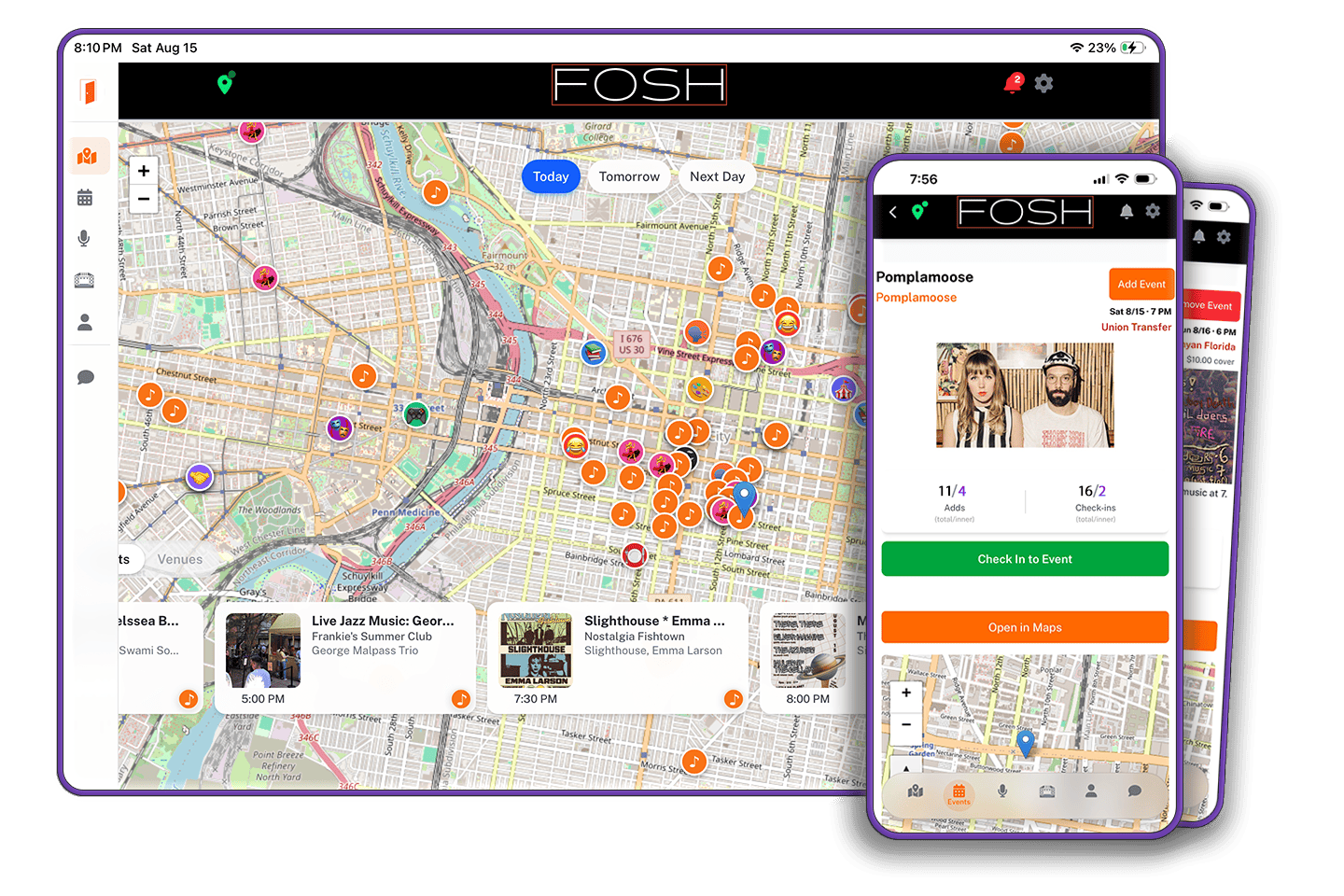
FOSH does for going out what Netflix did for staying in. We bring a city’s live events to one place, so people can quickly see what’s happening around them.
FOSH is free, on iOS, Android, and the web. Open it now. See what's happening in Philadelphia tonight, and decide for yourself whether your city should have this, too.
Problem
Entertainment comes to you. Real life does not.
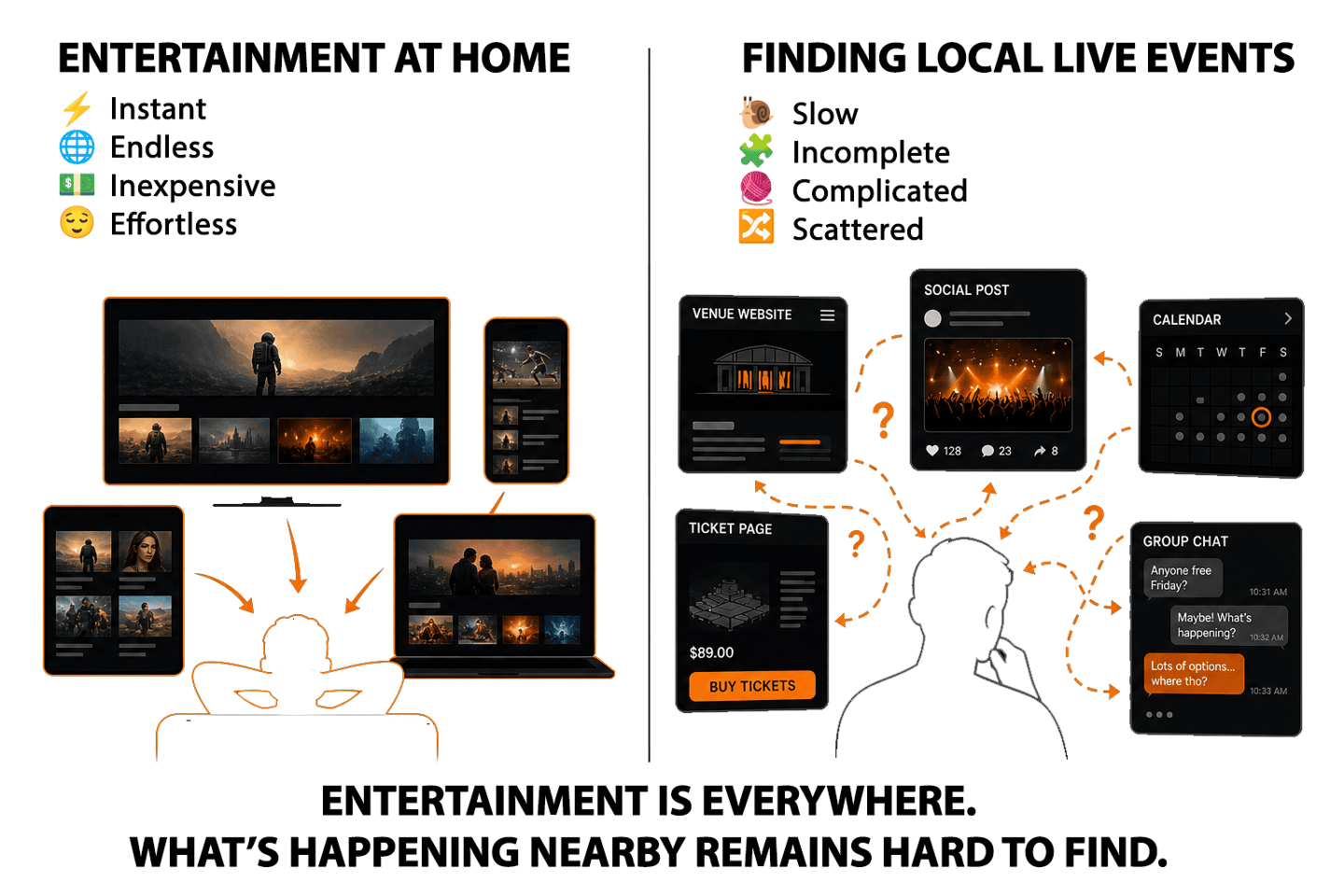
Entertainment is now fast, inexpensive, and everywhere. Nobody has to leave home—or even look up from a screen—to be entertained.
As a result, Americans are spending less time socializing than they did two decades ago. Average daily time spent doing so fell from 45 minutes in 2005 to 35 minutes in 2025. For young people, it's even worse. For 15 to 24-year-olds, it dropped from an hour to 35 minutes. Going out may be better than staying in, but it requires more effort.
You need to figure out what’s happening, where it’s happening, and when. The information is scattered across venue websites, social media, ticketing platforms, online calendars, posters, and newsletters.
That friction matters.
Sources: U.S. Bureau of Labor Statistics, American Time Use Survey—2005 and 2025; Axios analysis of BLS data; U.S. Surgeon General, Social Connection Advisory
Solution
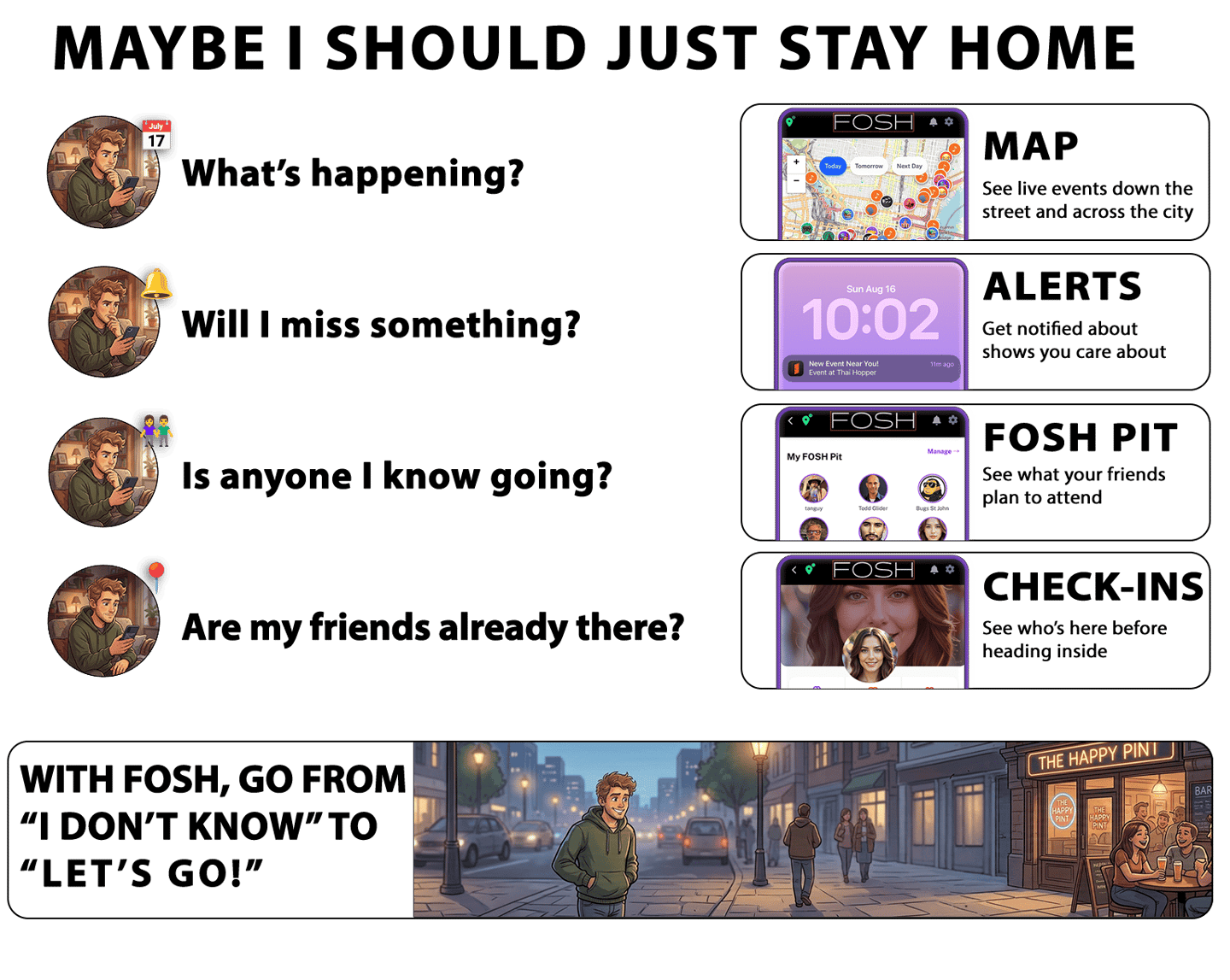
You know more about what’s on Apple TV tonight than what’s happening in your neighborhood.
For digital-native users, deciding whether to go out can bring a familiar stream of questions: What is happening? Where should I go? Is anyone I know going? Are my friends already there?
FOSH eliminates that uncertainty.
Instead of searching across disconnected sources, people can quickly see what is happening around them, get alerted to events they care about, see what friends are planning to attend, and even find out who's already there.
FOSH does not create the events. It removes friction between people and the events already happening around them.
Product
How FOSH works
Gather
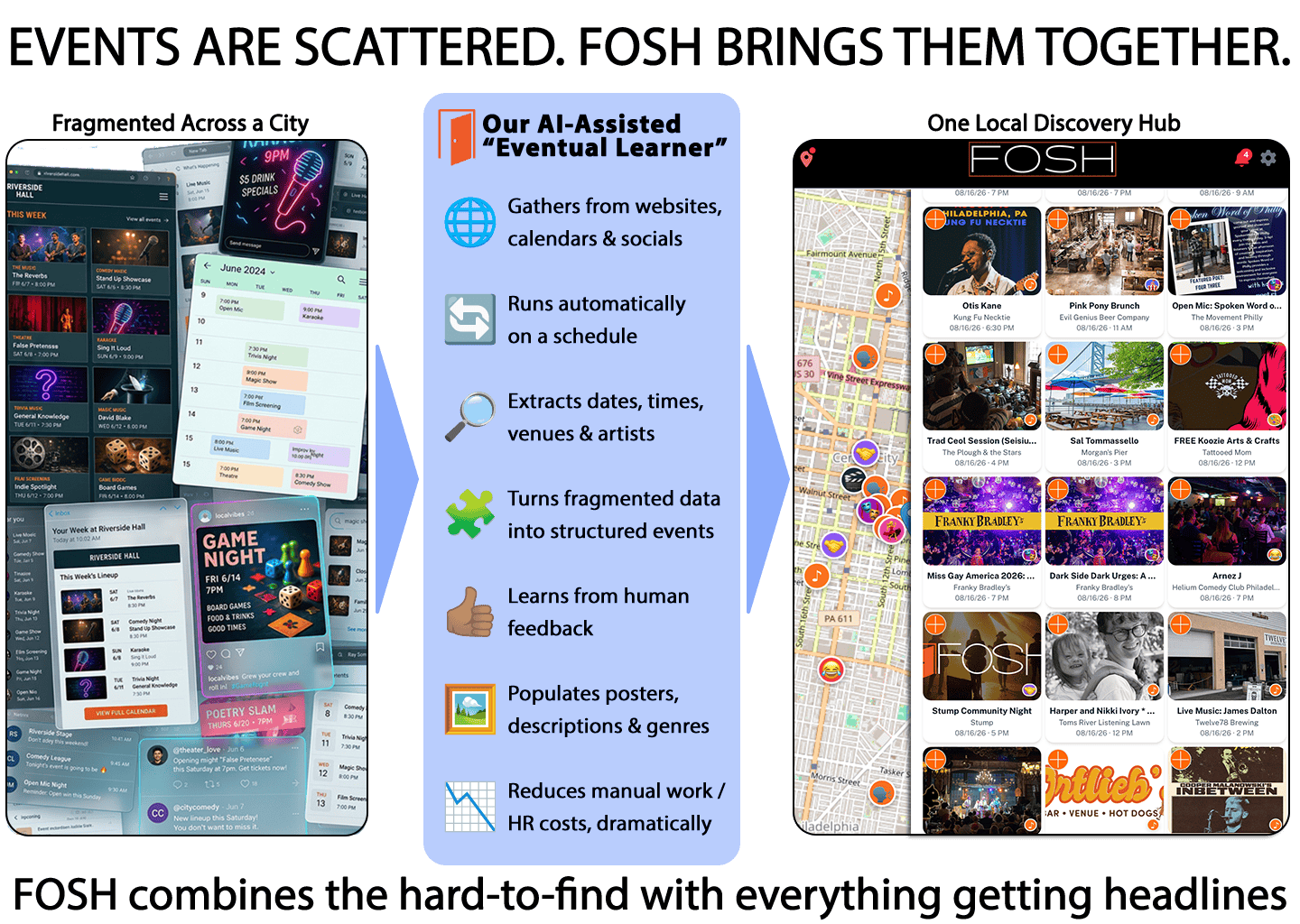
FOSH gathers fragmented event information from hundreds of sources across each market, including venue websites, calendars, social posts, and event graphics.
Organize
Its technology turns that information into structured event listings that organize dates, start times, venues, headliners and supporting acts, age requirements, cover charges, event descriptions, posters, and media samples.
Discover
FOSH makes events, venues, and performers searchable and geographically discoverable, giving users one place to see what is happening around them, search by genre, and even listen to samples of unfamiliar acts before deciding where to go.
Technology
Technology built for a data problem no one has solved
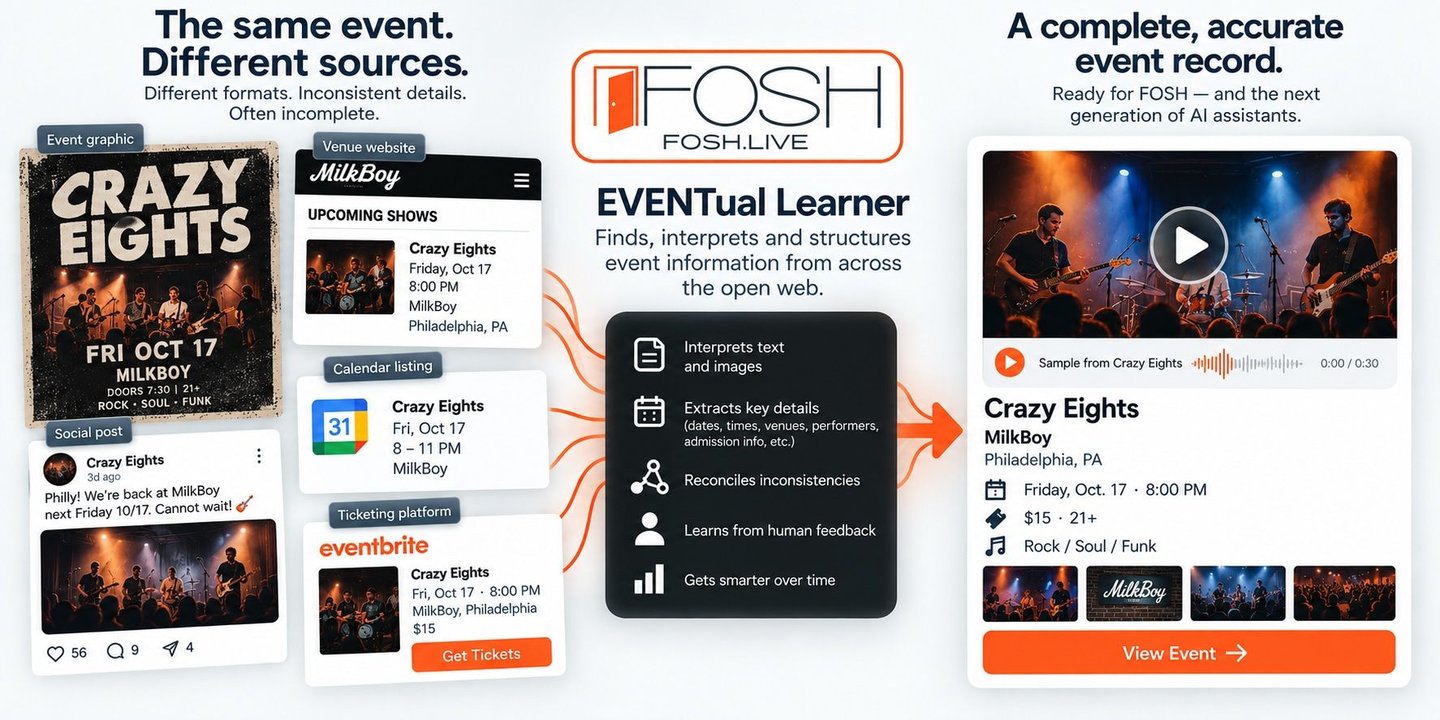 Local-event information is unusually difficult to organize.
Searches on Google, ChatGPT, and other general-purpose platforms can return an incomplete, outdated, or simply inaccurate picture of what is happening locally.
AI is core to FOSH’s event-aggregation technology.
FOSH's EVENTual Learner automatically gathers, interprets, and structures fragmented event information, extracting dates, times, venues, performers, admission information, and supporting media—work that OCR and conventional scraping cannot reliably perform on their own. Every result can be reviewed and approved or rejected, with feedback returned to the underlying language model so EVENTual Learner becomes smarter and more accurate over time.
EVENTual Learner performs at scale work that would otherwise require extensive manual research and data entry, allowing FOSH to build local-event inventory faster, more accurately, and at dramatically lower operating cost.
FOSH owns all code and intellectual property underlying its technology.
Traction
Built in Philadelphia. Now live in Rochester.
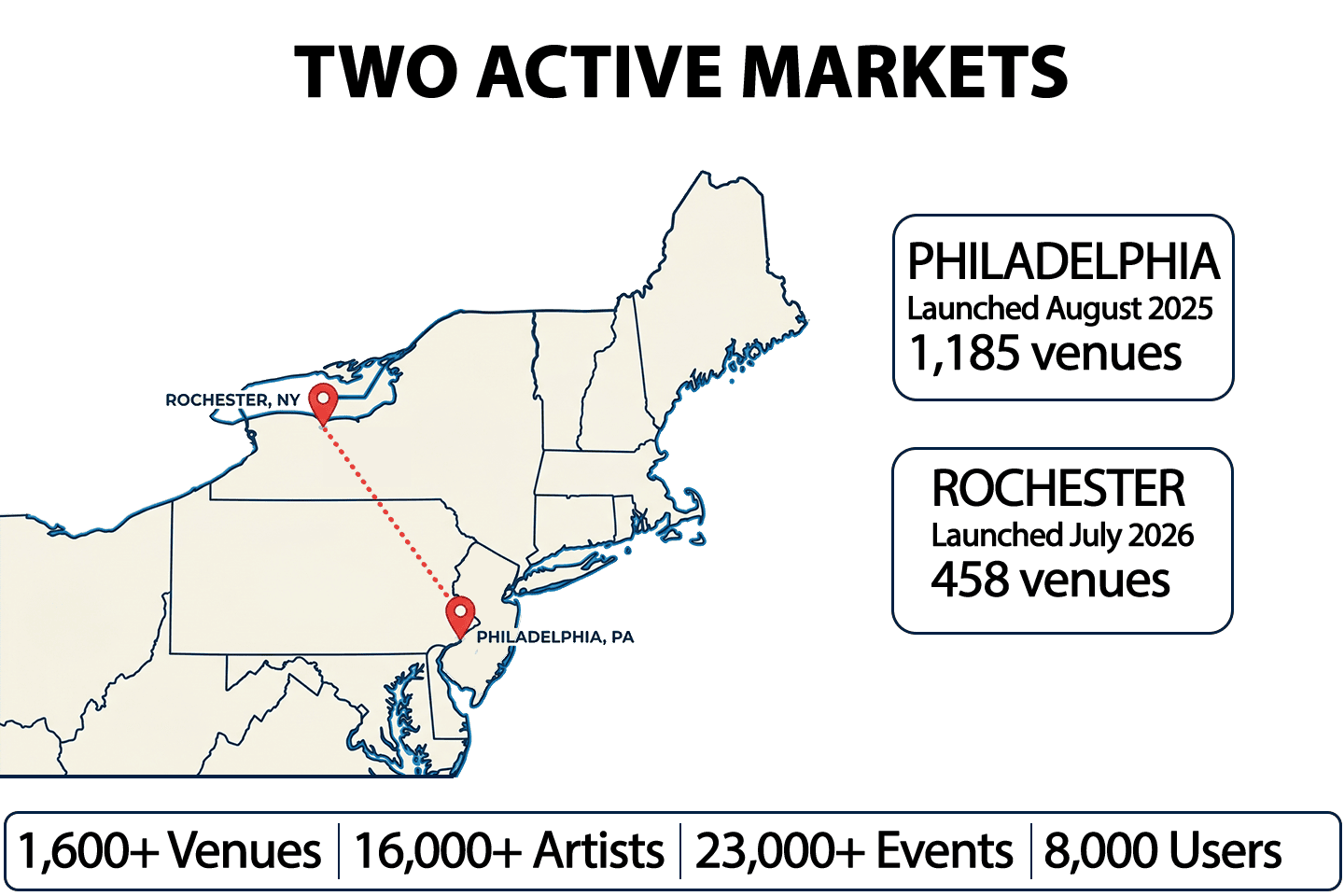
FOSH launched in Philadelphia in August 2025 and expanded to Rochester, New York, in July 2026.
In Philadelphia, reaching this level of event coverage took five months. In Rochester, it took two weeks—with the same team and no additional hires.
The Rochester launch provided the first real-world test of FOSH's ability to replicate its event-aggregation model in another market. FOSH now lists 458 Rochester-area venues and announces an average of approximately 60 events there every day.
The company’s four founders accomplished all of this—including the event-aggregation technology, advertising system, and app releases—without outside capital and with just $30,000 in spending.
This round will fund consumer growth and advertiser development in both cities while FOSH prepares to launch in three additional markets.
Market
A $408 billion market
The United States live-events market is estimated at approximately $408 billion.
- 61% of U.S. consumers attended a live event during the preceding six months.
- Event attendees averaged seven events within six months.
- 84% of eventgoers wanted more concerts at local independent venues.
- Cost prevented 60% of consumers from attending at least one event they wanted to experience.
Major concerts receive enormous attention, but cities offer thousands of more affordable, accessible experiences that remain difficult to discover. FOSH brings those experiences into view.
DoStuff Media does approximately $8.8 million a year in local event discovery. Bandsintown does approximately $18 million. Meetup, $30 million. Eventbrite, $325 million. These are companies operating today, in a category FOSH covers more completely than any of them.
Sources: (1) Researchandmarkets.com 9/06/2024; (2) Deloitte Center for Technology Media & Telecommunications 10/08/2024
Business Model
Turning local discovery into a business
FOSH’s business model expands as its audience, markets and proprietary data asset grow.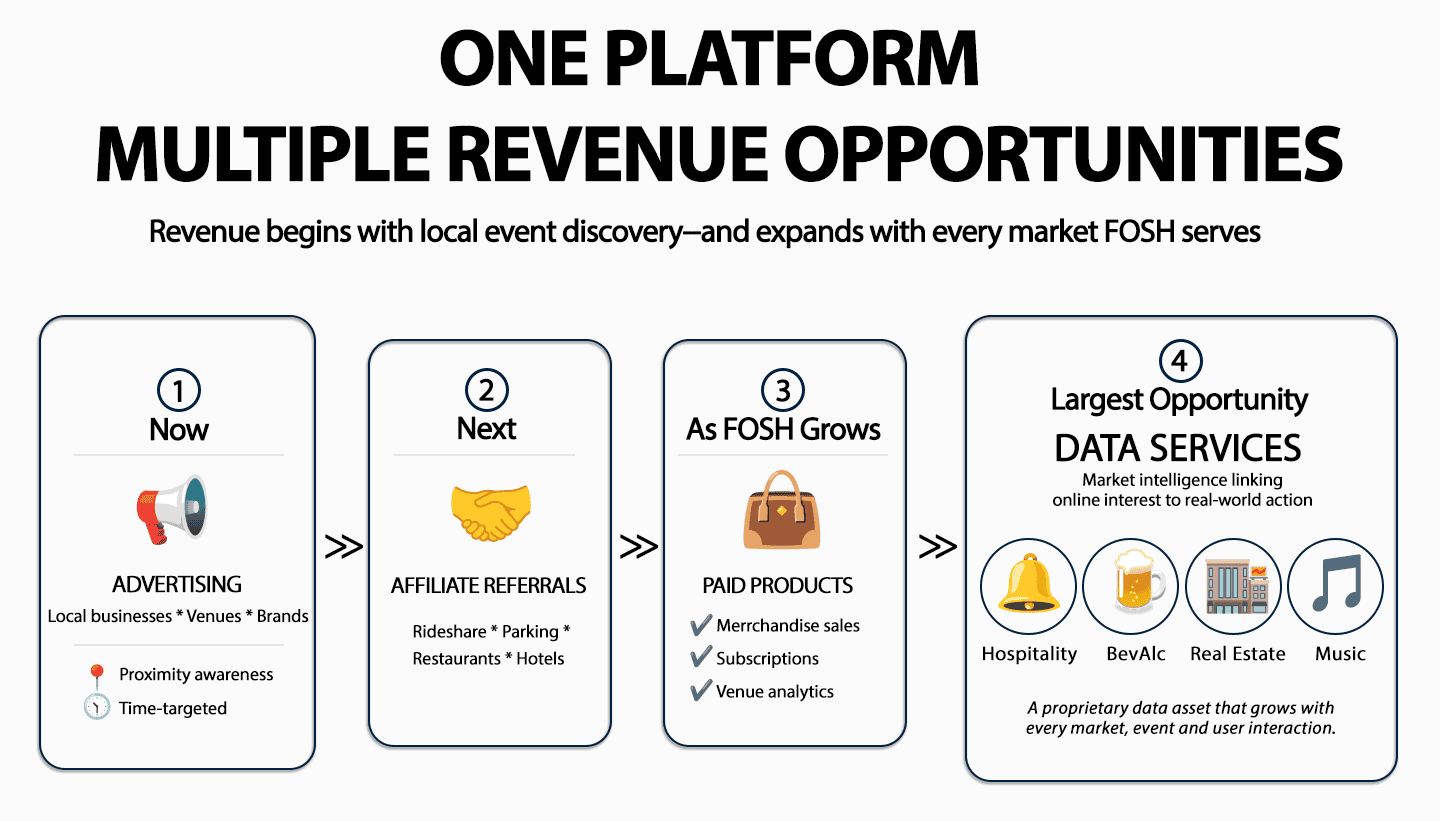 Operating now: Advertising
FOSH has built and launched its own advertising platform, giving businesses access to locally engaged audiences at the moment they are deciding where to go and what to do.
The platform supports geographic targeting, geofencing, time-based delivery, impression measurement, click measurement, and click-through-rate reporting.
Paid advertising is now underway. This round will fund audience growth, advertiser acquisition, and continued development of FOSH’s advertising platform—creating inventory for local businesses, venues, event organizers, and regional and national brands across every market FOSH enters.
The largest opportunity: Data services
Every new city adds events, venues, artists, users, advertisers, and commercial partners to the platform.
More event inventory makes FOSH more useful to consumers. A larger and more engaged audience makes it more valuable to advertisers and affiliate partners. Continued activity builds a proprietary understanding of how digital interest becomes real-world attendance.
That intelligence will help industries including hospitality, beverage alcohol, real estate, and music understand where local demand is forming, when people are going out, and what is driving them.
FOSH also publishes a Model Context Protocol server, making its structured event data directly queryable by AI assistants. As FOSH's dataset grows across markets, that interface becomes a channel for the data services business.
Planned next: Affiliate referrals
FOSH will connect eventgoers with services that become relevant when they decide to attend an event:
- Ridesharing
- Parking
- Restaurant reservations
- Hotels
These referrals create revenue at the moment a user is preparing to go out.
Additional revenue opportunities
As the platform grows, FOSH will add:
- Merchandise and payment processing
- Enhanced venue analytics
- An optional ad-free consumer experience
Each market strengthens the entire FOSH platform and creates more ways to generate revenue.
Investment Opportunity
What FOSH still needs
From January through August 2026, FOSH averaged 715 monthly users in Philadelphia, with 596 registered accounts. Every one arrived through an artist's post, a venue's link, or a friend. FOSH has never run a campaign or bought a user.
Three things stand between where we are now and a national business:
Money to reach people. Nothing has ever fed the top of the funnel. That is what half of this round pays for.
Product work. FOSH launched as a web application in the App Store and Google Play. Initial capital built a working product in two markets, and is the ceiling FOSH operates under. FOSH needs to build native applications; UX testing is crucial to turn a capable product into a habit.
People on the ground. Technology puts a city on the map; people bring FOSH to life. Every market needs a local organizer who knows which venues matter, which promoters to call, and where a scene actually lives.
Financial Outlook
What this round buys
Entering a city and building an audience in it are two different costs.
On the map means FOSH has that city's events. Every venue, every act, every night, current and searchable. The technology does this. Rochester took two weeks, and the marginal cost of the next city is close to zero.
On the ground means people in that city use FOSH. That requires a local team, marketing, community work, and advertiser relationships, which costs real money.
FOSH has already built the difficult half. This round pays for the other half.
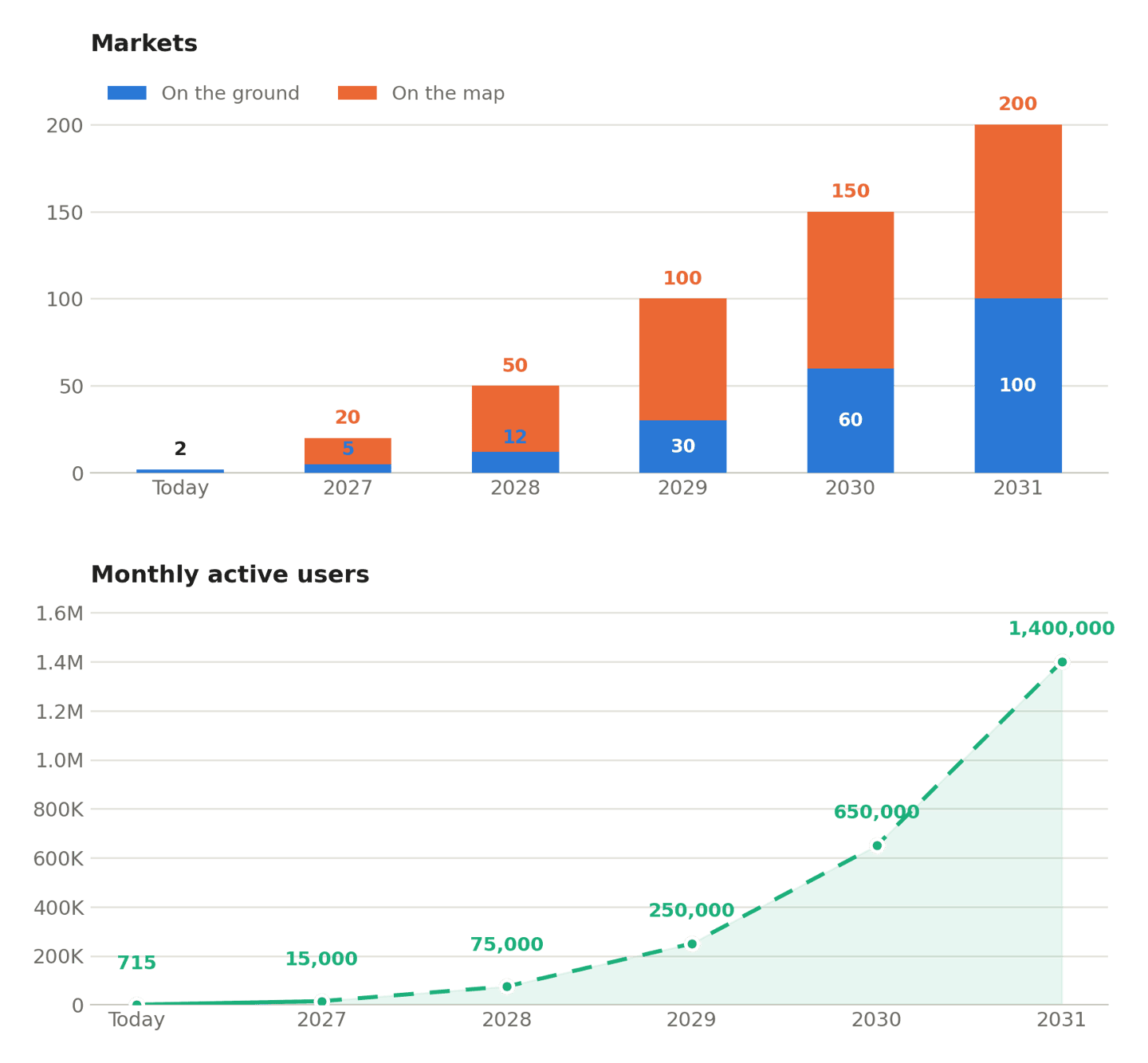
By the end of 2027, this round is intended to deliver:
- Native iOS and Android applications
- 100,000 people using the platform across Philadelphia and Rochester
- 40,000 registered users
- 15,000 monthly active users
- Five markets on the ground, with local teams, users and advertisers
- 20 markets on the map, fully indexed and ready to activate
- Advertising revenue at scale in Philadelphia, proving the model that funds every market after it
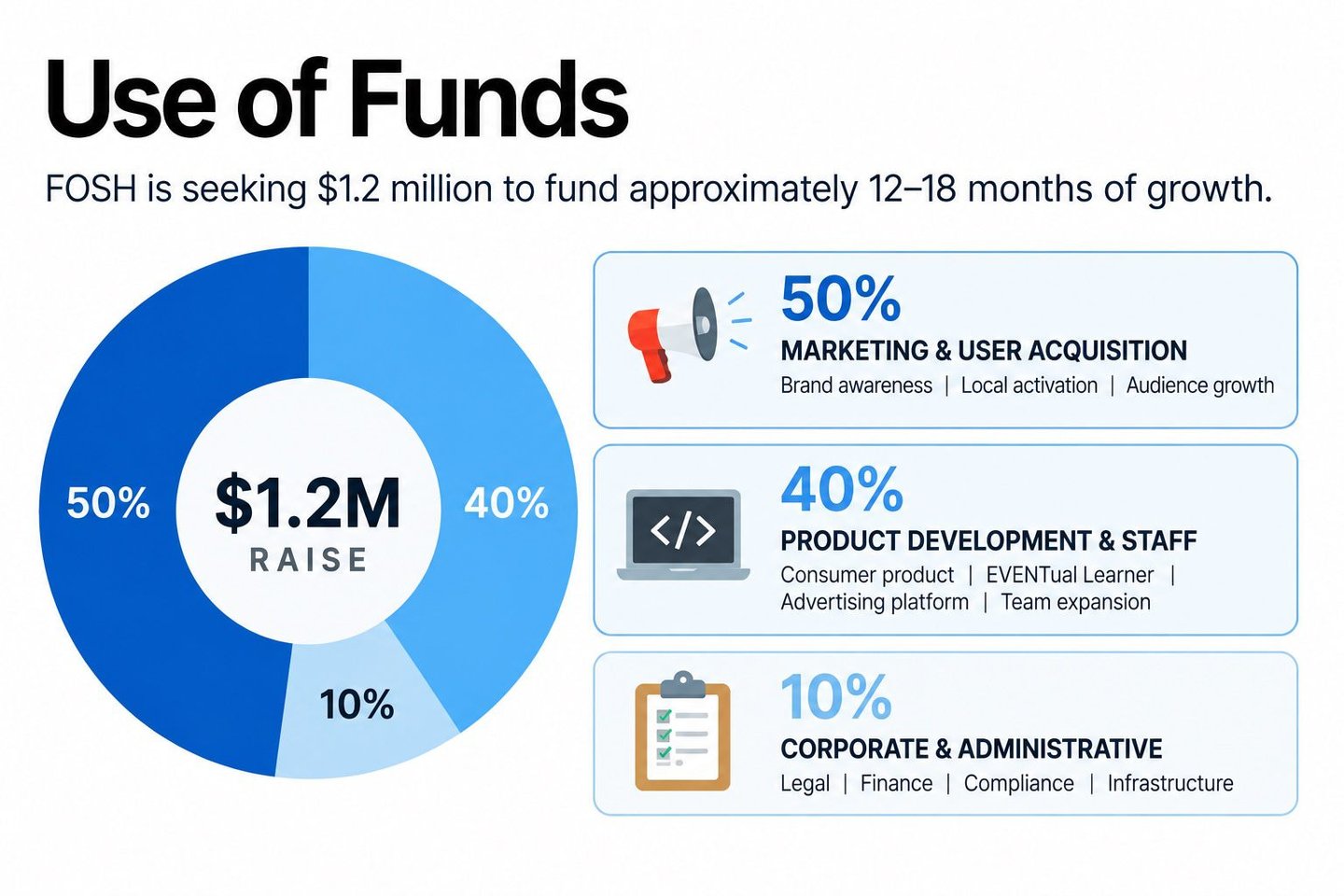
How the money is spent
- 50% — user acquisition and market launch
- 40% — native applications, product, engineering, and staff
- 10% — legal, accounting, and administration
The arithmetic
Approximately $555,000 of this round goes to acquisition. At a blended $4 to $6 per user, that is roughly 100,000 people using FOSH—more people in eighteen months than FOSH has reached in its entire existence.
15,000 monthly active users means about one in seven of them still opening FOSH in a given month. FOSH is not there today, and the product work is what closes the gap: native applications, as well as the onboarding, prompting, and interface refinement that has never been funded.
Why native applications matter
Native applications give FOSH reliable push notifications, a persistent user identity that survives across visits, and the ability to measure its own audience properly. The features designed to bring people back already exist. Native applications are what allow them to actually reach the people who installed FOSH, and what allow FOSH to see whether they worked.
This is the first thing the product budget pays for.
Forward-looking statement disclaimer per Republic/counsel guidance.
Expansion Strategy
Built with Each Community
FOSH combines scalable technology with participation from the people who create each city’s live culture.
Artists manage their pages, share music and posters, accept tips, and announce events. Venues manage their presence, promote events, and keep information current. FOSH reinforces that participation through local leadership, direct outreach, and relationships with artists, venues, and community organizations.
Technology allows FOSH to enter new markets efficiently. Local participation makes FOSH part of the community.
Team
Tech Roots, Brand Instincts, Live Event Obsession
Todd Glider: Chief Executive Officer
Todd Glider is a seasoned executive who’s been on the cutting edge of innovation since the dawn of the Internet age.
He turned a 3-person, $1 million/yr online marketing company into a 100-person, $25 million/yr lifestyle brand, carved out a new hemp-focused vertical for a decades-old merchant services organization, and spearheaded development of DLN.org, a blockchain solution designed to lift billions out of poverty.
He’s the author of 2 sci-fi books, and he wrote, produced, and directed the first English language series documenting Barcelona’s history.
Now based in Philly, Todd plays bass, sings, and writes most of his band’s material.
Julian Cohen: Chief Operations Officer
Julian Cohen is a brand builder with over 30 years of innovation, insights, strategy, and marketing experience in CPG, beverage alcohol, entertainment, and cannabis.
He has over a decade of ad agency experience at DDB and Leo Burnett on brands such as Gatorade, Home Depot, and Dell. He has spent the past 15 years on the client side, first at Beam where he ran global insights and innovation for the company’s whiskey, tequila, and rum brands, and then at Constellation Brands, where he led business intelligence, driving growth for Corona, Modelo, Mondavi, and Casa Noble. Most recently he worked in the cannabis industry as Canopy Growth’s Chief Growth and Innovation Officer.
He is based in Chicago and is a big music fan who tries to see several live shows a month.
Tanguy de Courson: Chief Technology Officer
Tanguy de Courson has been at the forefront of web innovation since 1996. He helped pioneer foundational technologies such as internet video streaming and secure online transactions.
Over the past three decades, he has led projects for some of the world’s most recognizable brands, including Warner Brothers, Live Nation, Apple, and Bird. Tanguy founded his own consulting firm in 2002, where he blends deep technical expertise across PHP, Laravel, Ruby on Rails, MySQL, and UNIX environments with a sharp focus on security and compliance.
Born, raised, and based in Los Angeles, when Tanguy's not coding, he's behind the wheel of his 2000 Harley Davidson Road King heading to a show at Magic Castle.
Sarah Elizabeth Paré: Chief Strategy Officer
Sarah Elizabeth Paré is a vision-forward strategist specialized in guiding organizations through periods of significant transformation, such as Constellation Brands and Canopy Growth. Her expertise lies at the intersection of finance, strategy, insights, and communications.
Over her career Sarah has led strategic evaluation and planning in the areas of M&A and divestitures, market entry and exits, go-to-market expansion, operating model restructuring, cost-savings programs, and investor relations. Her clients have ranged from Fortune 500 entities to small-cap firms.
As the Midwest daughter of artists, Sarah is a firm believer in the power of live events to inspire and connect. Based in Rochester, she sings and writes music in her band.
Join the Revolution
A problem people stopped noticing
Before Google, Airbnb, Waze, and Uber, people had become accustomed to familiar inconveniences.
Those companies did not create the underlying needs. They made longstanding problems visible and offered simpler ways forward.
Local-event discovery remains fragmented because people have become accustomed to it being fragmented. At a time when people are spending less time socializing in person, making it easier to find reasons to go out matters.
FOSH is building a new expectation: open one platform and see what is happening around you.
Already live in Philadelphia and Rochester without outside funding, FOSH has built the foundation for a repeatable multi-city business. This round is designed to accelerate audience growth, revenue, and expansion while building an increasingly valuable proprietary data asset.
We believe every city should have one place where people can discover its live, in-person life.
FOSH is building that place because FOSH is how Going Out Got Easy.