

 Oops! We couldn’t find any results...
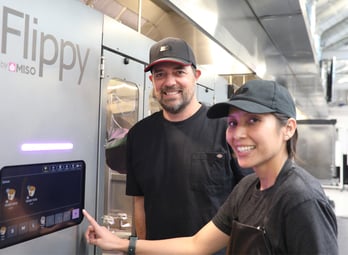
Third Generation’s the Charm
Miso’s New Flippy Fry Station AI Robot is ready for major expansion
Bob: Today we're talking with Richard Hull, CEO of MISO Robotics, about his company's advanced technology and the coming modernization of commercial kitchens. He also has an important announcement to share with us at the end of today's conversation. Rich, thank you for joining us.
Rich: Thanks for having me, Bob.
Bob: You put a three-part strategic plan in place at MISO when you arrived there. Where does that plan stand today?
Rich: Well, as you know, MISO was started 10 years ago, and I was brought in about three years ago, so I'm relatively new here. And I was just coming out of my last company, which had had a big exit, and I wanted to do it again. And so when I came to MISO, you're right, there was a three-part plan.
The first part of the plan was to just inject really experienced operating discipline into the business, reduce the burn, reduce some of the headcount, be very clear and focused about the product strategy, and we largely did that. So step one, check the box. Step two was to really shore up the technology platform, focus more on a platform than disconnected products.
And we did that both organically and inorganically. We focused on our Flippy Fry Station robot, which is really our signature product, and doubled down on that, built a new generation. And then we also did some where we acquired some other stuff.
And then, we checked that second box. And then the third step is that we want to package it all up and figure out the right way to take it public as the public markets have started opening up again. And that's the one that we're getting ready to start on.
Bob: We'll come back to some of those acquisitions in a little bit. But first, let's talk about Flippy, the flagship product for MISO. What does it take for a restaurant to install Flippy now compared to prior generations? And what kind of benefits can restaurant owners expect?
Rich: Well, we're on the third generation. If you know anything about disruptive technology, it's usually the third generation of anything that scales. The first two are always a little bit messy and you have to go through them, but then you get to the third and it's where it all starts to come together.
And so that's where we are on Flippy today. It's pretty easy now for a restaurant to install a Flippy in either a new location or existing location. And we fit into tens of thousands of existing locations throughout America.
The third generation is half the size, twice as fast. It installs in a few hours overnight versus a couple of days like the prior one. And then from an economic standpoint, we've architected a payment structure that is really simple for restaurants.
They don't have to put down any money up front if they don't want to. It's a monthly fee of a few thousand bucks and they sign a long-term contract with us and they'll own the Flippy after that contract. So we've made it really, really easy.
It's plug and play. And then once it's installed, it delivers a bunch of ROI and net new profits for them.
Bob: You've recently seen the first installations of Flippy in some new markets. How do those fit into your expansion plan?
Rich: We love these two partnerships. I think they have the opportunity to be massive. We can almost build the whole business on one or both of these partnerships alone.
So I went to the floor of the New York Stock Exchange not too long ago to announce that Flippy had entered its first NBA arena. And so we haven't announced publicly which one that is, but we love the trajectory of that. We're teaching the robot that use case, which is slightly different than what is in a restaurant.
Because in an arena, everybody wants to eat at halftime. So you've got 90 minutes to make your entire day. And if you fall short, that's just money that is left on the table.
And so we're really teaching the robot how to do that. So that's a really, really interesting partnership. The second one is one that we just recently announced, also in conjunction with media on the floor of the New York Stock Exchange.
And that is that we are entering our first California State University. And that's really important. The California State University system is massively important because of the cost of labor in the state of California in restaurants, which is $20 an hour.
It's the highest in the country. It's been really disruptive to restaurants. And so to get in there and to really use that as a land and expand strategy within the Cal State University system is a really, really massive announcement.
We're also doing an internship program with the students. And so not only are they getting the benefit of Flippy and the ROI that comes with that from a profit standpoint, but the students are getting a lot of benefit in terms of like real world training that they can use in their career. So those two partnerships alone are ones that we're really excited about.
Bob: How is the production of Flippy compared to a traditional fry cook? And what does Flippy free that person up to do inside the restaurant?
Rich: It frees them up to do everything. It's, you know, restaurants are dealing with a really massive labor shortage. If you and it kind of makes sense.
A lot of the jobs at the fry station and even in the kitchen in general have traditionally gone to teenagers, especially in fast food restaurants. Birth rates have been way down every year for the last 20 years. So there's just fewer teenagers out there.
And the ones that are available, they want different types of jobs. They want to focus more on technology. They're comfortable with technology.
And, you know, doing fries is not really high on the list, not to mention the fact that almost everybody burns themselves when they're working at the fry station. And you're lucky if you find somebody that, you know, lasts for 90 days before they bail out. So this just solves the restaurant's largest problem, which is that labor shortage by just taking the most dangerous, least desirable task off the table.
And then the humans can just go do anything else and get redeployed to the front of the house where they're talking to customers. They're doing upsells. They're asking you if you want to supersize it.
They're doing quality control. Even washing dishes brings you more value than somebody standing at the fry station burning themselves. You really want those humans working in much more human things that are much more high value.
And that's what Flippy allows them to do.
Bob: Miso recently attended the National Restaurant Association Conference and Robotics was even identified as one of the top tech trends by a leading magazine. How was Flippy received there?
Rich: It was amazing. We had crowds that were, you know, multiple people thick. It was, you know, we met probably thousands of people. We walked away with, you know, several hundred great leads, new relationships.
We've been following up on those ever since. We've been closing some of those sales. It really was amazing because in the prior days of the National Restaurant Association show, which is really the biggest show in the world for restaurants to gather.
It's in Chicago every year. It used to be a kind of technology on one side and restaurants on one side, and now they're combined and technology is just what a modern restaurant looks like. And so Flippy, I think, was really the bell of the ball.
You're right. We were named one of the top six tech trends by one of the leading publications. And it was a really, really amazing experience.
We also got to meet some of our crowdfunding investors. So we invited repeat investors in the Chicago area to come. We bought them tickets to the show.
We got to meet them in person. They got to film Flippy for the first time, see him in action. It was a really, really powerful experience for us.
Bob: That's great to have all those leads. Now, of course, operations in a restaurant extend well beyond the fry station. And you made a big acquisition earlier this year to expand Miso's presence throughout the restaurant.
Rich: We did. When I came here, if you think about what Miso's traditionally been known for, if you do a Google search for us, you'll see a lot of headlines about hardware, specifically Flippy.
I felt like when I came here that maybe we were building it in reverse because if you're really going to own the whole space with a new type of operating system for a modern restaurant, you want to sit at the collision of software and hardware. We started architecting a software product called Zippy. It's a restaurant operations tool that restaurant operators can use.
And then it helps frontline employees make more money, both for themselves and for the restaurant. And then we stumbled upon another company called Zignal that was doing something very similar. And we really liked how they had architected theirs.
So we acquired them and we're in the process of combining those two products. So between the two of those, we're very early on in that product, but between the two of those, we've got some amazing customers already. Jersey Mike's, Auntie Anne's Pretzels, Cinnabon, Carvel, Scooter's Coffee, Jamba, some really, really marquee tier one names that are already using that product. And we love the way that that's scaling. So that's one of our acquisitions that we made.
Bob: And then about a month ago, you made a major move requiring Zume Pizza's IP and technology. How does that evolve your plans on the product side and the technology side?
Rich: Well, that was all part of our strategy. So we really doubled down on patents, and got way smarter about them when I came here. We built what we call the software brand.
We call it the Miso Hub. It's kind of a software stack that really powers all of the different products that live on our platform and allows them to communicate seamlessly. And when we did that, we created a ton of new innovations.
And so we spent a lot of time doubling down on patents for that, and it made us much smarter about patents. And then we got the opportunity to acquire the patents, the IP, the technology from Zume Pizza. Zume Pizza was one of the first movers starting about 10 years ago in the innovation space.
They raised about $400-plus million from SoftBank and others, north of a $2 billion valuation. And they solved some amazing problems. They created some amazing, extraordinary technology.
They were probably just a little early. And so the concept of Zume is that you would order a pizza, a truck would start driving to your house, a robot in the back would make the pizza, and just as it pulled up at your front door, the pizza would be just coming out of the oven, walk to your front door, and it was sort of a pizzeria-type experience, fresh, hot, right out of the oven. We were able to acquire that, and now we get the opportunity to commercialize that innovation from the first wave.
We're now in the second wave. We think Miso's leading that. Do you want to be MySpace or do you want to be Facebook? Do you want to be PalmPilot or do you want to be iPad? So it's usually the second wave of people that commercialize the innovations from the first, and that's what we're working on doing with Zume Pizza's technology.
It's really incredible. We're really excited about it.
Bob: Another technology partnership you have is with NVIDIA, where you worked with them on a major advancement in Flippy's vision. What excites you most about sort of where AI and robotics are headed together over the next few years?
Rich: Well, it's one of the reasons I came here. I felt like that robotics was probably going to be the most important thing in my professional life, maybe with the exception of the iPhone. In my world, I come out of the streaming business and the technology side of that, and so maybe streaming.
But it was something I wanted a voice in. You know, in that collision between AI and robotics that some people call physical AI, I just think it's incredible. And so we're going through all these massive changes, and so to be right on the leading edge of that, I think, is really important.
We say we're on the leading edge, not the bleeding edge. The bleeding edge is like humanoids doing backflips on Instagram. That's cool, but it's not a business yet.
A lot of things have to go right for you to have a humanoid in your home or office or even kitchen. We're solving today's problems with specialized robots. And so for me, the ability to have a voice in that is really, really incredible personally.
But to build a company around that, that drives a ton of shareholder value at just the right time in the market, I think that's great.
Bob: What does the restaurant kitchen of the future look like? How do you foresee robots working alongside humans?
Rich: Well, we're not trying to get rid of humans in restaurants and why would you want to? We are trying to make humans' existence in restaurants far more enjoyable. And if you do that, everybody's life is better.
Whether it be the restaurant owners who hold on to employees longer or the employees themselves who have a better existence, it's a win-win for everybody. Humans and robots working together to create great food and the best experience for the customer in fastest way possible. That's what a modern restaurant looks like.
Today, we're seeing that change happen, but what was the last innovation you can think of in a restaurant kitchen? I mean, for me, it was the microwave oven, which has been a long time. And so they've largely been operating the same way for 50 years. And so what we are really doing is just this massive step up of modernization.
Bob: How do the people respond to working with Flippy today?
Rich: They love it. It makes their life way easier. So why wouldn't they love it? A while back, we opened a restaurant across the street from us as a summer pop-up.
The landlord across the street from our robot lab in Los Angeles had an empty restaurant space. It was pretty well decked out. And he said, I don't have a tenant for the summer.
So if I give it to you for free, can you put some robots in there and keep the building alive? And we thought, yes. And so we did that. We put a Flippy in there and some other things.
And right before we opened, we put out a job rec looking for people to work in the kitchen and we got zero applications. So we pulled it back. We rewrote it.
We said, you get to work with robots, put it back out. And within 24 hours, we'd gotten 200. I think that really sort of indicates how much people want this experience.
They want these skills working with technology. It's good for their careers. It's way more enjoyable.
And then on the frontline employees, we get feedback all the time about how much they enjoy the experience. So the workers really love it.
Bob: What does success for Miso look like in the next few years?
Rich: Well, ultimately we want to scale our business and drive it towards an exit.
That's one of the reasons I came here. We have done a lot of the work to make that possible by resetting the business, resetting the product portfolio. Last year, we spent a lot of time building what we call the deployment layer.
It's the infrastructure that you need to put products out in the field and support them at scale. It's sort of a classic young startup mistake to push your products out too soon into the physical world and not be able to support them. So we have 24 seven tech support, multiple languages.
We have a nationwide network of field technicians who can show up in a few hours and service anything in the field. So you get a lot of discipline that we've injected into the business. Now the trick is to scale it and we're just starting to see that hockey stick and then also to try to take it public.
The public markets have been sort of locked up for the last few years. We're starting to see some green shoots with SpaceX going public and some others that are going public, even some robotics companies that are starting to go public. And with our scale of retail capital shareholders, we think that's a really interesting entree into the public market.
So nobody has a crystal ball. I surely don't, but that's our plan that we're working on and that's kind of the next step in our business. Right.
Bob: That's certainly fair to say. I recently saw some statistics that in even the first half of 2026 or to date, the amount raised for IPOs was the same as the previous four years combined. So those public markets have opened up considerably.
Rich: I think that you're also seeing retail capital being a place that is a de facto stop on the way to becoming public today. And I think some of it is what you talked about, there's been so few IPOs that people really want a special way to go public and retail has become that. So crowdfunding has become that.
We're incredibly honored to have 40,000 plus retail investors who have chosen to invest in MISO. But if you look at even OpenAI, when they raised their last round, which they are calling their last private round before going public, they opened up a tranche of that to retail investors. Obviously, SpaceX went public recently.
And so we think that's a really good lead in for us as what you're talking about manifests itself more and more and with companies now starting to come public in a way that they just haven't over the last few years.
Bob: Right. And that opens the door to all kinds of investors, not just accredited ones, which was often the case in the past. Now, before we go, you've got an important announcement to make about Miso shares and what's happening next with them.
Rich: Yeah, we have really made it a point to keep our share price the same for quite a long time.
We did that because we wanted to be heads down, focus on operating our business, give investors the best price possible and really prove out everything that was part of our execution plan. Cut to today, we have made incredible strides. We've crossed milestone after milestone of things that we set out to do.
We're continuing to scale. And so, especially as there's much more attention in the market on other companies in the robotics space and the food modernization space, we're seeing other people's valuations just really go through the roof. So we are going to make a share price change on September 17th.
And so this window before then will be investors' last chance to get in at this current share price.
Bob: Well, Rich, thank you for taking the time to speak with us today and share more about MISO's journey and future with our investors.
Rich: Thanks, Bob. I really enjoyed the conversation and we're really honored to be part of the Republic community now.