
Republic Republic Republic
  • Log in
Open account
Oops! We couldn’t find any results...

Can’t find a deal? Try advanced search.
Is something missing? Add your suggestion here.
Primary market Live deals Trading Buy and sell Republic Note Own a piece of Republic's upside
Republic Ventures Opportunities for accredited investors
Republic Capital Multi-stage venture firm
Wallet Manage your digital assets Mobile app Available on iOS or Android Learning center Explore investor resources FAQ Get your questions answered
Capital fundraising Raise on Republic Tokenized assets Design, launch, manage tokenized assets Sharedrops Gift equity as a reward Founder Academy A complete guide to raising funds
Advisory Access veteran web3 advisors Infrastructure Stake your digital assets Tokenization Deploy your assets on-chain
Republic Capital In-house Venture Capital fund Broker dealer Regulated capital services
Republic Republic Republic
Oops! We couldn’t find any results...
Can’t find a deal? Try advanced search.
Is something missing? Add your suggestion here.
  • US

  • Log in
  • Open account
All investors
Primary market Live deals Trading Buy and sell
Republic Note Own a piece of Republic's upside
Accredited only
Republic Ventures Opportunities for accredited investors
Institutional
Republic Capital Multi-stage venture firm
More
Wallet Manage your digital assets Mobile app Available on iOS or Android Learning center Explore investor resources FAQ Get your questions answered
Growth capital solutions
Capital fundraising Raise on Republic Tokenized assets Design, launch, manage tokenized assets Sharedrops Gift equity as a reward Founder Academy A complete guide to raising funds
Web3 services
Advisory Access veteran web3 advisors Infrastructure Stake your digital assets
Tokenization Deploy your assets on-chain
Institutional services
Republic Capital In-house Venture Capital fund
Broker dealer Regulated capital services
Logo of  Metaintro

Metaintro

The Bloomberg of Labor Markets - AI-powered workforce intelligence.
B2C Software
Facebook Telegram Twitter LinkedIn
Featured image of  Metaintro
$800,310
64% raised of $1.24M max
545
Investors
27 days
Left to invest
Invest in Metaintro
$100 minimum investment · Deal terms
Pitch Discussion 16 Updates Reviews 36
Invest Invest in Metaintro
Facebook Telegram Twitter LinkedIn
Problem Platform Traction Biz. model Market Market opportunity Use of Funds Leadership
About Team FAQ Risks Discussion

Documents

Republic (OpenDeal Portal LLC, CRD #283874) is hosting this Reg CF securities offering by Metaintro, Inc.. View the official SEC filing and all updates:
Official SEC Logo Form C SEC.gov
Company documents
Subscription Agreement Metaintro Form C-A 4-30-26.pdf Metaintro Form C.pdf
Loading

Hear from some of the 545 investors in Metaintro


Show more

Highlights


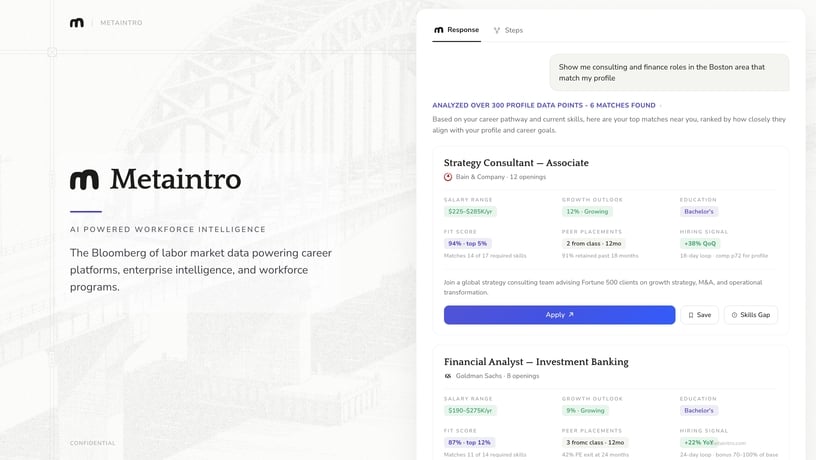
  • AI-powered job-search platform aggregates every job listing in the world
  • 1.8 million active consumer users
  • Government & university pilots signed, $6M projected contracted value
  • $1.2M projected Q12027 ARR from workforce programs desperate for ROI data
  • 93% match accuracy vs 67% industry standard through proprietary AI engine
  • 20x lower infrastructure costs than leading job platforms
  • Raising $15M Series A to capture the $22B gov workforce development market

Problem


Information Asymmetry Is Killing the Labor Market
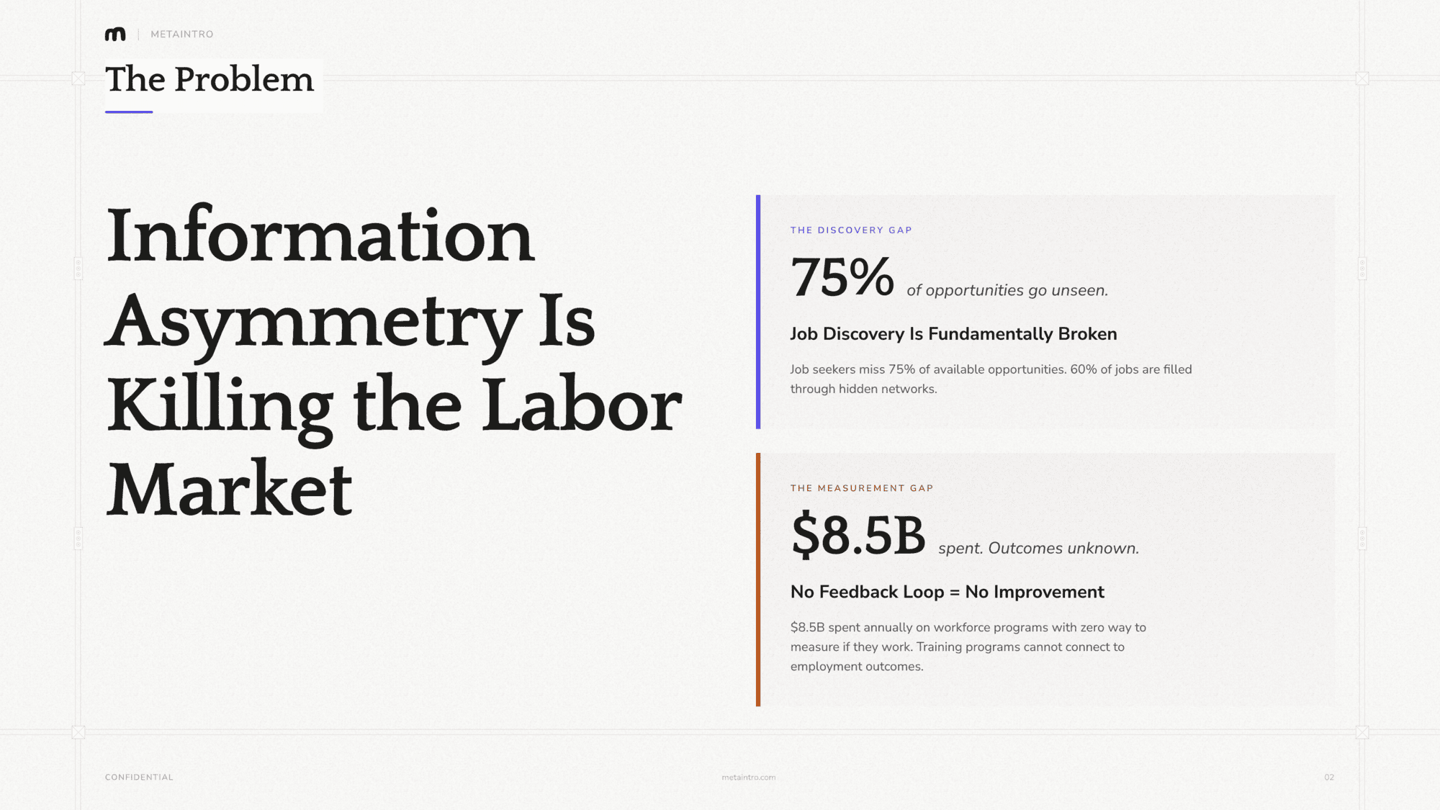

Job seekers miss the majority of available opportunities because traditional platforms only capture jobs that employers post publicly. Most roles are filled through channels invisible to standard job boards.

Workforce development programs spend $8.5B annually in the US alone - with zero visibility into whether their training leads to employment. Programs can't measure what works, so effective programs can't scale and ineffective ones waste public funding.

The result: Job seekers waste months searching. Programs lose funding because they can't prove ROI. And $240B in OECD labor programs globally are operating blind - until now.

Platform


Job Seekers Generate The Data. Programs Use It.
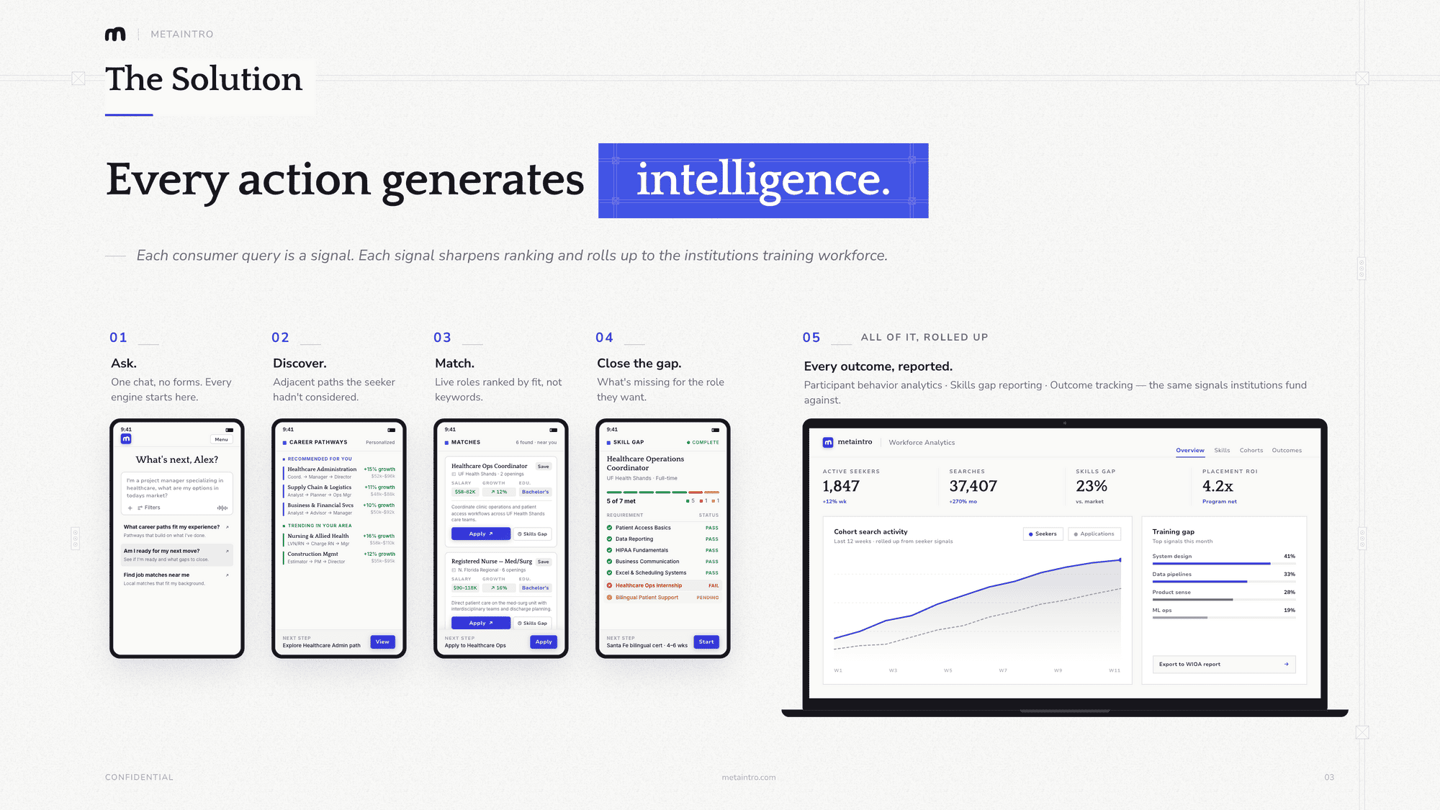
Metaintro solves information asymmetry through a dual-sided platform:

For Job Seekers: Total Market Coverage

  • Aggregates 50M+ verified jobs from 600M web sources - company career pages, government postings, NGOs, aggregators across 120 countries
  • Hourly data refresh vs competitors' monthly updates ensures jobs are actually available
  • RAG-powered AI matching delivers 93% accuracy vs 67% industry standard
  • Predictive career pathing and adaptive ranking via behavioral signals
  • Open-source stack, self-hosted infrastructure - no third-party data dependency

For Workforce Programs: Unprecedented Intelligence

  • First platform to track participant job search behavior in real-time

  • Skills gap analysis shows exactly what training is needed vs what's being taught

  • ROI calculations prove program effectiveness to secure continued funding

  • 4-6 week deployment vs 7+ months for legacy systems

The Flywheel: Every job seeker using the platform creates better labor market intelligence. That intelligence helps workforce programs optimize their training. Better training creates more successful job seekers. More users improve the matching algorithm for everyone.

Technical Moat:

  • Three proprietary data pipelines: direct employer hiring feeds, our own web intelligence engine monitoring millions of domains, and 1.8M users generating real-time behavior data
  • Verification protocol ensures 94% of listings are actively hiring - zero ghost jobs
  • 21-node on-prem K8s cluster (600+ CPUs, 2TB RAM, self-hosted RKE2) at 1/20th the cost of cloud - no vendor lock-in
  • Supply-side behavioral data is structurally impossible for incumbents to replicate - they would need to become consumer companies
  • Near real-time data freshness vs monthly or quarterly delivery from market incumbents

No platform has ever connected comprehensive job discovery with workforce program intelligence. Job boards focus on employer postings. Career service platforms provide basic analytics. Nobody provides real-time labor market intelligence that both helps people find jobs and proves which training programs work. Metaintro is that missing layer. 

Data Licensing Opportunity:

Our combined data pipelines produce a proprietary workforce signal that institutional buyers - hedge funds, PE firms, and corporates - pay $150K-$300K per year to access. 94.7% earnings correlation in backtests: hiring velocity predicts stock movement before earnings reports. This is a $30B+ alternative data market where we offer a structurally differentiated real-time signal.

Business model


Token-Based Pricing. Pay for What You Use.
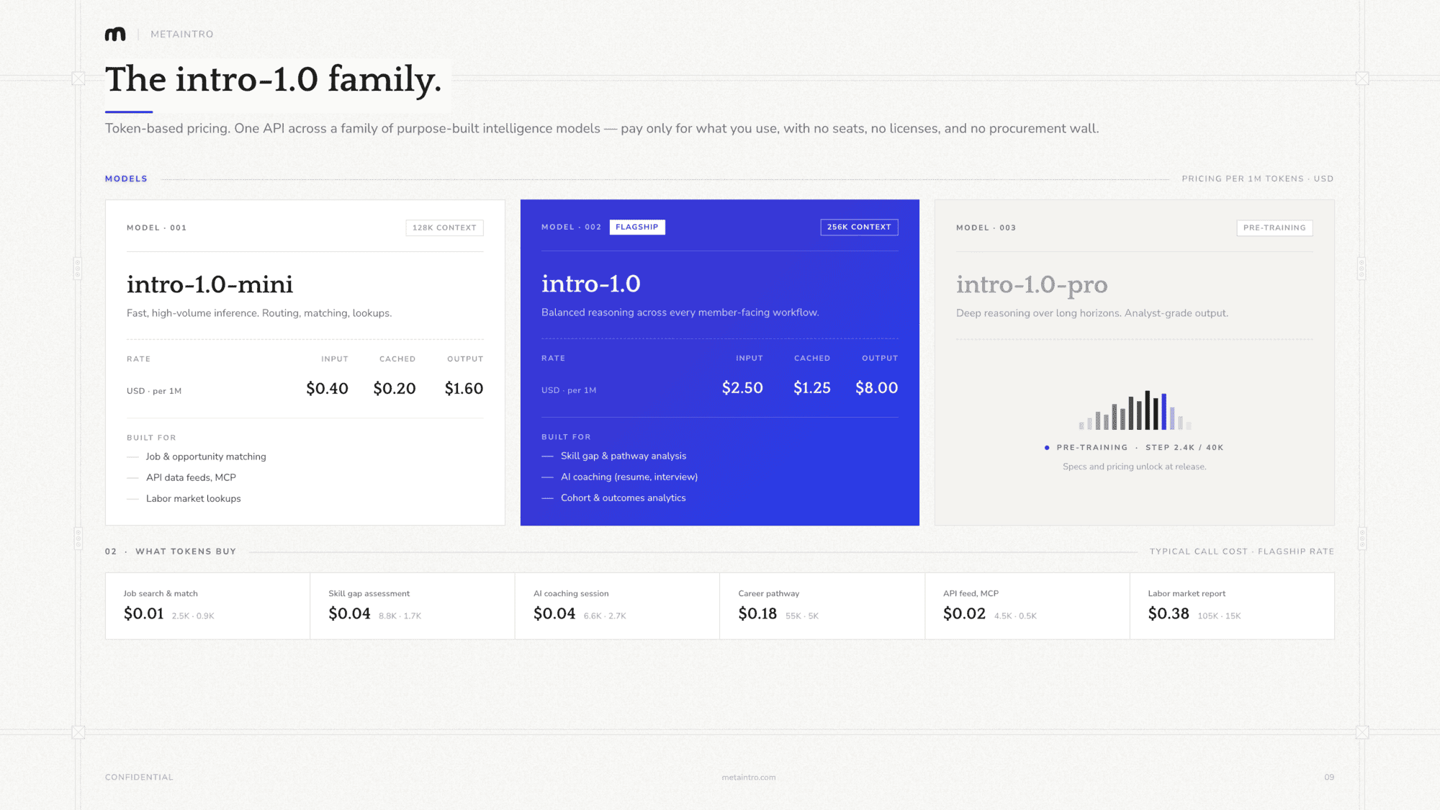
Every platform interaction consumes tokens. No seats. No licenses. No procurement wall. Clients buy tokens and scale usage naturally.

Consumer (High Volume, Lower ARPU):

  • Free tier drives user growth and data collection - every user generates behavioral data
  • $4.99/month premium subscriptions (8.2% conversion rate, improving 0.4% monthly) (2027 roadmap*)
  • Current metrics: 1.8M active users, $0.32 CAC

Enterprise & Government (Lower Volume, High ARPU):

  • Token-based pricing eliminates procurement walls - under threshold requires no RFP
  • Multi-year contracts with 22+ month average lock-in
  • 4-6 week deployment vs 7+ months for legacy systems
  • Current traction: $6M contracted value, $13-27M active pipeline, 45+ demos booked, 20+ bids across the U.S. and abroad

Data & Financial Services (High Margin, High ACV) (2027 roadmap*):

  • Institutional-grade workforce intelligence for hedge funds, PE firms, and corporates
  • 94.7% earnings correlation - hiring velocity predicts stock movement before earnings
  • Delivered via API, Snowflake, S3, or flat files
  • $150K-$300K annual contracts in a $30B+ alternative data market

Why This Model Works: Consumer side generates the supply-side behavioral data no one else has. Enterprise side monetizes it through compliance-mandated contracts. Financial data licensing turns the same asset into a high-margin revenue stream. 80-85% gross margin across all three engines.

This statement contains forward-looking information and projections. Actual results may differ materially.

Market


This Isn't a Pitch. It's Proof.

We didn't build a deck. We built a product that 1.8M people use and programs are buying - without a sales team.

Key Metrics:

  • $6M - Multi-year enterprise contracts, $500K current ARR, growing to an estimated $1.2M by Q1 2027
  • 1.8M - Active users generating supply-side data at $0.32 CAC
  • 21 Nodes - On-prem K8s cluster, 600+ CPUs, 2TB RAM, self-hosted RKE2. No cloud lock-in. 20x cheaper than enterprise average.
  • $13-27M - Government sales pipeline across multiple states ($5-15M replacement cycles)
  • 45+ demos - Booked across universities and workforce boards with 100% follow-up rate

Enterprise Pipeline Highlights:

  • International government ministry - 15,000+ participants deployed
  • University and higher ed clients - ~500,000 students across multiple institutions to start in Fall

These statements contain forward-looking information. Actual results may differ materially. Past performance is not indicative of future results.

Market opportunity


Beachhead: $22B US. TAM: $240B OECD Global.
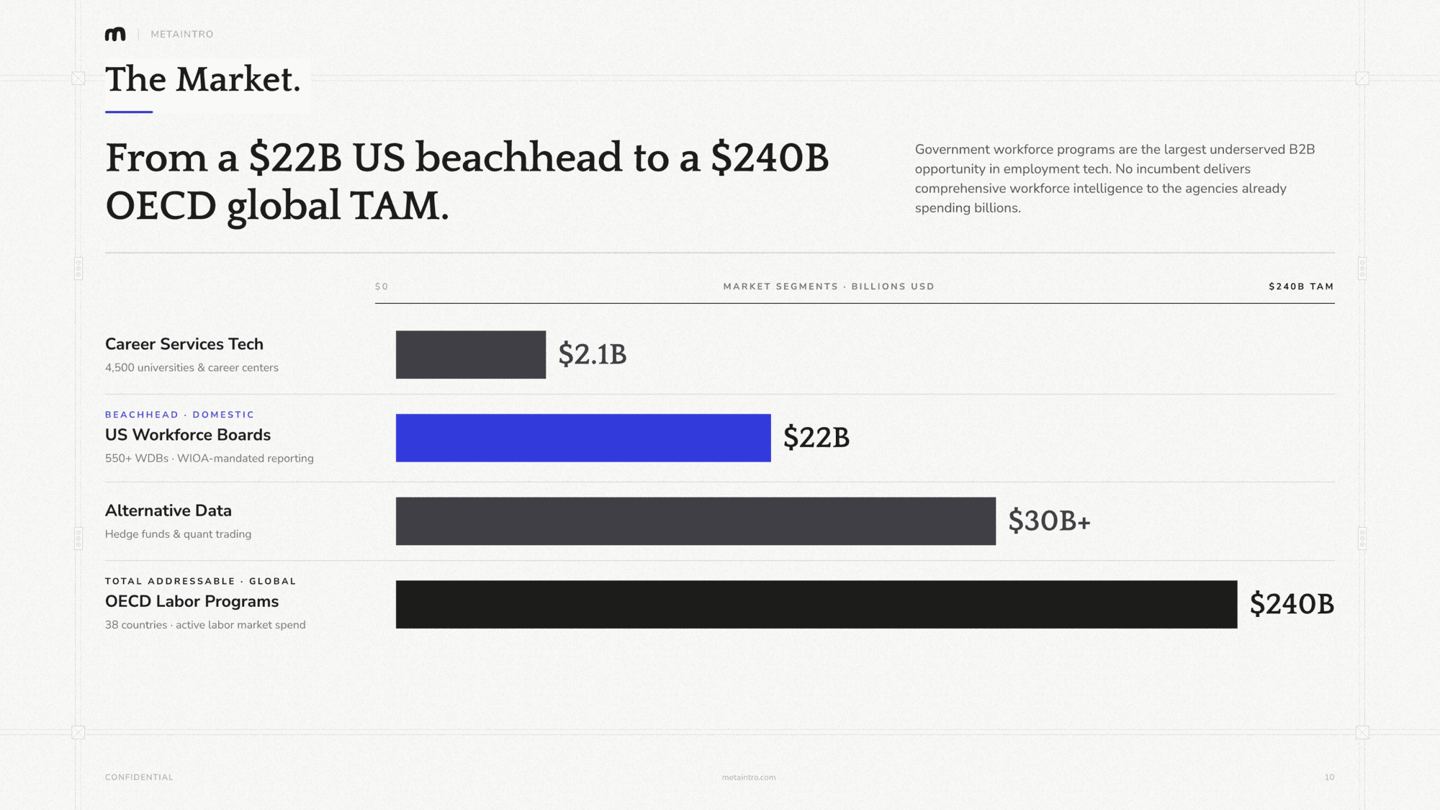
Government workforce programs represent the largest underserved B2B opportunity in employment technology. Unlike consumer job platforms, no one provides comprehensive workforce intelligence to the agencies spending billions on employment programs.

Our addressable markets:

  • $240B - OECD Labor Programs: Global active labor market spend
  • $30B+ - Alternative Data: Hedge funds and quant trading firms buying workforce signals
  • $22B - US Workforce (Beachhead): 550+ WDBs, WIOA-mandated compliance
  • $2.1B - Career Services Tech: 4,500 universities, career centers

Why Now: Three forces converged in 2025. (1) WIOA mandates $3.9B in annual funding with outcomes tracking requirements. (2) AI made supply-side data processing possible at scale for the first time. (3) Incumbent architecture cannot adapt - Geographic Solutions' .NET stack dates to 2002, major 2022 breach, 40+ states actively replacing. The window is 2026.

Go-to-Market Phases:

  1. Government Workforce (NOW) - Captive buyers with compliance mandates and allocated budgets
  2. Higher Education (2026-27) - 5,800+ schools, enrollment declining, "what happens after graduation" is mandatory
  3. Financial Data (2027+) - The $30B play. Supply-side signals that institutional buyers cannot get elsewhere

Use of Funds


$2M Bridge to A

Seed extension accelerates enterprise platform development and government workforce market capture. The A round will end up going towards:

  • Enterprise platform development (compliance/FERPA, SOC2, etc.) - $6M
  • Core AI/ML development (deepen our technical moat) - $5M
  • Key hires (engineering, enterprise sales) - $2M
  • Enterprise sales and marketing (pilot program costs) - $1M
  • Operations + extended runway - $1M

18-Month Milestones to Series B:

  • Scale to $3M+ ARR through 50 institutional clients
  • Launch financial data product with 2-3 hedge fund clients
  • Grow to 5M+ consumer users and deepen supply-side data moat
  • Win 4+ government contracts from submitted RFPs
  • Expand engineering team to 8 and build dedicated sales org

This section contains forward-looking information. Actual results may differ materially.

Leadership


Built by People Who Understand Both Sides
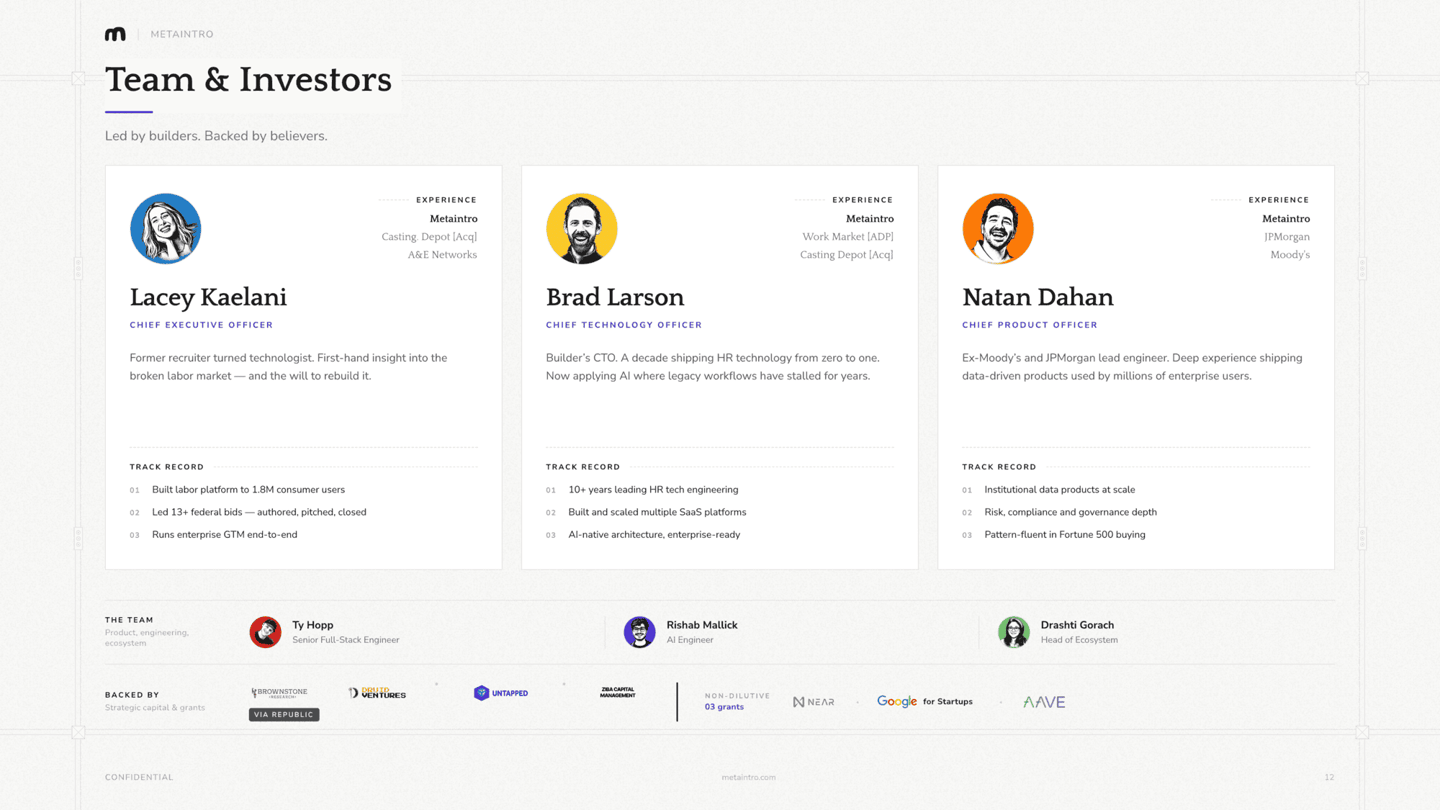
Lacey Kaelani (CEO) Former recruiter who placed thousands of candidates across industries. Built labor marketplace at previous startup (acquired 2022). Understands the broken labor market from the inside and a passion to fix it. Built Metaintro from zero to 1.8M users. Leads enterprise and government sales directly.

Brad Larson (CTO) Experienced CTO with 10+ years scaling HR technology platforms, from zero to one. Passion for using AI to disrupt legacy markets. Built Metaintro's real-time matching engine.

Natan Dahan (CPO) Ex-Moody's, JPMorgan lead engineer with extensive experience building data-driven products used by millions. Architect of Metaintro's web intelligence engine (Snappy), 20x infrastructure cost advantage, and kai AI memory system. Expert in data privacy and compliance.

Backed by:

  • Brownstone Research (raised via Republic, 2022)

  • Druid Ventures (partners now leading ARK Venture's early-stage efforts)

  • Google for Startups, AAVE, NEAR, Untapped, Ziba Capital

$

Deal terms


Minimum investment

$100

The smallest investment amount the issuer is accepting in this offering.

Maximum investment

$250,000

The largest investment amount the issuer is accepting in this offering.

Funding goal

$1.24M

The maximum amount the offering can raise is $1.24M.
Learn more

Deadline
Metaintro campaign will end on .
Type of security

Class B Common Stock shares

Common stock issued by Metaintro, Inc.
Learn more

Price per share

$1

The price of each share of Class B Common Stock.

How it works

Documents

Republic (OpenDeal Portal LLC, CRD #283874) is hosting this Reg CF securities offering by Metaintro, Inc.. View the official SEC filing and all updates:
Official SEC Logo Form C SEC.gov
Company documents
Subscription Agreement Metaintro Form C-A 4-30-26.pdf Metaintro Form C.pdf

About Metaintro

Legal Name
Metaintro, Inc.
Founded
Jun 2022
Form
Delaware Corporation
Employees
6
Website
metaintro.com
Social Media
Headquarters
Google Map location of of  Metaintro
228 Park Ave S , New York, NY
Headquarters
228 Park Ave S, New York, NY, United States 10003

Metaintro Team
Everyone helping build Metaintro , not limited to employees

Profile picture of Lacey Kaelani
Lacey Kaelani
Founder
Profile picture of Brad Larson
Brad Larson
CTO
Lacey Kaelani
Founder
Brad Larson
CTO

FAQ

What is a custodian and what is a custodial account?

What is a custodian and what is a custodial account?

A custodian is a qualified third-party entity that acts as a legal holder of securities. An investor will open a custodial account with the qualified custodian, which is used to hold investments, namely the securities in a company. A custodial account allows you to name a beneficiary and accept payments such as dividends distributions or cash payouts. Custodial accounts are not managed or held by Republic; instead, they are managed by the custodian who works with the issuer raising on the platform. The custodian of this offering is BitGo Bank and Trust, N.A.
Why use a custodial account?

Why use a custodial account?

Companies will utilize a custodian to ensure that all securities they offer in their campaign are in one place. This means if a liquidity event or any other material event in respect to the securities occurs, the company can look to the custodian to service the securities, rather than each individual investor. For investors, utilizing a custodian safeguards their investment, or security interest, with a qualified financial institution. Having a custodial account allows for easier transfers and creates additional layers of protection for your securities. For companies, it can increase efficiency by reducing their cap table management costs and creating a single-line item, making future funding rounds easier.
Will I have to set up a custodial account? What is the process?

Will I have to set up a custodial account? What is the process?

Yes, since the company is utilizing a custodian, all investors in the offering will be required to create a custodial account with BitGo Bank and Trust, N.A. and enter into an omnibus nominee agreement. The custodial account creation process is hosted in our investment checkout system, meaning you will commit your investment and establish your account with BitGo all at once. During investment checkout, you will be automatically prompted to review and sign certain custodial documents with BitGo. In addition, you may be asked to provide certain information to verify your identity. Once completed, you will receive an email confirming your investment commitment.
Does it cost me anything to open a custodial account with BitGo?

Does it cost me anything to open a custodial account with BitGo?

Right now, there are no costs for investors to open a custodial account. Custodial accounts do sometimes have a low annual cost to maintain; however, such costs are covered for the investor in this offering at this time.
I’m being told my custody account is in manual review, what should I do?

I’m being told my custody account is in manual review, what should I do?

BitGo reviews accounts that require manual review on a daily basis. Please expect to receive confirmation of your account being opened or to hear further guidance from our team within 24-48 hours.
Why would a company use a custodian like BitGo?

Why would a company use a custodian like BitGo?

Companies will utilize a custodian to ensure that all securities they offer in their campaign are in one place. This means if a liquidity event or any other material event in respect to the securities occurs, the company can look to the custodian to service the securities, rather than each individual investor. For investors, utilizing a custodian safeguards their investment, or security interest, with a qualified financial institution. Having a custodial account allows for easier transfers and creates additional layers of protection for your securities. For companies, it can increase efficiency by reducing their cap table management costs and creating a single-line item, making future funding rounds easier.
What are the risks associated with investing in equity securities?

What are the risks associated with investing in equity securities?

Equity security investments are subject to market fluctuations, company-specific risks, and general economic conditions. Prices can be volatile, and there is risk of losing the invested capital. Remember, investing always carries risks, and it's essential to conduct thorough research or consult with a financial advisor before making investment decisions.
How do I earn a return?

How do I earn a return?

We are issuing equity in our company. You may realize returns if the company “exits,” meaning it is acquired or goes public at a higher price than you paid for it, or if you sell the securities at a higher price than you purchased them for. There is also a risk that you could lose your entire investment if the company fails. Startup investing is risky, so there’s no guarantee of a return on this kind of investment. It’s always best to refer to the individual offering documents provided by the company to understand your investment risks.
Do you have any active government contracts?

Do you have any active government contracts?

We have $6M in enterprise contracted value and 2 signed government LOIs representing $4M in additional pipeline. We've submitted 13+ government bids across 10+ states including Georgia, Wyoming, Indiana, Montana, North Dakota, and New York. These are in various stages of evaluation. This statement contains forward-looking information. Actual results may differ materially.

What will the funds go towards?

What will the funds go towards?

$5M for data infrastructure (scaling our web intelligence engine and employer integrations), $4M for enterprise platform development (compliance certifications, dashboards), $3M for key hires (VP Sales, VP Marketing, ML engineers), and $3M for operations and runway.
What is your data moat?

What is your data moat?

We have three proprietary data pipelines: (1) direct feeds from employer hiring systems providing structured, real-time job data, (2) our own web intelligence engine that monitors millions of domains daily for company signals and career page changes, and (3) behavioral data from 1.8M active job seekers showing real-time search intent, skills profiles, and career movement patterns.
When do you expect to generate revenue?

When do you expect to generate revenue?

We already have $6M in enterprise contracted value. Our consumer platform will soon generate revenue through premium subscriptions and advertising. We are in active conversations with institutional data buyers for our data licensing product. We expect meaningful recurring revenue to begin as pilot programs convert to full contracts in 2026. This statement contains forward-looking information. Actual results may differ materially.

How is this raise different from the Series A?

How is this raise different from the Series A?

This Republic campaign runs alongside our institutional Series A. Republic investors get the same Class B Common Stock at $1/share. The $1.2M raised here goes directly toward enterprise sales and data infrastructure - the two things that accelerate our path to the revenue milestones that will make the institutional round even stronger.

Didn't Metaintro previously raise for a Web3 resume wallet?

Didn't Metaintro previously raise for a Web3 resume wallet?

Yes. In 2022, we raised on Republic to build a blockchain-based resume wallet. We built it - the technology works and lives on as part of our backend credential verification infrastructure. But as we deployed with real users, we discovered something bigger: the labor market doesn't have an intelligence problem at the credential level. It has an intelligence problem at the system level. Workforce programs spending $8.5B a year can't measure outcomes. Employers can't find candidates. Job seekers miss 75% of opportunities. That insight led us to rebuild Metaintro as a full workforce intelligence platform - and the traction validated the pivot. We now have 1.8M users, $6M in contracted enterprise value, and a data licensing business emerging. The wallet technology isn't gone - it will power our credential verification layer. But the business is much bigger than a wallet.
How is my investment structured?

How is my investment structured?

Your investment purchases Class B Common Stock shares at $1 per share. Minimum investment is $100 and maximum is $250,000. This is a Reg CF offering hosted by Republic (OpenDeal Portal LLC).
Who are your competitors?

Who are your competitors?

In workforce data, the established players are Lightcast (~$160M revenue, 750 employees) and Revelio Labs (~$7.5M revenue). Both scrape career pages and deliver data monthly or quarterly. Our advantage is that we pull structured data directly from employer hiring systems and combine it with our own web intelligence engine - giving us a near real-time signal they can't match. In career platforms, Handshake serves universities but doesn't offer data licensing or government workforce intelligence. No one else combines a live platform with institutional-grade data products.
How does Metaintro make money?

How does Metaintro make money?

Three revenue streams. (1) Consumer: premium subscriptions and advertising from our 1.8M user base. (2) Enterprise: SaaS contracts with government workforce agencies and universities for workforce intelligence dashboards. (3) Data licensing: selling our proprietary real-time workforce data to hedge funds, PE firms, and corporates.

Still have questions? Check the discussion section.
Show all FAQ

Risks

We have a limited operating history upon which you can evaluate our performance, and accordingly, our prospects must be considered in light of the risks that any new company encounters.

The Issuer is still in an early phase, and we are just beginning to implement our business plan. There can be no assurance that we will ever operate profitably. The likelihood of our success should be considered in light of the problems, expenses, difficulties, complications and delays usually encountered by early-stage companies. The Issuer may not be successful in attaining the objectives necessary for it to overcome these risks and uncertainties.

We need to rapidly and successfully develop and introduce new products in a competitive, demanding and rapidly changing environment.

To succeed in our intensely competitive industry, we must continually improve, refresh and expand our product and service offerings to include newer features, functionality or solutions, and keep pace with changes in the industry. Shortened product life cycles due to changing customer demands and competitive pressures may impact the pace at which we must introduce new products or implement new functions or solutions. In addition, bringing new products or solutions to the market entails a costly and lengthy process, and requires us to accurately anticipate changing

customer needs and trends. We must continue to respond to changing market demands and trends or our business operations may be adversely affected.

The amount of capital the Issuer is attempting to raise in this Offering may not be enough to sustain the Issuer’s current business plan.

In order to achieve the Issuer’s near and long-term goals, the Issuer may need to procure funds in addition to the amount raised in the Offering. There is no guarantee the Issuer will be able to raise such funds on acceptable terms or at all. If we are not able to raise sufficient capital in the future, we may not be able to execute our business plan, our continued operations will be in jeopardy and we may be forced to cease operations and sell or otherwise transfer all or substantially all of our remaining assets, which could cause an Investor to lose all or a portion of their investment.

We may face potential difficulties in obtaining capital.

We may have difficulty raising needed capital in the future as a result of, among other factors, our revenues from sales, as well as the inherent business risks associated with the Issuer and present and future market conditions. Additionally, our future sources of revenue may not be sufficient to meet our future capital requirements. As such, we may require additional funds to execute our business strategy and conduct our operations. If adequate funds are unavailable, we may be required to delay, reduce the scope of or eliminate one or more of our research, development or commercialization programs, product launches or marketing efforts, any of which may materially harm our business, financial condition and results of operations.

The Issuer’s Co-Founders currently own all of the outstanding shares of Class A Common Stock, and they will exercise voting control.

Prior to the Offering, Lacey Kaelani, the Co-Founder, CEO and Director, and Brad Larson, the Co-Founder, Chief Technical Officer and Director, beneficially own all of the outstanding shares of Class A Common Stock of the Issuer. Subject to any fiduciary duties owed to other shareholders under Delaware law, the Co-Founders may be able to exercise significant influence over matters requiring shareholder approval, including the election of directors and approval of significant Issuer transactions, and will have significant control over the Issuer’s management and policies. The Co-Founders may have interests that are different from yours. For example, the Co-Founders may support proposals and actions with which you may disagree. The concentration of ownership could delay or prevent a change in control of the Issuer or otherwise discourage a potential acquirer from attempting to obtain control of the Issuer, which in turn could reduce the price potential investors are willing to pay for the Issuer. In addition, the Co-Founders could use their voting influence to maintain the Issuer’s existing management, delay or prevent changes in control of the Issuer, issue additional securities which may dilute you, repurchase securities of the Issuer, enter into transactions with related parties or support or reject other management and board proposals that are subject to shareholder approval.

If we are unsuccessful in adding users to our platform, or if platform users decrease their level of engagement, our revenue, financial results, and business may be significantly harmed.

We have launched a job search platform for web3 applicants. The size of our user base on the platform, and our users' level of engagement, will be critical to our success. Our financial performance will be significantly determined by our success in adding, retaining, and engaging active users of our platform and the services offered. If people do not perceive our platform or services to be useful, reliable, and trustworthy, we may not be able to attract or retain users or otherwise maintain or increase the frequency and duration of their engagement. There is no guarantee that we will not experience an erosion of our active user base or engagement levels in the future.

We may implement new lines of business or offer new products and services within existing lines of business.

As an early-stage company, we may implement new lines of business at any time. There are substantial risks and uncertainties associated with these efforts, particularly in instances where the markets are not fully developed. In developing and marketing new lines of business and/or new products and services, we may invest significant time and resources. Initial timetables for the introduction and development of new lines of business and/or new products or services may not be achieved, and price and profitability targets may not prove feasible. We may not be successful in introducing new products and services in response to industry trends or developments in technology, or those new products may not achieve market acceptance. As a result, we could lose business, be forced to price products and services on less advantageous terms to retain or attract clients or be subject to cost increases. As a result, our business, financial condition or results of operations may be adversely affected.

We rely on other companies to provide services for our products.

We depend on third party vendors to meet our contractual obligations to our customers and conduct our operations. Our ability to meet our obligations to our customers may be adversely affected if vendors do not provide the agreed-upon services in compliance with customer requirements and in a timely and cost-effective manner. Likewise, the quality of our services may be adversely impacted if companies to whom we delegate certain services do not perform to our, and our customers’, expectations. Our vendors may also be unable to quickly recover from natural disasters and other events beyond their control and may be subject to additional risks such as financial problems that limit their ability to conduct their operations. The risk of these adverse effects may be greater in circumstances where we rely on only one or two vendors for a particular service.

We rely on various intellectual property rights in order to operate our business.

The Issuer relies on certain intellectual property rights, particularly trade secrets, to operate its business. The Issuer’s intellectual property rights are unregistered and may not be sufficiently broad or otherwise may not provide us a significant competitive advantage. In addition, the steps that we have taken to maintain and protect our intellectual property may not prevent it from being challenged, invalidated, circumvented or designed-around, particularly in countries where intellectual property rights are not highly developed or protected. In some circumstances, enforcement may not be available to us because an infringer has a dominant intellectual property position or for other business reasons, or countries may require compulsory licensing of our intellectual property. Our failure to obtain or maintain intellectual property rights that convey competitive advantage, adequately protect our intellectual property or detect or prevent circumvention or unauthorized use of such property, could adversely impact our competitive position and results of operations. We also rely on nondisclosure and noncompetition agreements with employees, consultants and other parties to protect, in part, trade secrets and other proprietary rights. There can be no assurance that these agreements will adequately protect our trade secrets and other proprietary rights and will not be breached, that we will have adequate remedies for any breach, that others will not independently develop substantially equivalent proprietary information or that third parties will not otherwise gain access to our trade secrets or other proprietary rights. As we expand our business, protecting our intellectual property will become increasingly important. The protective steps we have taken may be inadequate to deter our competitors from using our proprietary information. In order to protect or enforce our intellectual property rights, we may be required to initiate litigation against third parties, such as infringement lawsuits. Also, these third parties may assert claims against us with or without provocation. These lawsuits could be expensive, take significant time and could divert management’s attention from other business concerns. We cannot assure you that we will prevail in any of these potential suits or that the damages or other remedies awarded, if any, would be commercially valuable.

The Issuer’s business plan is based on numerous assumptions and projections that may not prove accurate.

The Issuer’s business plan and potential growth is based upon numerous assumptions. No assurance can be given regarding the attainability of the financial projections. The Issuer’s ability to adhere to, and implement, its business plan will depend upon the Issuer’s ability to successfully raise funds and a variety of other factors, many of which are beyond the Issuer’s control. Likewise, management is not bound to follow the business plan and may elect to adopt other strategies based upon unanticipated opportunities, or changes in circumstances or market conditions. All financial projections contained in the business plan are based entirely upon management’s assumptions and projections and should not be considered as a forecast of actual revenues or our liquidity. Actual operating results may be materially different.

Although the Issuer believes the assumptions upon which the Issuer’s business and financial projections are based have reasonable bases, the Issuer cannot offer any assurance that its results of operations and growth will be as contemplated. If any of the assumptions upon which these opinions and projections are based prove to be inaccurate, including growth of the economy in general and trends in our industry, these opinions and projections could be adversely affected. Prospective investors should be aware that these opinions and other projections and predictions of future performance, whether included in the business plan, or previously or subsequently communicated to prospective investors, are based on certain assumptions which are highly speculative. Such projections or opinions are not (and should not be regarded as) a representation or warranty by the Issuer or any other person that the overall objectives of the Issuer will ever be achieved or that the Issuer will ever achieve significant revenues or profitability. These opinions, financial projections, and any other predictions of future performance should not be relied upon by potential investors in making an investment decision in regard to this Offering.

The Issuer’s success depends on the experience and skill of its executive officers and key personnel.

We are dependent on our executive officers and key personnel. These persons may not devote their full time and attention to the matters of the Issuer. The loss of all or any of our executive officers and key personnel could harm the Issuer’s business, financial condition, cash flow and results of operations.

Although dependent on certain key personnel, the Issuer does not have any key person life insurance policies on any such people.

We are dependent on certain key personnel in order to conduct our operations and execute our business plan, however, the Issuer has not purchased any insurance policies with respect to those individuals in the event of their death or disability. Therefore, if any of these personnel die or become disabled, the Issuer will not receive any compensation to assist with such person’s absence. The loss of such person could negatively affect the Issuer and our operations. We have no way to guarantee key personnel will stay with the Issuer, as many states do not enforce non-competition agreements, and therefore acquiring key man insurance will not ameliorate all of the risk of relying on key personnel.

In order for the Issuer to compete and grow, it must attract, recruit, retain and develop the necessary personnel who have the needed experience.

Recruiting and retaining highly qualified personnel is critical to our success. These demands may require us to hire additional personnel and will require our existing management and other personnel to develop additional expertise. We face intense competition for personnel, making recruitment time-consuming and expensive. The failure to attract and retain personnel or to develop such expertise could delay or halt the development and commercialization of our product candidates. If we experience difficulties in hiring and retaining personnel in key positions, we could suffer from delays in product development, loss of customers and sales and diversion of management resources, which could adversely affect operating results. Our consultants and advisors may be employed by third parties and may have commitments under consulting or advisory contracts with third parties that may limit their availability to us, which could further delay or disrupt our product development and growth plans.

The development and commercialization of our products is highly competitive.

We face competition with respect to any products that we may seek to develop or commercialize in the future. Our competitors include major companies worldwide. Many of our competitors have significantly greater financial, technical and human resources than we have and superior expertise in research and development and marketing approved products and thus may be better equipped than us to develop and commercialize products. These competitors also compete with us in recruiting and retaining qualified personnel and acquiring technologies. Smaller or early-stage companies may also prove to be significant competitors, particularly through collaborative arrangements with large and established companies. Accordingly, our competitors may commercialize products more rapidly or effectively than we are able to, which would adversely affect our competitive position, the likelihood that our products will achieve initial market acceptance, and our ability to generate meaningful additional revenues from our products.

Damage to our reputation could negatively impact our business, financial condition and results of operations.

Our reputation and the quality of our brand are critical to our business and success in existing markets and will be critical to our success as we enter new markets. Any incident that erodes consumer loyalty for our brand could significantly reduce its value and damage our business. We may be adversely affected by any negative publicity, regardless of its accuracy. Also, there has been a marked increase in the use of social media platforms and similar devices, including blogs, social media websites and other forms of internet-based communications that provide individuals with access to a broad audience of consumers and other interested persons. The availability of information on social media platforms is virtually immediate as is its impact. Information posted may be adverse to our interests or may be inaccurate, each of which may harm our performance, prospects or business. The harm may be immediate and may disseminate rapidly and broadly, without affording us an opportunity for redress or correction.

Our business could be negatively impacted by cyber security threats, attacks and other disruptions.

We may face advanced and persistent attacks on our information infrastructure where we manage and store various proprietary information and sensitive/confidential data relating to our operations. These attacks may include sophisticated malware (viruses, worms, and other malicious software programs) and phishing emails that attack our products or otherwise exploit any security vulnerabilities. These intrusions sometimes may be zero-day malware that are difficult to identify because they are not included in the signature set of commercially available antivirus scanning programs. Experienced computer programmers and hackers may be able to penetrate our network security and misappropriate or compromise our confidential information or that of our customers or other third-parties, create system disruptions, or cause shutdowns. Additionally, sophisticated software and applications that we produce or procure from third-parties may contain defects in design or manufacture, including “bugs” and other problems that could unexpectedly interfere with the operation of the information infrastructure. A disruption, infiltration or failure of our information infrastructure systems or any of our data centers as a result of software or hardware malfunctions, computer viruses, cyber-attacks, employee theft or misuse, power disruptions, natural disasters or accidents could cause breaches of data security, loss of critical data and performance delays, which in turn could adversely affect our business.

Security breaches of confidential customer information, in connection with our electronic processing of credit and debit card transactions, or confidential employee information may adversely affect our business.

Our business requires the collection, transmission and retention of personally identifiable information, in various information technology systems that we maintain and in those maintained by third parties with whom we contract to provide services. The integrity and protection of that data is critical to us. The information, security and privacy requirements imposed by governmental regulations are increasingly demanding. Our systems may not be able to satisfy these changing requirements and customer and employee expectations or may require significant additional investments or time in order to do so. A breach in the security of our information technology systems or those of our service providers could lead to an interruption in the operation of our systems, resulting in operational inefficiencies and a loss of profits. Additionally, a significant theft, loss or misappropriation of, or access to, customers’ or other proprietary data or other breach of our information technology systems could result in fines, legal claims or proceedings.

Investors will be unable to declare the Security in “default” and demand repayment.

Unlike convertible notes and some other securities, the Securities do not have any “default” provisions upon which Investors will be able to demand repayment of their investment. Only in limited circumstances, such as a liquidity event, may the Investors demand payment and even then, such payments will be limited to the amount of cash available to the Issuer.

The use of individually identifiable data by our business, our business associates and third parties is regulated at the state, federal and international levels.

The regulation of individual data is changing rapidly, and in unpredictable ways. A change in regulation could adversely affect our business, including causing our business model to no longer be viable. Costs associated with information security, such as investment in technology, the costs of compliance with consumer protection laws and costs resulting from consumer fraud, could cause our business and results of operations to suffer materially. Additionally, the success of our online operations depends upon the secure transmission of confidential information over public networks, including the use of cashless payments. The intentional or negligent actions of employees, business associates or third parties may undermine our security measures. As a result, unauthorized parties may obtain access to our data systems and misappropriate confidential data. There can be no assurance that advances in computer capabilities, new discoveries in the field of cryptography or other developments will prevent the compromise of our customer transaction processing capabilities and personal data. If any such compromise of our security or the security of information residing with our business associates or third parties were to occur, it could have a material adverse effect on our reputation, operating results and financial condition. Any compromise of our data security may materially increase the costs we incur to protect against such breaches and could subject us to additional legal risk.

The Issuer is not subject to Sarbanes-Oxley regulations and may lack the financial controls and procedures of public companies.

The Issuer may not have the internal control infrastructure that would meet the standards of a public company, including the requirements of the Sarbanes Oxley Act of 2002. As a privately-held (non-public) issuer, the Issuer is currently not subject to the Sarbanes Oxley Act of 2002, and its financial and disclosure controls and procedures reflect its status as a development stage, non-public company. There can be no guarantee that there are no significant deficiencies or material weaknesses in the quality of the Issuer’s financial and disclosure controls and procedures. If it were necessary to implement such financial and disclosure controls and procedures, the cost to the Issuer of such compliance could be substantial and could have a material adverse effect on the Issuer’s results of operations.

Changes in federal, state or local laws and government regulation could adversely impact our business.

The Issuer is subject to legislation and regulation at the federal and local levels and, in some instances, at the state level. New laws and regulations may impose new and significant disclosure obligations and other operational, marketing and compliance-related obligations and requirements, which may lead to additional costs, risks of non-compliance, and diversion of our management's time and attention from strategic initiatives. Additionally, federal, state and local legislators or regulators may change current laws or regulations which could adversely impact our business. Further, court actions or regulatory proceedings could also change our rights and obligations under applicable federal, state and local laws, which cannot be predicted. Modifications to existing requirements or imposition of new requirements or limitations could have an adverse impact on our business.

We operate in a highly regulated environment, and if we are found to be in violation of any of the federal, state, or local laws or regulations applicable to us, our business could suffer.

We are also subject to a wide range of federal, state, and local laws and regulations. The violation of these or future requirements or laws and regulations could result in administrative, civil, or criminal sanctions against us, which may include fines, a cease-and-desist order against the subject operations or even revocation or suspension of our license to operate the subject business. As a result, we may incur capital and operating expenditures and other costs to comply with these requirements and laws and regulations.

Changes in employment laws or regulation could harm our performance.

Various federal and state labor laws govern our relationship with our employees and affect operating costs. These laws include minimum wage requirements, overtime pay, healthcare reform and the implementation of the Patient Protection and Affordable Care Act, unemployment tax rates, workers’ compensation rates, citizenship requirements, union membership and sales taxes. A number of factors could adversely affect our operating results, including additional government- imposed increases in minimum wages, overtime pay, paid leaves of absence and mandated health benefits, mandated training for employees, changing regulations from the National Labor Relations Board and increased employee litigation including claims relating to the Fair Labor Standards Act.

Global crises and geopolitical events, including without limitation, COVID-19 can have a significant effect on our business operations and revenue projections.

A significant outbreak of contagious diseases, such as COVID-19, in the human population could result in a widespread health crisis. Additionally, geopolitical events, such as wars or conflicts, could result in global disruptions to supplies, political uncertainty and displacement. Each of these crises could adversely affect the economies and financial markets of many countries, including the United States where we principally operate, resulting in an economic downturn that could reduce the demand for our products and services and impair our business prospects, including as a result of being unable to raise additional capital on acceptable terms, if at all.

Risks Related to the Offering

State and federal securities laws are complex, and the Company could potentially be found to have not complied with all relevant state and federal securities law in prior offerings of securities.

The Company has conducted previous offerings of securities and may not have complied with all relevant state and federal securities laws. If a court or regulatory body with the required jurisdiction ever concluded that the Company may have violated state or federal securities laws, any such violation could result in the Company being required to offer rescission rights to investors in such offering. If such investors exercised their rescission rights, the Company would have to pay to such investors an amount of funds equal to the purchase price paid by such investors plus interest from the date of any such purchase. No assurances can be given the Company will, if it is required to offer such investors a rescission right, have sufficient funds to pay the prior investors the amounts required or that proceeds from this Offering would not be used to pay such amounts.

In addition, if the Company violated federal or state securities laws in connection with a prior offering and/or sale of its securities, federal or state regulators could bring an enforcement, regulatory and/or other legal action against the Company which, among other things, could result in the Company having to pay substantial fines and be prohibited from selling securities in the future.

The U.S. Securities and Exchange Commission does not pass upon the merits of the Securities or the terms of the Offering, nor does it pass upon the accuracy or completeness of any Offering document or literature.

You should not rely on the fact that our Form C is accessible through the U.S. Securities and Exchange Commission’s EDGAR filing system as an approval, endorsement or guarantee of compliance as it relates to this Offering. The U.S. Securities and Exchange Commission has not reviewed this Form C, nor any document or literature related to this Offering.

Neither the Offering nor the Securities have been registered under federal or state securities laws.

No governmental agency has reviewed or passed upon this Offering or the Securities. Neither the Offering nor the Securities have been registered under federal or state securities laws. Investors will not receive any of the benefits available in registered offerings, which may include access to quarterly and annual financial statements that have been audited by an independent accounting firm. Investors must therefore assess the adequacy of disclosure and the fairness of the terms of this Offering based on the information provided in this Form C and the accompanying exhibits.

The Issuer's management may have broad discretion in how the Issuer uses the net proceeds of the Offering.

Unless the Issuer has agreed to a specific use of the proceeds from the Offering, the Issuer’s management will have considerable discretion over the use of proceeds from the Offering. You may not have the opportunity, as part of your investment decision, to assess whether the proceeds are being used appropriately.

The Intermediary Fees paid by the Issuer are subject to change depending on the success of the Offering.

At the conclusion of the Offering, the Issuer shall pay the Intermediary the greater of (A) $15,000.00 and (B) the amount determined pursuant to the following schedule: (1) 0% of any dollar amounts raised in the Offering up to

$100,000.00 and (2) 6% of any dollar amounts raised in the Offering exceeding $100,000.01. The compensation paid by the Issuer to the Intermediary may impact how the Issuer uses the net proceeds of the Offering.

The Issuer has the right to limit individual Investor commitment amounts based on the Issuer’s determination of an Investor’s sophistication.

The Issuer may prevent any Investor from committing more than a certain amount in this Offering based on the Issuer’s determination of the Investor’s sophistication and ability to assume the risk of the investment. This means that your desired investment amount may be limited or lowered based solely on the Issuer’s determination and not in line with relevant investment limits set forth by the Regulation CF rules. This also means that other Investors may receive larger allocations of the Offering based solely on the Issuer’s determination.

The Issuer has the right to extend the Offering Deadline.

The Issuer may extend the Offering Deadline beyond what is currently stated herein. This means that your investment may continue to be held in escrow while the Issuer attempts to raise the Target Offering Amount even after the Offering Deadline stated herein is reached. While you have the right to cancel your investment in the event the Issuer extends the Offering Deadline, if you choose to reconfirm your investment, your investment will not be accruing interest during this time and will simply be held until such time as the new Offering Deadline is reached without the Issuer receiving the Target Offering Amount, at which time it will be returned to you without interest or deduction, or the Issuer receives the Target Offering Amount, at which time it will be released to the Issuer to be used as set forth herein. Upon or shortly after the release of such funds to the Issuer, the Securities will be issued and distributed to you.

The Issuer may also end the Offering early.

If the Target Offering Amount is met after 21 calendar days, but before the Offering Deadline, the Issuer can end the Offering by providing notice to Investors at least 5 business days prior to the end of the Offering. This means your failure to participate in the Offering in a timely manner, may prevent you from being able to invest in this Offering – it also means the Issuer may limit the amount of capital it can raise during the Offering by ending the Offering early.

The Issuer has the right to conduct multiple closings during the Offering.

If the Issuer meets certain terms and conditions, an intermediate close (also known as a rolling close) of the Offering can occur, which will allow the Issuer to draw down on seventy percent (70%) of Investor proceeds committed and captured in the Offering during the relevant period. The Issuer may choose to continue the Offering thereafter. Investors should be mindful that this means they can make multiple investment commitments in the Offering, which may be subject to different cancellation rights. For example, if an intermediate close occurs and later a material change occurs as the Offering continues, Investors whose investment commitments were previously closed upon will not have the right to re-confirm their investment as it will be deemed to have been completed prior to the material change.

Risks Related to the Securities

The Custodian shall serve as the legal title holder of the Securities. Investors will only obtain a beneficial ownership in the Securities.

The Issuer and the Investor shall appoint and authorize the qualified third-party Custodian for the benefit of the Investor, to hold the Securities in registered form in the Custodian’s name or the name of the Custodian’s nominees for the benefit of the Investor and Investor’s permitted assigns. The Custodian may take direction from the Lead who will act on behalf of the Investors, and the Custodian may be permitted to rely on the Lead’s instructions related to the Securities. As such, an Investor will never become an equity holder, merely a beneficial owner of an equity interest.

The Securities will not be freely tradable under the Securities Act until one year from when the securities are issued. Although the Securities may be tradable under federal securities law, state securities regulations may apply, and each Investor should consult with their attorney.

You should be aware of the long-term nature of this investment. There is not now and likely will not ever be a public market for the Securities. Because the Securities have not been registered under the Securities Act or under the securities laws of any state or foreign jurisdiction, the Securities have transfer restrictions and cannot be resold in the United States except pursuant to Rule 501 of Regulation CF beginning one year following the issuance of the Securities. It is not currently contemplated that registration under the Securities Act or other securities laws will be effected. Limitations on the transfer of the Securities may also adversely affect the price that you might be able to obtain for the Securities in a private sale. Investors should be aware of the long-term nature of their investment in the Issuer. Each Investor in this Offering will be required to represent that they are purchasing the Securities for their own

account, for investment purposes and not with a view to resale or distribution thereof. Additionally, Investors will only have a beneficial interest in the Securities, not legal ownership, which may make their resale more difficult as it will require coordination with BitGo Trust Company, Inc., who will serve as the custodian and nominee for the Securities.

An investment in the Issuer's Securities could result in a loss of your entire investment.

An investment in the Issuer's Securities offered in this Offering involves a high degree of risk and you should not purchase the Securities if you cannot afford the loss of your entire investment. You may not be able to liquidate your investment for any reason in the near future.

The securities in this Offering have no protective provisions.

The Securities in this Offering have no protective provisions. As such, you will not be afforded protection, by any provision of the Securities or as a Shareholder, in the event of a transaction that may adversely affect you, including a reorganization, restructuring, merger or other similar transaction involving the Issuer. If there is a liquidation event, or change of control for the Issuer, the Securities being offered do not provide you with any protection.

Investors will not have voting rights.

Investors in the Securities will not have voting rights. Thus, Investors will never be able to vote upon any matters of the Company. As such, Investors will not have any influence over matters requiring stockholder approval, including the election of directors or managers and approval of significant Company transactions, nor the Company’s management and policies. Moreover, those with voting rights could use their voting influence to maintain the Company’s existing management, delay or prevent changes in control of the Company, issue additional securities which may dilute you, repurchase securities of the Company, enter into transactions with related parties or support or reject other management and board proposals.

Investors will not be entitled to any inspection or information rights other than those required by law.

Investors will not have the right to inspect the books and records of the Issuer or to receive financial or other information from the Issuer, other than as required by law. Other security holders of the Issuer may have such rights. Regulation CF requires only the provision of an annual report on Form C and no additional information. Additionally, there are numerous methods by which the Issuer can terminate annual report obligations, resulting in no information rights, contractual, statutory or otherwise, owed to Investors. This lack of information could put Investors at a disadvantage in general and with respect to other security holders, including certain security holders who have rights to periodic financial statements and updates from the Issuer such as quarterly unaudited financials, annual projections and budgets, and monthly progress reports, among other things.

The Issuer may never undergo a liquidity event.

The Issuer may never undergo a liquidity event such as a sale of the Issuer or an initial public offering. If a liquidity event never occurs, Investors could be left holding the Securities in perpetuity. The Securities have numerous transfer restrictions and will likely be highly illiquid, with no secondary market on which to sell them.

In addition to the risks listed above, businesses are often subject to risks not foreseen or fully appreciated by the management. It is not possible to foresee all risks that may affect us. Moreover, the Issuer cannot predict whether the Issuer will successfully effectuate the Issuer’s current business plan. Each prospective Investor is encouraged to carefully analyze the risks and merits of an investment in the Securities and should take into consideration when making such analysis, among other, the Risk Factors discussed above.

The Securities may be significantly diluted as a consequence of subsequent equity financings.

The Securities will be subject to dilution. The Issuer may issue additional equity to employees and third-party financing sources in amounts that are uncertain at this time, and as a consequence holders of the Securities will be subject to dilution in an unpredictable amount. Such dilution may reduce the Investor’s control and economic interests in the Issuer.

The amount of additional financing needed by the Issuer will depend upon several contingencies not foreseen at the time of this Offering. Generally, additional financing (whether in the form of loans or the issuance of other securities) will be intended to provide the Issuer with enough capital to reach the next major corporate milestone. If the funds received in any additional financing are not sufficient to meet the Issuer’s needs, the Issuer may have to raise additional capital at a price unfavorable to their existing investors, including the holders of the Securities. The availability of capital is at least partially a function of capital market conditions that are beyond the control of the Issuer. There can be no assurance that the Issuer will be able to accurately predict the future capital requirements necessary for success or that additional funds will be available from any source. Failure to obtain financing on favorable terms could dilute or otherwise severely impair the value of the Securities.

There is no present market for the Securities, and we have arbitrarily set the price.

The Offering price was not established in a competitive market. We have arbitrarily set the price of the Securities with reference to the general status of the securities market and other relevant factors. The offering price for the Securities should not be considered an indication of the actual value of the Securities and is not based on our asset value, net worth, revenues, prior earnings or other established criteria of value. We cannot guarantee that the Securities can be resold at the Offering price or at any other price.

There is no guarantee of a return on an Investor’s investment.

There is no assurance that an Investor will realize a return on their investment or that they will not lose their entire investment. For this reason, each Investor should read this Form C and all exhibits carefully and should consult with their attorney and business advisor prior to making any investment decision.

Show all Risks

Discussion

Ask questions and share feedback with the Metaintro team below. If you have support related questions for Republic, please contact investors@republic.co.
Loading
Logo of  Metaintro

Metaintro

Invest in Metaintro
Republic

Giving everyone access to early-stage startup investing

For investors
  • Why invest
  • How it works
  • FAQ
  • Risks
  • Privacy policy
  • Accessibility
  • Cookie Preferences
  • Form CRS
For startups
  • Why raise
  • Learn
  • FAQ
  • Tokenized assets
Company
  • About
  • Insights
  • Events
  • Contact
  • Security
  • We're hiring!
Dollar Refer a startup, get $2,500

Invest in the app

Android app iOS app

Invest in the app

Android app iOS app

This site (the "Site") is owned and maintained by OpenDeal Inc., which is not a registered broker-dealer. OpenDeal Inc. does not give investment advice, endorsement, analysis or recommendations with respect to any securities. All securities listed here are being offered by, and all information included on this Site is the responsibility of, the applicable issuer of such securities. The intermediary facilitating the offering will be identified in such offering’s documentation.

All related securities activity is conducted by OpenDeal Broker LLC a registered broker-dealer, Member of FINRA and SiPC, an affiliate of OpenDeal Inc. and OpenDeal Portal LLC, located at 149 5th Avenue, 10th Floor, New York, NY 10010. Please check our background on FINRA’s BrokerCheck.

Certain pages discussing the mechanics and providing educational materials regarding regulation crowdfunding offerings may refer to OpenDeal Broker LLC and OpenDeal Portal LLC collectively as “Republic”, solely for explanatory purposes.

Neither OpenDeal Inc., OpenDeal Portal LLC nor OpenDeal Broker LLC make investment recommendations and no communication, through this Site, or in any other medium, should be construed as a recommendation for any security offered on or off this investment platform. Investment opportunities posted on this Site are private placements of securities that are not publicly traded, involve a high degree of risk, may lose value including the total loss of invested capital, are subject to holding period requirements and are intended for investors who do not need a liquid investment. Past performance is not indicative of future results. Investors must be able to afford the loss of their entire investment. Only qualified investors, who understand the risks of early-stage investment and who meet the Republic's investment criteria may invest. Investors may be restricted to only Accredited Investors or non-U.S. persons, to invest in offerings hosted by OpenDeal Broker. Neither OpenDeal Inc., OpenDeal Portal LLC nor OpenDeal Broker LLC, nor any of their officers, directors, agents and employees make any warranty, express or implied, of any kind whatsoever related to the adequacy, accuracy or completeness of any information on this Site or the use of information on this site. Offers to sell securities can only be made through official offering documents that contain important information about the investment and the issuers, including risks. Investors should carefully read the offering documents. Investors should conduct their own due diligence and are encouraged to consult with their tax, legal and financial advisors.

By accessing the Site and any pages thereof, you agree to be bound by the Terms of Use and Privacy Policy. Please also see OpenDeal Broker’s Business Continuity Plan and Additional Risk Disclosures. All issuers offering securities under regulation crowdfunding as hosted by OpenDeal Portal LLC are listed on the All Companies Page. The inclusion or exclusion of an issuer on the Platform Page and/or Republic’s Homepage, which includes offerings conducted under regulation crowdfunding as well as other exemptions from registration, is not based upon any endorsement or recommendation by OpenDeal Inc, OpenDeal Portal LLC, or OpenDeal Broker LLC, nor any of their affiliates, officers, directors, agents, and employees. Rather, issuers of securities may, in their sole discretion, opt-out of being listed on the Platform Page and Homepage.

Investors should verify any issuer information they consider important before making an investment.

Investments in private companies are particularly risky and may result in total loss of invested capital. Past performance of a security or a company does not guarantee future results or returns. Only investors who understand the risks of early stage investment and who meet the Republic's investment criteria may invest.

Neither OpenDeal Inc., OpenDeal Portal LLC nor OpenDeal Broker LLC verify information provided by companies on this Site and makes no assurance as to the completeness or accuracy of any such information. Additional information about companies fundraising on the Site can be found by searching the EDGAR database, or the offering documentation located on the Site when the offering does not require an EDGAR filing.

To help the government fight the funding of terrorism and money laundering activities, Federal law requires all financial institutions to obtain, verify, and record information that identifies each person who opens an account. Therefore, when you use the Services we will ask for your name, address, date of birth, and other information that will allow us to identify you. We may also ask to see your driver's license, passport or other identifying documents.

Republic and its affiliates are not and do not operate or act as a bank. Certain banking services are provided by BitGo Trust Company, a South Dakota-chartered trust company and registered money services business. BitGo Trust Company is not an FDIC member. Digital (crypto) assets and investment products are not insured by the FDIC, may lose value, and are not deposits or other obligations of BitGo Trust Company and are not guaranteed by BitGo Trust Company. Terms and conditions apply.

Invest in startups using your credit card
You can invest using your credit card

Made in SF/NYC