


 Oops! We couldn’t find any results...



Opportunity
Turning Signal Margin Into Value
Satellite operators generate over $25 billion annually from bandwidth — limited network capacity sold on a recurring basis. When networks approach capacity, the default response is to purchase more bandwidth, increase transmit power, or deploy larger antennas — all of which increase capital or operating cost.
Signal margin determines throughput. Increasing usable margin improves spectral efficiency. Under favorable conditions, improvements on the order of 10 dB (a logarithmic measure of signal strength, where small increases represent large performance changes) can enable multiple modulation upgrades — in some cases delivering 2×–5× more throughput within the same allocated spectrum, depending on starting conditions and channel environment.
Because bandwidth is a recurring expense, even incremental efficiency improvements can scale materially across global satellite networks. FANTEC focuses on expanding usable capacity inside existing infrastructure — enabling networks to do more without expanding hardware, physical footprint, or spectrum.
BoostBox
Patent-pending Waveform-Level Signal Recovery
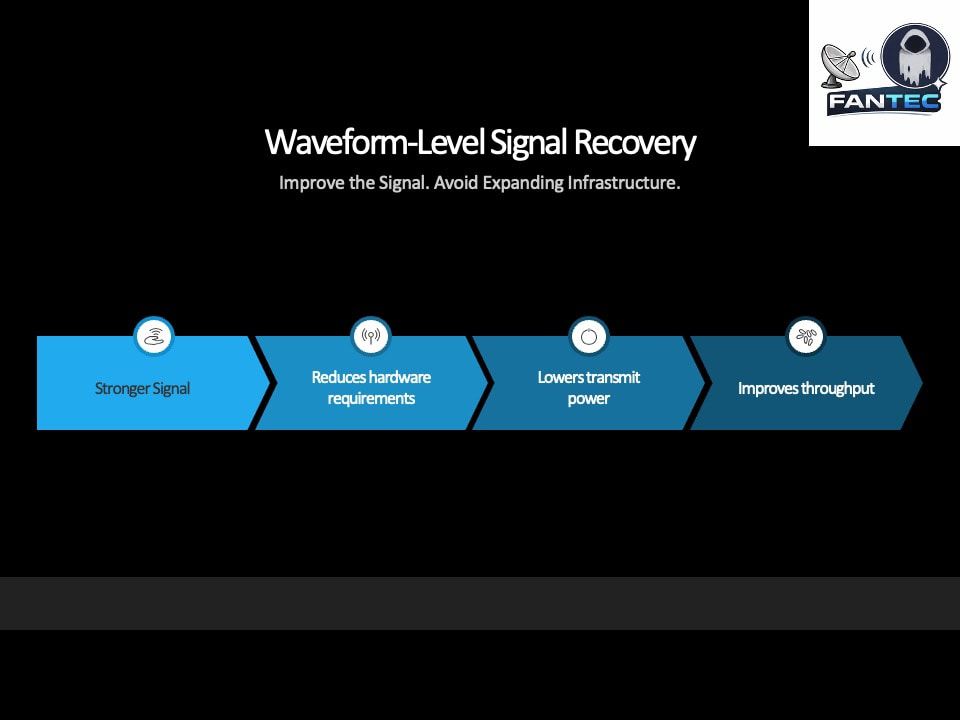
BoostBox™ digitally reduces noise at the waveform level to recover signal energy already present in the channel. Prototype deployments indicate 7–17 dB gains, depending on operating conditions.
A 10 dB improvement represents roughly a tenfold increase in effective signal power at the receiver — margin that can be converted into higher modulation, lower transmit power, smaller antennas, or reduced bandwidth expense.
On a $25B global bandwidth base, a 1% efficiency improvement represents roughly $250M per year in potential revenue or cost savings across operators.
BoostBox™ monetizes recoverable signal energy rather than driving capital expansion.
Applications
BoostBox™ Applications
BoostBox™ is deployed in environments where link margin directly drives infrastructure cost:
• Satellite ground stations and teleport networks
• Deep-space and extended-range communications
• Defense systems operating in contested/degraded conditions
• Capacity-constrained commercial networks
Customers
BoostBox™ Markets
Satellite Infrastructure Operators
Ground station owners increasing link margin without expanding physical footprint.
Commercial Constellations
Operators scaling bandwidth in aperture- and power-constrained systems.
Defense & Government Communications
Resilient performance in contested and low-SNR environments.
OEM Equipment Manufacturers
Embedded waveform-level signal recovery in next-generation modem and RF systems.
Adjacent Markets
Leveraging the same waveform-layer architecture:
Passive Radar
Defense surveillance, border security, and counter-UAS operators using signal extraction without active emissions.
RF Fingerprinting (IoT & Anti-Spoofing)
IoT platforms, device authentication systems, and secure navigation integrity applications.
Alternative GPS (Resilient PNT)
Defense navigation programs, aerospace systems, autonomous platforms, and critical infrastructure timing.
Business Model
Monetizing the Signal Layer
Signal Recovery as a Service (SRaaS)
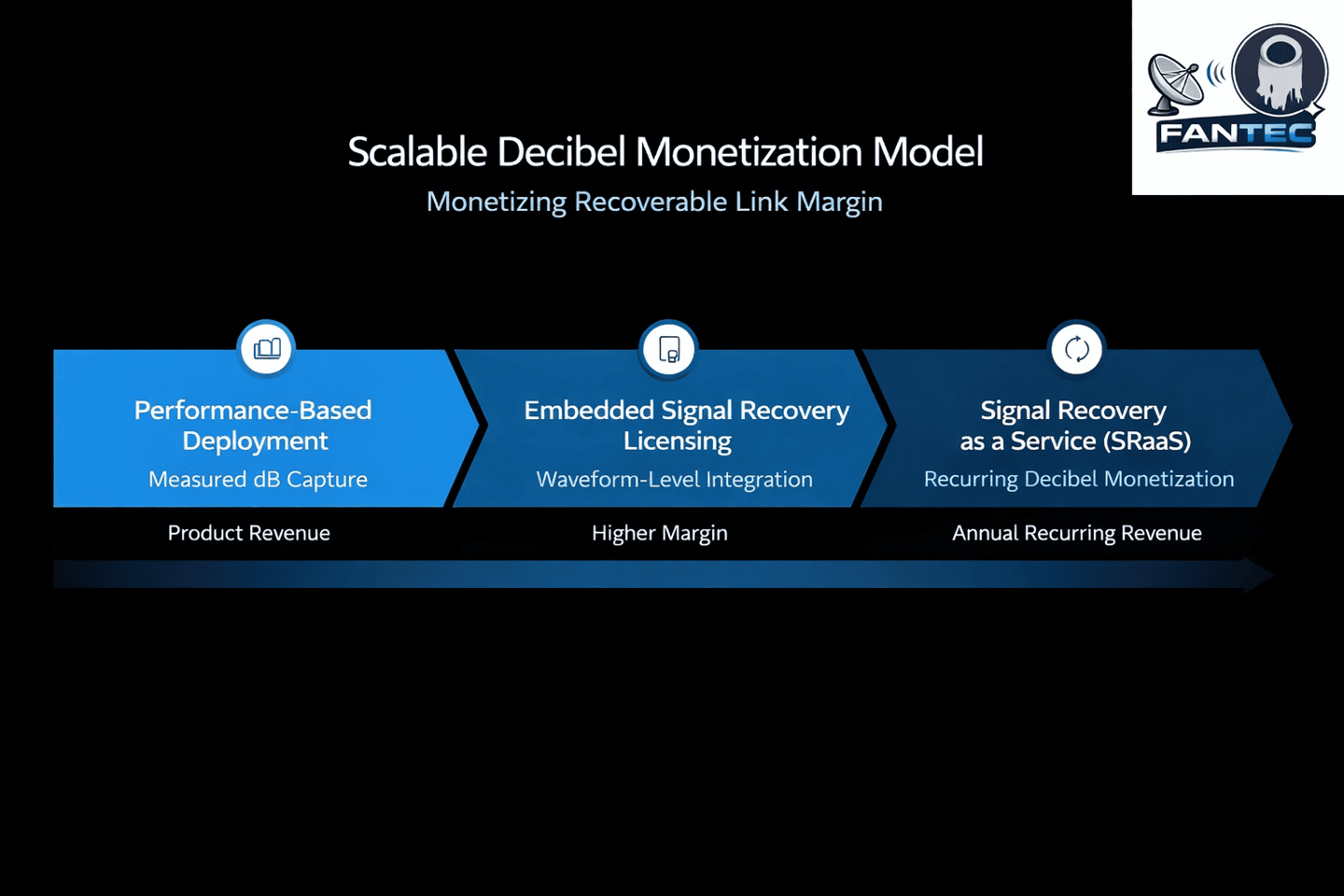
FANTEC monetizes recoverable signal performance at the decibel level.
BoostBox™ establishes waveform-layer signal recovery at the edge, enabling customers to enhance link margin within existing infrastructure. From that foundation, FANTEC captures value through performance-tiered deployment, embedded licensing, and recurring signal recovery services.
Performance-Based Deployment
BoostBox™ units are deployed as signal-recovery platforms, with pricing aligned to delivered link-margin improvement bands (7–17 dB). Customers pay for measurable performance enhancement, not simply hardware.
Value-Aligned Commercial Contracts
As customers realize improved link margin, lower infrastructure expansion requirements, and reduced energy consumption, FANTEC captures a portion of the economic benefit through performance-aligned pricing structures. FANTEC monetizes recoverable decibels.
Embedded & OEM Integration
Over time, waveform-level signal recovery migrates from external BoostBox™ deployments into modems and OEM platforms, creating scalable embedded licensing revenue across satellite, 5G, WiFi, and mobility systems.
Recurring Signal Enhancement Services
Customers subscribe to ongoing DSP optimization, modulation support, and continuous performance updates, creating high-margin recurring Signal Recovery as a Service (SRaaS) revenue layered on deployments and licensing.
Expansion Across Signal-Critical Markets
Leveraging the same waveform-layer architecture, FANTEC expands into passive radar, RF anti-spoofing, and resilient positioning applications within defense and critical infrastructure sectors.
This model enables near-term performance-based deployment revenue, mid-term embedded licensing scale, and long-term recurring SRaaS revenue driven by decibel monetization.
Traction
Early Revenue and Federal Engagements
FANTEC has generated early revenue and secured active federal engagement around BoostBox™ and its signal detection platform.
Commercial & Government Sales
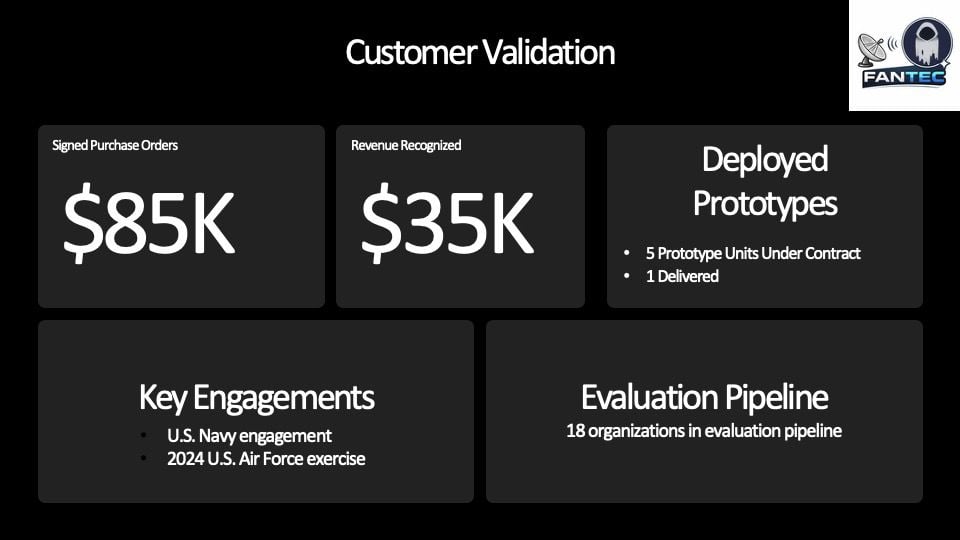
Five BoostBox™ prototype unit POs totaling $85,000, with $35,000 revenue recognized to date.
Customers include three organizations, including the U.S. Navy (USN)
Demonstrated BoostBox™ software performance directly to the U.S. Navy
Growing Customer Pipeline
18 additional prospective customers awaiting prototype demonstrations
This early validation establishes product-market alignment in satellite communications performance while expanding federal and commercial interest.
Program Engagement & Development Pipeline
Submitted a $1.2 million SBIR proposal to the U.S. Army for passive radar development
Passive radar technology was demonstrated during a 2024 U.S. Air Force exercise.
This positions FANTEC within advanced sensing, defense communications, and hypersonic detection programs.
Leadership
Scaling Innovation into Infrastructure
FANTEC’s leadership team is focused on translating waveform-level signal recovery from prototype validation into deployable commercial and federal systems.
The team integrates:
• National defense budgeting and acquisition insight
• Aerospace market strategy and commercialization experience
• Advanced DSP architecture and embedded engineering leadership
• Disciplined venture creation and capital allocation
This combination enables FANTEC to navigate federal engagement, OEM partnerships, and commercial satellite infrastructure markets while maintaining technical rigor at the signal layer.
The same leadership that architected the core platform is executing its transition from standalone hardware deployment to embedded OEM licensing and recurring signal-software models.
Competition
Competing Against Infrastructure and Bandwidth
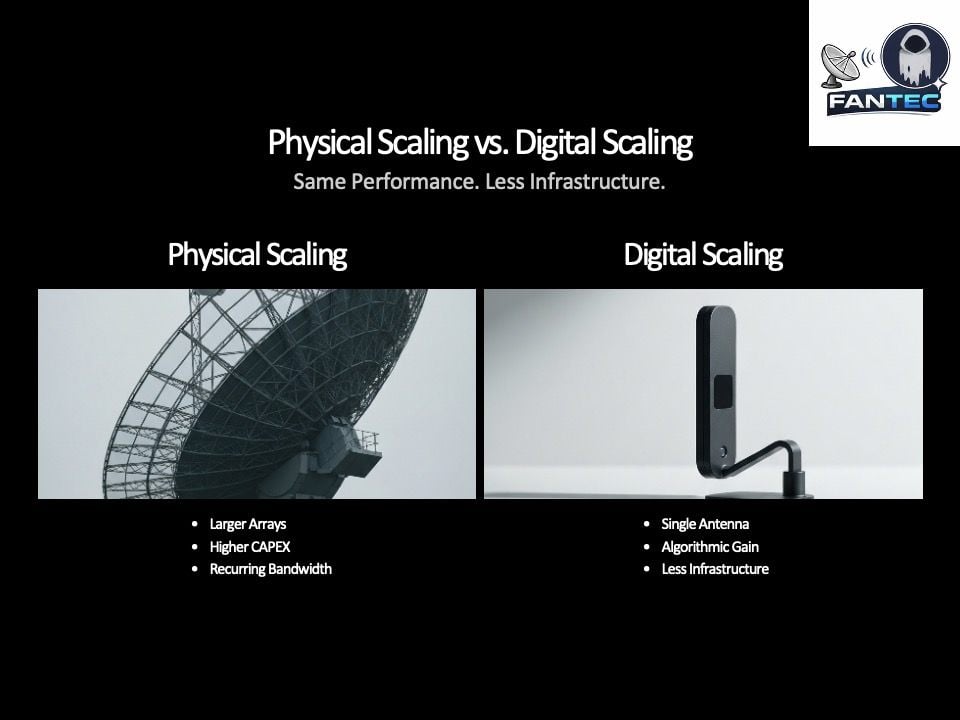
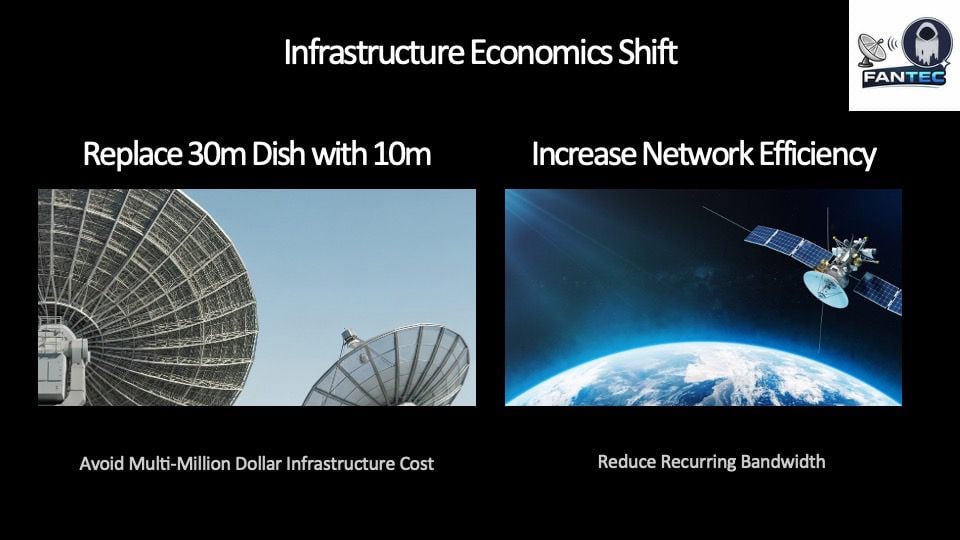
FANTEC does not compete directly with traditional satellite hardware vendors. It competes with capital-intensive infrastructure expansion and recurring bandwidth spend.
Today, operators solve performance constraints in two primary ways:
Larger Antennas – Deploying bigger, more expensive dishes to increase link margin
More Bandwidth – Purchasing additional capacity from satellite service providers
Both approaches increase capital expenditure or recurring operating costs.
BoostBox™ offers a different path.
FANTEC does not compete on antenna size, spectrum allocation, or transmission power. It competes by increasing recoverable signal margin within existing infrastructure — redefining how performance is achieved.
By improving signal recovery at the waveform layer, FANTEC increases effective link margin without oversizing hardware or increasing spectrum spend.
In essence, FANTEC competes against infrastructure scaling — not against modem manufacturers or satellite operators.
Vision and strategy
Owning the Signal Layer
Wireless performance and cost ultimately depend on recoverable signal. FANTEC’s vision is to become foundational infrastructure at the signal layer — increasing usable signal energy inside existing satellite, telecom, and defense networks without expanding physical infrastructure or spectrum.
As networks scale globally, the value of each recoverable decibel compounds across thousands of links, terminals, and embedded devices, creating economic leverage that grows with network size.
Strategic Execution
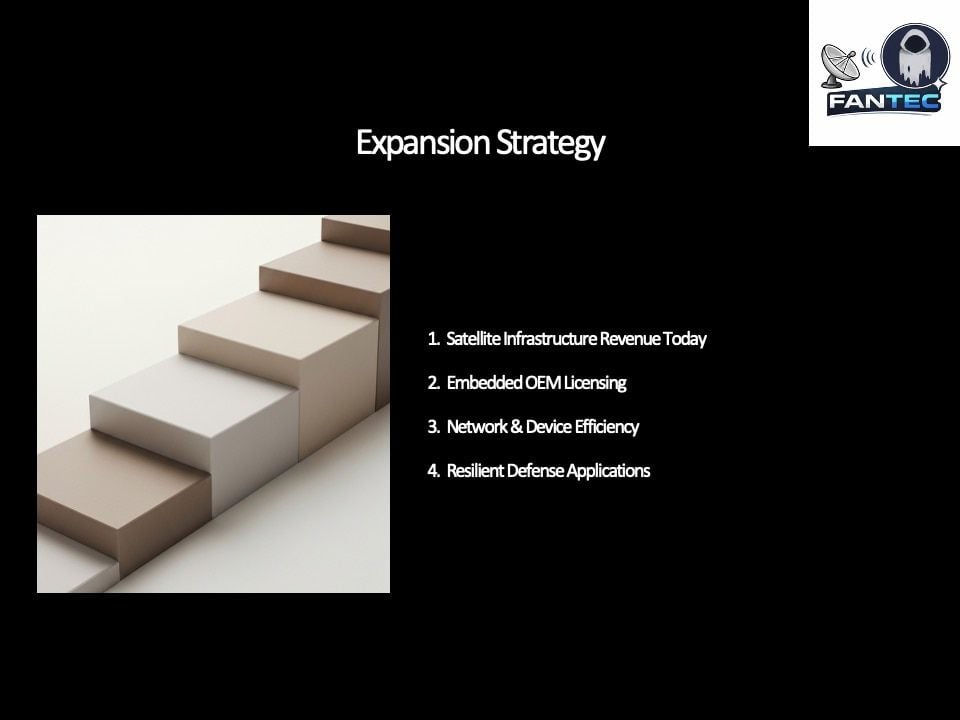
Phase 1 – Satellite Infrastructure
Establish revenue and validation in link-margin-critical environments.
Phase 2 – Embedded OEM Licensing
Transition from external hardware enhancement to integrated modem-level licensing.
Phase 3 – Network & Device Efficiency
Expand into 5G, mobility, and satellite-enabled devices where power and spectrum efficiency scale value.
Phase 4 – Resilient Defense Applications
Apply signal-layer capabilities to passive radar, RF fingerprinting, and navigation resilience in contested environments.
Each phase builds on proven deployment, expanding scope while reducing execution risk. The objective is not a standalone hardware product — but scalable control of signal-layer performance across modern wireless systems.
Impact
Redefining Efficiency in Wireless Systems
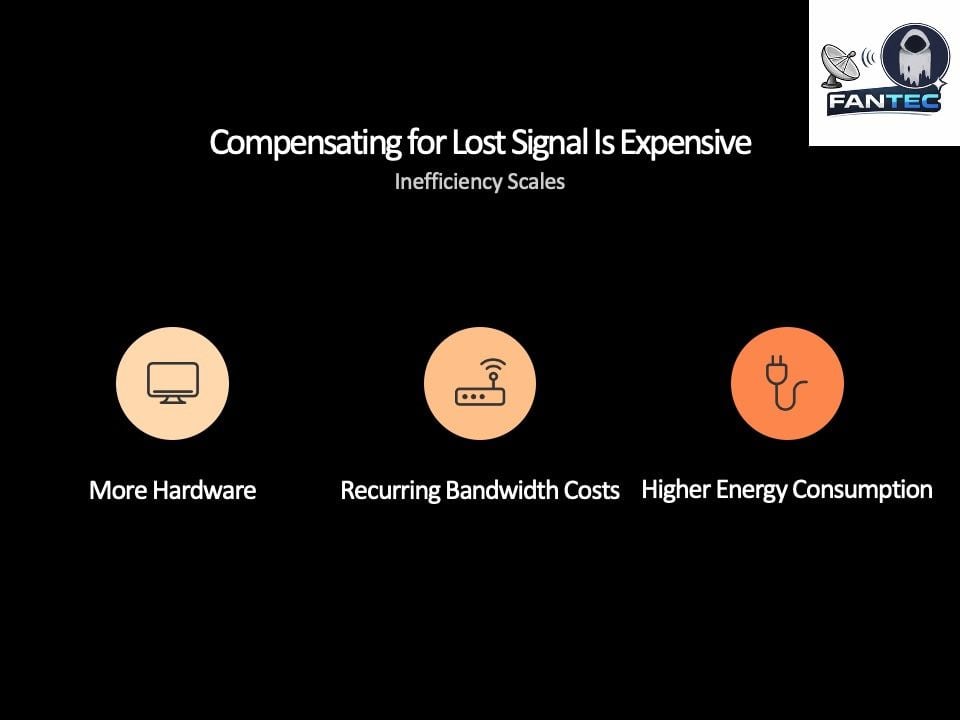
Modern wireless infrastructure compensates for signal loss with more hardware, more power, and more spectrum — increasing capital intensity, energy consumption, and recurring cost.
FANTEC reduces the need for brute-force expansion by improving recoverable signal at the waveform layer.
Signal-layer control enables:
• Smaller antenna systems and reduced capital expenditure
• Lower transmit power and energy consumption
• Greater spectrum efficiency in constrained environments
• More resilient communications in remote, contested, and disaster-prone regions
At scale, waveform-level signal recovery lowers cost per bit, extends device life, and expands connectivity where infrastructure build-out is impractical or uneconomic.
As global reliance on wireless systems accelerates — from orbital platforms to handheld devices — efficiency at the signal layer compounds across entire networks, creating durable economic and operational impact.
Funding
Scaling Deployment and Embedded Integration
Capital accelerates deployment of monetizable decibel capture across satellite and embedded platforms.
Capital will support:
Production Scaling – Manufacturing and deploying BoostBox™ production units
OEM & Modem Integration – Engineering resources to embed signal detection into modem and terminal architectures
Software & Algorithm Development – Advancing DSP performance, new modulation support, and recurring software service capabilities
Customer Demonstrations & Pilot Programs – Accelerating prototype conversions across 18+ interested customers
Federal & Defense Program Pursuits – Supporting proposal development and technical validation efforts
This funding bridges the company from early validation to recurring revenue across hardware, licensing, and software services.
Near-term success is defined by converting prototype momentum into production deployments and securing embedded OEM agreements.
Founders
Origin of the Signal Layer
FANTEC was founded to unlock usable signal at the faintest edges of the waveform — performance conventional systems cannot resolve.
The company brings together national defense strategy and deep digital signal processing expertise to build foundational signal-layer infrastructure.
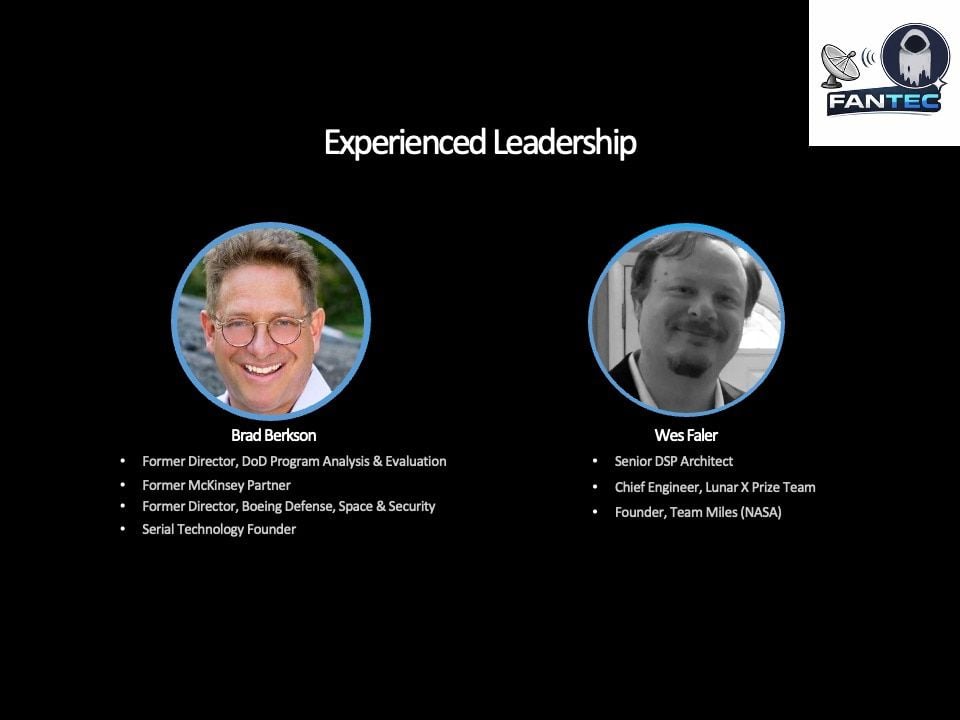
Brad Berkson has operated at the highest levels of U.S. defense decision-making, including serving as Director of Program Analysis & Evaluation (PA&E) and Acting Deputy Under Secretary of Defense for Logistics and Materiel Readiness. He previously held senior leadership and advisory board roles at McKinsey & Company and Boeing Defense, Space & Security. His background spans capital allocation, defense acquisition, and large-scale aerospace systems.
Wes Faler is a serial technologist and advanced DSP architect with senior software leadership experience in the U.S. and Europe. He served as Chief Engineer for a Lunar X-Prize team and founded Team Miles in collaboration with NASA. He designed the core DSP and AI architecture underlying FANTEC’s waveform-level signal recovery platform.
Together, they combine defense insight, commercial execution, and signal-level innovation to build scalable infrastructure at the recoverable signal layer.
Summary
Owning the Economics of Signal Performance
FANTEC develops waveform-level signal recovery technology that improves wireless performance without expanding infrastructure.
Its first product, BoostBox™, increases effective link margin, reduces antenna requirements, and lowers power demand. The system has generated prototype revenue, demonstrated capability in federal environments, and validated performance in demanding communications contexts.
The company’s strategy begins with satellite infrastructure deployments, transitions into embedded modem licensing, and scales into device-level efficiency and resilient defense applications.
By improving recoverable signal rather than expanding hardware or spectrum, FANTEC positions itself as foundational signal-layer infrastructure—capturing the economics of every decibel across modern wireless systems.